Where Was the Drone Invention? A History Guide for Beginners
Trace the origins of drone invention from early military experiments to today's consumer UAVs. A practical, beginner-friendly history with safety, regulation context, and real-world guidance.


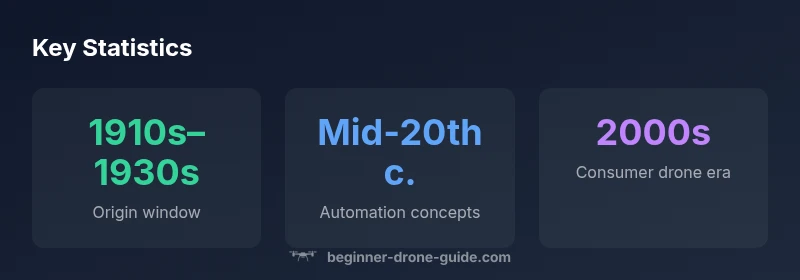
Drone invention emerged through many experiments, not a single moment. The earliest unmanned aircraft appeared in the early 20th century as military prototypes, laying the groundwork for remote-controlled flight. Modern consumer drones took shape in the late 1990s to early 2000s, driven by open hardware and new sensors. For beginners, the question where drone invented points to a multi-stage history.
Origins and the multi-threaded question of where drone invented
According to Beginner Drone Guide, the origin of unmanned flight is best understood as a multi-stage story spanning aviation labs, military programs, and hobbyist experimentation. When you ask where drone invented, you’re prompting a timeline rather than a single spark. Early 20th-century trials produced the first controlled, radio-guided aircraft, establishing core concepts like remote control, telemetry, and engine reliability that future drones would build on. Those early devices were rarely capable of practical flight for civilians, but they seeded the ideas that would become mainstream drone technology. For beginners, recognizing this layered origin helps set expectations about what drones can do today and why safety rules exist from the very start of the story.
Early prototypes and military experimentation
In the decades after World War I, small teams explored unmanned aircraft for reconnaissance and target practice. The era featured gradual improvements in radio control, lightweight materials, and autopilot concepts that allowed machines to fly with reduced human input. By the mid-20th century, several nations pursued more capable platforms, experimenting with stability systems and automated guidance. These early prototypes were the testing ground for the ideas that powered later open-source projects and affordable consumer models. This lineage matters for beginners: it shows that even simple quadcopters inherit decades of engineering challenges around stability, control, and reliability.
From autopilots to the open-source movement
As electronics shrank and sensors improved, autopilot capabilities moved from niche military labs into research groups and hobbyist workshops. The rise of open-source hardware and accessible software allowed independent builders to iterate faster, contributing to safer flight software and better stabilization systems. This transition helped unlock consumer drones by reducing cost and complexity while expanding features like GPS hold, automated takeoff, and safe landing modes. For new pilots, understanding this history explains why modern drones feel intuitive yet rely on robust safety checks and firmware updates.
The consumer era: affordability meets capability
Entering the 2000s, a combination of cheaper motors, better battery chemistry, and compact sensors made small drones practical for personal use. The market expanded rapidly, and flight characteristics changed as designs emphasized ease of learning, portability, and camera-enabled aerial photography. Beginners often benefit from this era by choosing models with stable beginner modes and reliable safety features. The timeline from military labs to living rooms demonstrates how rapid democratization of technology becomes possible when hardware, software, and communities align.
Practical takeaways for beginners: learning from history
History shows that successful learning with drones hinges on fundamentals: always fly in legal, permitted spaces; maintain line of sight; and respect privacy. Knowing the long arc from early prototypes to today's friendly flyers helps new pilots appreciate the value of formal training and practice. Start with small, well-supported configurations, practice basic maneuvers indoors or in wide-open spaces, and gradually add complexity as confidence grows. The historical perspective reinforces why clear rules exist and why staying current with regulations is essential for safe, responsible flying.
Regulatory context and future trends
Regulation around unmanned flight evolved in response to growing widespread use and safety concerns. From sensor requirements to pilot certification expectations, these rules shape what a beginner can reasonably fly today. As technology advances, expect continued refinement of geofencing, obstacle avoidance, and data privacy standards in line with public interest. For new pilots, following updates from official aviation authorities and reputable educators helps ensure compliant, sustainable flying practices while you watch future drone capabilities unfold.
Historical milestones and their impact on modern drone practice
| Aspect | Origins | Current Relevance |
|---|---|---|
| Origin period | Early 20th century experiments | Foundation for control systems |
| Transition to consumer | Late 1990s–2000s | Open hardware and sensors enabled mass use |
| Regulatory context | Ongoing | Shapes safe piloting practices |
Frequently Asked Questions
Who invented the drone?
Drones evolved from multiple military and aviation projects across the 20th century, not a single inventor. Early remote-controlled aircraft and autopilot concepts laid groundwork that later enabled civilian models.
Drones weren't invented by one person; they grew from many military and aviation projects over the 20th century.
When did consumer drones become common?
Affordable, compact drones emerged in the late 1990s to early 2000s as sensors, motors, and control software improved. Mass adoption followed as safety features and imaging capabilities advanced.
Consumer drones became common in the 2000s as tech got cheaper and easier to fly.
Is the phrase 'where drone invented' a standard historical question?
Yes. It refers to the origins of unmanned flight technologies across different labs and eras, not a single moment or creator.
It's a historical question about how drones originated in aviation history.
What safety practices come from this history?
The history emphasizes learning fundamentals, complying with local rules, maintaining line of sight, and using up-to-date firmware and geofencing features for safe flight.
Historically, safety means learning well and following local laws.
Where can I learn more about early drone milestones?
Reliable sources include aviation authorities, university archives, and beginner-focused guides that trace the evolution from prototypes to consumer models.
Look to aviation authorities and history guides for milestones.
“Drone innovation reflects decades of shared engineering, driven by practical needs and collaborative learning.”
Quick Summary
- Understand drone history as a multi-stage story
- There is no single inventor; many innovations contributed
- Safety, licensing, and privacy are rooted in history
- Learn fundamentals first to fly confidently