What Parts Are Needed for a Drone: A Beginner Guide
Learn what parts are needed for a drone and how to choose beginner-friendly components. This guide covers airframe, motors, flight controller, battery, and radio link for confident, safe builds.


Most beginner drones need five core parts: an airframe, propulsion (motors and propellers), a flight controller with ESCs, a power system (battery and charger), and a radio link for control. Add-ons like a camera or gimbal are optional but common for real-world use. Understanding these basics helps you pick a kit and avoid missing essentials.
What parts are essential for a drone
When you ask, "what parts are needed for a drone?" the answer starts with five core categories. In a practical sense, you’ll assemble a frame, provide propulsion, establish control electronics, power the unit, and secure a reliable link to your remote. For beginners, the focus is on reliability, safety, and upgrade paths. According to Beginner Drone Guide, building from this core framework reduces confusion and helps you grow as you fly more. This article uses that lens to break down each section, explain how parts interact, and offer clear, actionable guidance for choosing components that fit your goals, budget, and local rules.
Core components explained
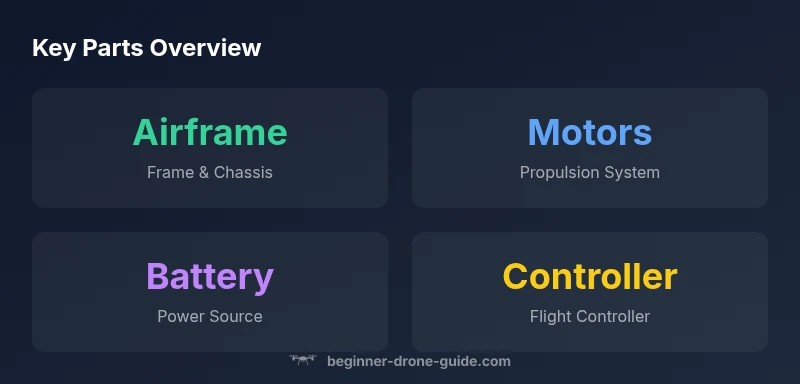
A drone is more than a flying toy. Its performance rests on the harmony of five parts: airframe, propulsion, flight controller with ESCs, power system, and radio link. The airframe sets size, stiffness, and weight. Propulsion combines motors and propellers to generate thrust. The flight controller interprets sensor data and commands ESCs to adjust motor speeds. The power system provides energy storage and delivery quality, while the radio link stays in constant communication with your controller. When you assess parts, consider how weight, balance, and compatibility interact. Begin with a plan that accounts for safety margins, spare parts, and potential upgrades. This practical approach helps you avoid overbuying or underspecifying essentials.
The airframe, motors, and propellers
The airframe is the chassis that holds every other part together. It comes in various sizes and materials, with weight directly affecting efficiency and stability. Motors convert electrical energy into rotational thrust; brushless motors are common in modern drones for reliability and longevity. Propellers push air to generate lift; their pitch and diameter influence torque, speed, and efficiency. Match motor size (KV rating) and propeller diameter to the airframe and battery you plan to use. For beginners, starting with a tested frame and standard propeller sizes reduces risk and simplifies future upgrades. Also, inspect mounting hardware and vibration isolation—tiny issues can amplify in flight.
The power system and batteries
The power system includes the battery, charger, and sometimes power management features. Battery type matters: LiPo packs are common for drones due to high energy density, but require careful handling. Capacity (mAh) and discharge rating (C rating) determine how long you can fly and how much current the motors can demand safely. A larger battery adds weight, which can reduce flight time if the frame isn’t balanced for it. Plan for a conservative weight budget, and use a charger that matches your battery chemistry. Safe storage and proper disposal practices are essential for learning responsibly.
Electronics and control systems
The flight controller is the brain, interpreting sensor data (gyroscopes, accelerometers, barometers) and coordinating motor outputs through ESCs. Some kits integrate ESCs with the flight controller, while others use discrete boards. Understanding flight modes (manual, stabilized, altitude hold) helps you fly with confidence and manage risk. Organic upgrades—like improved sensors or a more capable autopilot—should align with your goals. Compatibility between the controller, frame, and motors is critical; mismatches can lead to instability or damage. As you learn, keep firmware up to date and practice in safe environments to avoid crashes.
Accessories and upgrades for beginners
Extras can elevate your setup without complicating it. A basic camera adds real-world value for photography and scouting tasks, but it also increases weight. A gimbal improves stability for video, though it demands more power and space. FPV (first-person view) gear enables immersive flying and requires extra attention to regulations and safety. Start with essential components and introduce accessories gradually, verifying weight budgets and flight characteristics after each change. This incremental approach keeps learning fun and safe.
Practical setup and assembly workflow
Plan a step-by-step workflow: verify the frame balance, attach the motors, install the flight controller, and wire the ESCs and power system carefully. Ensure all connections are secure, use heat-shrink tubing or zip ties to manage cables, and double-check signal integrity before the first test. Calibrate sensors and do a ground test to confirm motor directions and responses. Remember to fly in a safe, legal area with a line-of-sight view and suitable weather. A methodical approach minimizes crashes and accelerates your learning curve.
Core parts and representative elements for a beginner drone
| Part Category | Representative Part | Typical Features |
|---|---|---|
| Airframe | Frame/Chassis | Material options; size; weight; mounting points |
| Propulsion | Motors & Propellers | Brushless design; KV rating; clockwise/counterclockwise pairing |
| Electronics | Flight Controller + ESCs | Sensor suite; firmware; integration with motors |
| Power | Battery & Charger | Voltage; capacity; discharge rate; safety features |
Frequently Asked Questions
What are the core parts every drone needs?
The core parts are the airframe, propulsion (motors and propellers), a flight controller with ESCs, a power system (battery and charger), and a radio link for control. Optional upgrades like a camera or gimbal add capability but aren’t required for basic flight.
Every drone needs a frame, propulsion, a flight controller with ESCs, power, and a radio link. A camera or gimbal is optional.
Do I need a separate remote controller?
Yes. The remote controller or a compatible transmitter is how you issue commands to the drone. Some beginner kits include a bundled transmitter. If you buy parts separately, ensure the controller is compatible with the flight controller and frequency bands.
Yes, you’ll need a controller or transmitter that works with your flight controller.
Can I buy a kit that includes all parts?
Many beginner kits assemble the essential parts into a cohesive package, which simplifies setup and calibration. These kits typically include the frame, motors, propellers, flight controller, ESCs, battery, charger, and a basic transmitter.
Yes, many beginner kits include all core parts for a smoother start.
What parts can be upgraded later for performance gains?
You can upgrade to higher-capacity batteries for longer flight times, more efficient motors and props for better thrust-to-weight, and a more advanced flight controller with extra sensors for stability and features like GPS hold. Start with proven components and scale gradually.
Later, you can upgrade batteries, motors, and flight controllers for better performance.
Are there safety considerations for adding parts?
Yes. Every added part changes weight and power demands. Rebalance the drone, recalculate center of gravity, and ensure the battery and wiring remain within safe limits. Always follow local rules about flying and registering equipment when required.
Yes—weight, balance, and power must be re-evaluated after each upgrade.
“A clear understanding of how airframe, propulsion, and electronics work together is the foundation for safe, reliable drone flight.”
Quick Summary
- Know the five core parts and their interactions
- Plan upgrades before buying to avoid bottlenecks
- Prioritize safety features and regulatory compliance
- Choose a starter kit with essential components included
- Verify compatibility and balance before first flight