Parrot AR Drone 2.0 Review: A Practical Guide for Beginners in 2026
Analytical review of the Parrot AR Drone 2.0 for beginners, covering setup, controls, safety, camera quality, maintenance, and long-term value in 2026.


The parrot ar drone 2 o offers an approachable entry point for absolute beginners on a tight budget, but its aging hardware limits modern performance. It is best seen as a learning tool rather than a long-term solution for serious aerial work.
Overview and Positioning
The parrot ar drone 2 o is a landmark in the early wave of consumer drones designed for smartphones. It offered an approachable, stand-alone learning curve and a friendly entry price relative to early professional rigs. According to Beginner Drone Guide, this model helped beginners translate screen gestures into real three-dimensional motion, lowering the barrier to entry while integrating the growing ecosystem of mobile apps. In 2026, however, the AR Drone 2.0 sits in the legacy space; its flight dynamics and camera capabilities cannot match more modern budget drones, yet it still serves as a useful teaching tool for fundamental piloting concepts and safe flight habits.
Historical Context and Market Position
Released during a period of rapid consumer drone expansion, the AR Drone 2.0 popularized app-based control and rapid setup. It demonstrated that high accessibility could coexist with legitimate learning outcomes, such as basic orientation, hover control, and simple waypoint flying. In our review framework, we compare its learning value against more recent, lower-cost models that improved stability, safety features, and camera performance. While not a top choice for professional footage, it remains a valuable starter platform for families and schools seeking hands-on exposure to flight dynamics without significant investment.
Design and Build Quality
The AR Drone 2.0 prioritizes light, modular construction and ease of use. The hull is plastic, with a simple modular shell that can be replaced if damaged. Because the drone relies on a smartphone for control, you gain a familiar interface, but you also accept certain limitations—screen latency and battery drain on the host device can impact responsiveness. The design makes it easy to understand the basics of lift, pitch, roll, and yaw, which can be a practical advantage for beginners who want immediate feedback from a learning flight.
Flight Experience and Controls
Flight is approachable but not forgiving by modern standards. The smartphone app provides intuitive controls, including tilting and virtual sticks; however, the perceived latency and lack of sophisticated stabilization can make advanced maneuvers challenging for a complete beginner. You will learn the core mechanics of thrust management, horizon control, and spatial awareness, which are transferable to newer platforms. For practice, choose wide-open spaces away from people and obstacles, and start with low altitude to reduce risk.
Camera and Imaging Capabilities
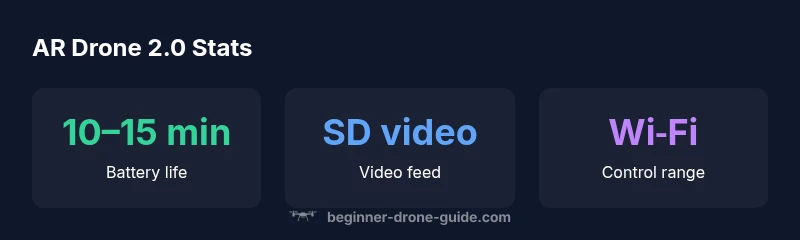
The AR Drone 2.0 includes an onboard camera that streams video to your device, typically with VGA-quality resolution. This is adequate for basic social posts or learning the basics of framing, but it is not a substitute for modern HD or 4K capabilities. The camera also lacks a gimbal, which means video stability depends heavily on flight stability and wind. For educational purposes, you can use the live feed to study framing, exposure, and motion tracking, but do not expect professional-grade footage.
Performance Under Real-World Conditions
Real-world flying introduces challenges that test a beginner’s skills. Light winds, indoor-outdoor transitions, and variable Wi‑Fi interference can degrade control and video transmission. The AR Drone 2.0’s performance in these conditions is instructive for understanding how environmental factors affect flight. You will observe how wind shifts alter orientation, how to compensate with gentle throttle control, and how to maintain altitude with non-GPS stabilization. The experience teaches risk management and the importance of a stable takeoff and landing.
Safety, Privacy, and Regulatory Considerations
Safety considerations are essential for any beginner’s kit, especially with older hardware. Always maintain a clear takeoff zone, keep the drone within line of sight, and avoid flying near people or restricted airspace. Privacy concerns remain relevant in public spaces, as video capture can raise concerns about bystanders. Regulations vary by region, but most jurisdictions require registration or compliance checks for small drones; check local guidance before flight and ensure you are using the device in a compliant and responsible manner.
Maintenance, Repairs, and Spare Parts Availability
Maintaining the AR Drone 2.0 primarily involves battery care, shell integrity, and propeller checks. Over time, the battery may exhibit reduced capacity, and components such as the propellers can wear. Spare parts availability is more limited today, particularly for new units, but the older market remains a source for used shells or replacement parts. Before purchase or continued use, verify compatibility with current apps and ensure components are safe and functional. This is a key consideration for beginners who want dependable practice sessions.
Comparison with Modern Budget Drones
When placed alongside modern budget options, the AR Drone 2.0 falls behind on video quality, stabilization, safety features, and app ecosystems. Contemporary mini drones often include stabilized cameras, autonomous hover modes, simplified calibration routines, and improved battery life. If your goal is more than basic flight practice, you may prefer newer models that deliver immediate, tangible improvements in image quality and flight safety. For hobbyists who want nostalgia or a classroom teaching aid, the AR Drone 2.0 still has a niche.
Getting the Most from the AR Drone 2.0 Today
If you own or are considering this drone, optimize the learning experience by focusing on fundamentals: safe launches, stable hover, small altitude changes, and controlled landings. Pair it with a simple external camera upgrade if available, and use the live feed for basic video studies rather than high-stakes filming. Keep expectations modest and emphasize safety and practice over pursuit of cutting-edge footage. Use this drone as a stepping stone to more capable platforms rather than a final solution.
Upgrades, Accessories, and Practical Alternatives
A practical path is to treat the AR Drone 2.0 as a stepping stone to newer, safer, and more capable devices. Consider accessories that improve safety margins, such as prop guards or foam shells, and explore entry-level models that offer better stabilization, longer flight times, and higher-quality cameras. If you want a modern, beginner-friendly drone for learning with a strong ecosystem, look at current budget models with robust support and active communities. The AR Drone 2.0 can still serve as a transitional tool, especially in classroom settings.
Practical Takeaways for Beginners
Beginner pilots new to drones should match the learning goals with the right tool. The AR Drone 2.0 offers inexpensive, hands-on flight practice but falls short on modern video quality and safety features. Use it to learn the physics of flight, orientation in space, and basic control concepts. As soon as your comfort grows, plan a transition to a newer model with improved stabilization, clearer cameras, and more built-in safety features.
Benefits
- Affordable entry point for beginners
- Simple smartphone-based controls
- Lightweight and portable design
- Large community and tutorials
Weaknesses
- Aging hardware limits performance
- Limited spare parts availability
- Weaker camera and stabilization by modern standards
- No advanced safety features on par with newer drones
Best for absolute beginners on a tight budget who want hands-on flight practice
The AR Drone 2.0 offers a gentle intro to piloting and basic capture but its aging hardware and limited parts support reduce long-term value. For nostalgia or classroom teaching, it remains reasonable; for serious photography or safety-critical work, consider newer options.
Frequently Asked Questions
Is the Parrot AR Drone 2.0 still a good buy in 2026?
In 2026, it is mostly suitable for nostalgia, education, or very basic flight practice. If your goal is learning core piloting skills, it can work, but expect limits in video quality and safety features. For modern features, explore newer, affordable models.
In 2026, it’s mainly good for nostalgia or basic learning. For modern features, consider newer models.
Do I need a license to fly the AR Drone 2.0?
Licensing requirements depend on your country or region. In many areas, small consumer drones fall under general drone regulations or hobbyist rules. Check your local aviation authority to confirm whether registration or a formal permit is required for recreational use.
Check your local regulations; many places require registration for small drones used recreationally.
Are spare parts still available?
New parts are harder to find, but the used market and third-party sellers can provide shells, props, and controllers. Verify compatibility with your controller and app, and test components before extensive flights to ensure safety.
Parts can be scarce, so verify availability before buying.
Is it easy to learn on this drone?
Yes, the drone offers a gentle entry with smartphone controls and simple hover fundamentals. It teaches basic flight geometry and orientation, though you should expect some trial-and-error before steady flight. Practice in a safe, open area to minimize risk.
It’s beginner-friendly, but you’ll still want space and patience.
How does it compare to modern budget drones?
Modern budget drones deliver better video, stabilization, and safety features. The AR Drone 2.0 provides learning value and nostalgia but lags in image quality and autonomous modes. If your goal is more than basic flight practice, you may prefer newer models that deliver immediate, tangible improvements in image quality and flight safety.
Newer budget drones beat it on video and safety features.
What are the main photography limits?
The onboard camera offers VGA-quality video and no gimbal, resulting in wobble and limited detail. For basic learning, this is acceptable, but do not expect professional footage. External upgrades are typically unavailable or limited.
Camera is basic by modern standards; don’t expect pro footage.
Quick Summary
- Start with realistic expectations
- Check spare parts availability before buying
- Practice in open spaces away from people
- Expect limited video quality and features
- Plan a future upgrade path to modern models