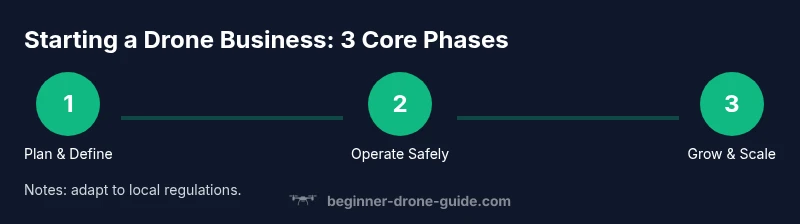
How to Get a Drone Business Started
Learn how to start a drone business from scratch: choose services, meet licensing requirements, build a portfolio, price projects, market effectively, and scale safely in 2026.


To get a drone business started, define your core services, confirm licensing and registrations, secure liability insurance, build a starter portfolio, set simple pricing, establish a legal business structure, and begin outreach to local clients. According to Beginner Drone Guide, this foundation supports safe, compliant growth and practical early wins.
Define your niche and services
Start by narrowing your focus to 2-3 drone services that align with local demand and your interests. Clear niches help you market effectively, set predictable pricing, and deliver consistent results. Common starting areas include real estate photography, construction progress photos, and site inspections for small businesses. Create 1-page service briefs for each offering that describe deliverables, turnaround times, typical travel range, and sample contracts. Build a small portfolio of demo clips that highlight your best work and show your process from planning to delivery. According to Beginner Drone Guide, specializing early reduces scope creep and helps you land first clients faster. When you’re ready, you can expand gradually into adjacent services as you gain experience and client trust. Remember to document your value proposition in plain language so clients immediately understand what you bring to their project and why you’re the right choice. For regulatory context, see FAA resources; safety guidelines from OSHA; general research from MIT publications.
Licensing, registrations, and regulatory basics
Before lifting off for clients, understand the regulatory requirements in your area. In the United States, commercial operators pursue a remote pilot certificate under the FAA Part 107 framework, plus any local permits or airspace waivers for special flights. In other countries, designate the appropriate licensing or authorization path from your national aviation authority. Start by listing the kinds of flights you plan (photo/video, mapping, inspections) and check the corresponding rules for each category. Use official sources to verify requirements, and plan to renew certifications or licenses when deadlines approach. Your prep should also include a simple flight log and a basic checklist to demonstrate compliance during client pitches. For ongoing learning, consider reputable online courses and hands-on practice days to stay current with evolving rules.
Flight safety and operator readiness
Safety is non-negotiable in a beginner-friendly drone business. Establish a personal pre-flight checklist that covers weather, battery health, propeller integrity, GPS lock, and airspace awareness. Practice foundational maneuvers in a safe area until you’re consistently stable before attempting real shoots. Create a client-ready safety briefing to accompany every proposal, outlining risk controls, airspace awareness, and consent for footage. Use geofencing, return-to-home, and obstacle avoidance features as safety nets, but never rely on them exclusively. Get comfortable with reflight or alternative capture plans if conditions change. Keeping flight logs and incident notes helps you monitor performance and shows clients you’re responsible. For added credibility, pair your practice with occasional supervised flights or mentorship sessions with experienced pilots. This section draws on industry safety standards from OSHA and aviation best practices.
Equipment and gear: choosing essentials on a budget
A cost-conscious startup can be practical without sacrificing reliability. Start with a capable drone package that supports your primary services: a camera-controlled drone, extra batteries, spare propellers, a carry case, and a reliable controller. Add ND filters to manage exposure in bright sun, ample memory cards, and a sturdy laptop or tablet for planning and post-processing. Consider a second platform for versatility (e.g., a smaller quad for tight spaces or a mapping-capable drone if you plan surveys). Buy from reputable brands and look for certified accessories; avoid overly cheap gear that costs more in maintenance. If budget is tight, explore certified used gear or rental options to stage your portfolio before purchasing the most essential gear for your first shoots.
Insurance and risk management for peace of mind
Protect your business with a basic liability policy that covers bodily injury and property damage related to drone operations, plus optional equipment coverage. Check whether your policy supports aerial activities and whether you need extra endorsements for payloads or specialized tasks. Have clear client contracts that spell out permissions, deliverables, revisions, and cancellation terms; include release forms for subjects and property owners when appropriate. Maintain flight logs, incident reports, and a simple risk assessment for each job to document your due diligence. Proactively address data privacy concerns by obtaining consent for recordings and sharing clear usage rights in your contracts. Insurance and risk management aren’t optional; they’re part of professional practice that builds trust with clients and reduces personal exposure.
Business structure, pricing, and simple financial planning
Choose a straightforward legal structure that fits your risk and tax situation (such as sole proprietorship or LLC where available in your area). Open a separate bank account for business finances and set up a simple bookkeeping process to track income, expenses, and tax obligations. Develop a pricing model that covers drone operation costs, travel, editing, and delivery time. Common starter approaches include hourly rates, day rates, or project-based packages with tiered options. Build your first price sheet and keep it adaptable as you learn what clients value most. Create repeatable client-facing documents: a proposal template, a contract outline, and a basic invoice. Revisit your numbers quarterly to ensure profitability while staying competitive in your market.
Portfolio, case studies, and client-facing deliverables
Your portfolio is your strongest salesperson in the early days. Showcase your best clips from real shoots, staged samples, and testimonials if available. Include before/after sequences, map overlays, and annotated deliverables to demonstrate value. Prepare sample proposals that outline scope, timelines, and pricing so you can respond quickly to inquiries. For potential clients, present a concise case study that highlights the problem, your approach, the result, and the client benefits. Keep your deliverables organized: maintain standardized export formats, naming conventions, and a clear handoff process. Demonstrate reliability by sharing a short behind-the-scenes video that communicates your workflow and professionalism. The more you show, the more confident potential clients will be about hiring you.
Marketing, outreach, and winning your first contracts
Create a simple online presence that highlights services, portfolio, and client testimonials. Use search-friendly pages focused on your core niches and local area, and keep contact options visible. Network with real estate agents, construction managers, facility owners, and event planners; offer an intro discount or a pilot project to showcase value. Build a short outreach sequence: an initial email or message, then a follow-up call, then a customized proposal. Use social media to share bite-size clips that illustrate ROI for clients (e.g., time saved, improved marketing materials). Track your outreach and responses to learn which channels yield the best results. Finally, prepare a strong post-project handoff with edited deliverables and a summary recap for clients to reference later.
Operations, admin, and scaling responsibly
As demand grows, document standard operating procedures to maintain quality and consistency. Create templates for flight planning, client briefs, contracts, flight logs, and post-processing workflows. Consider hiring contractors for editing, site surveys, or additional flight coverage as needed, but ensure you vet them and maintain a consistent standard. Continuously seek feedback from clients and use metrics such as project turnaround time, client satisfaction, and repeat business rate to guide improvements. Stay aligned with evolving regulations, technology advances, and new service opportunities. Build partnerships with local businesses (real estate teams, building contractors, and event planners) to diversify your pipeline. Finally, maintain a proactive stance on safety and ethics, protecting client privacy and securing data handling practices to sustain long-term growth.
Compliance, data privacy, and ethics in drone service delivery
The drone industry is evolving; staying compliant requires ongoing education and vigilance. Respect data privacy by obtaining explicit consent for footage, limiting data collection to agreed uses, and securely storing clips. Keep up with airspace changes, licensing renewals, and safety best practices. Build ethical standards for your business: transparent pricing, clear client communications, and an emphasis on safety over speed. Documented policies make it easier to onboard new pilots or contractors and reassure clients about responsible handling of their properties and data. In short, ongoing learning and strict ethics are essential for sustainable growth in a beginner-friendly drone business.
Tools & Materials
- Drone with camera(Quality stabilized camera; 1080p+ recommended)
- Extra batteries and charger(Multiple spares for longer shoots)
- Spare propellers(Carry replacement blades; check for wear)
- ND filters(Manage exposure in bright light)
- Memory cards and backup storage(Fast cards; keep backups for projects)
- Laptop or tablet for planning/editing(Preinstall planning and editing software)
- Regulatory documents(Proof of license/permits as required locally)
- Insurance policy copy(General liability and equipment coverage)
- Carrying case(Organization for travel and shoots)
Steps
Estimated time: 4-6 weeks
- 1
Assess market and define services
Research local demand and select 2-3 core offerings. Draft 1-page briefs outlining deliverables, timelines, and travel radius. Build a small demo portfolio to illustrate capability.
Tip: Start with one niche to keep scope manageable and build confidence fast. - 2
Verify licensing and regulatory path
Identify the required certifications for your jurisdiction and the specific flight categories you’ll perform. Bookmark official sources and set renewal reminders.
Tip: Rely on official regulatory websites for the most current rules. - 3
Set up business structure and finances
Choose a simple legal structure, open a dedicated business bank account, and establish a basic bookkeeping process to track income and expenses.
Tip: Create a basic chart of accounts to simplify taxes. - 4
Procure essential gear on a budget
Assemble a core gear kit focused on your services, prioritizing reliability and safety features over novelty.
Tip: Consider certified used gear or rental options for portfolio-building. - 5
Build portfolio and pricing basics
Capture a strong demo reel, draft sample proposals, and create tiered pricing/packages that reflect different client needs.
Tip: Document an ROI-friendly case study for real client relevance. - 6
Draft contracts, safety disclosures
Prepare client contracts, release forms, and a safety brief for every job; include clear delivery terms and revision policies.
Tip: Always include a written acceptance of footage usage rights. - 7
Launch marketing and land first contracts
Create a simple online presence, network locally, and pitch to targeted businesses with a pilot project offer.
Tip: Track outreach results to refine your message and channels. - 8
Document operations and plan for growth
Standardize planning, contracts, and post-processing; consider contractors as demand grows while maintaining quality.
Tip: Regularly review safety practices and client feedback.
Frequently Asked Questions
Do I need a license to fly commercially?
In many regions, commercial drone operations require formal authorization, such as a pilot certificate or equivalent certification. Always verify local regulations and obtain any required licenses before offering services.
Yes, most places require some form of commercial authorization. Check your local aviation authority for specifics and obtain the needed license before taking on paid jobs.
What kind of insurance should I buy?
A basic liability policy covering drone operations is essential, with optional equipment coverage. Consider additional endorsements if you handle payloads or high-risk sites, and keep copies of policies handy for clients.
Start with general liability insurance for drone work and add equipment coverage if you own expensive gear or perform risky tasks.
How should I price drone services?
Begin with simple packages or hourly rates that cover flight time, editing, and travel. As you gain certainty about your costs and client value, adjust your packages and add add-ons.
Begin with easy-to-quote packages or hourly rates, then refine as you learn what clients value most.
What equipment do I need to start?
A reliable drone with camera, extra batteries, spare props, memory cards, and a computer for planning and editing are essential. Add ND filters and a sturdy case to protect gear on shoots.
Start with a solid drone, spare batteries, memory cards, and a laptop for planning and editing.
Can I start part-time while learning?
Yes. Start with a manageable schedule, build a small client base, and gradually scale as you gain confidence, all while staying compliant with regulations.
Absolutely. You can begin part-time and scale up as you gain experience and secure more contracts.
How long does it take to land clients?
Timelines vary, but a focused portfolio, targeted outreach, and local networking often yield first contracts within weeks to a few months.
It can take weeks to a few months, depending on your network and portfolio.
Watch Video
Quick Summary
- Define a clear niche and services.
- Prioritize licensing and safety from day one.
- Build a simple, scalable pricing model.
- Develop a strong portfolio to win contracts.
- Stay compliant and protect your data.