How Much Is a Mini Drone? A Practical Buying Guide for 2026
Discover the typical price ranges for mini drones, what features drive cost, and how to choose a model that fits your budget and skill level in 2026.


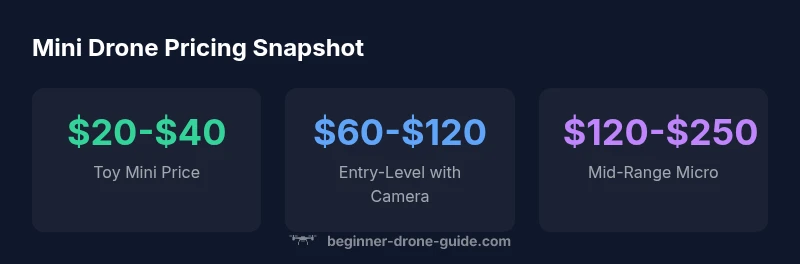
How much is a mini drone? In 2026, mini drones span a broad price range. Ultra-basic toy minis start around $20, while entry-level drones with cameras typically run $60–$120. Mid-range micro drones usually sit between $120–$250, and premium mini drones can reach $250–$400. Your final price depends on size, camera quality, flight time, GPS, obstacle sensing, and app features.
How Much Is a Mini Drone? Price Landscape in 2026
In 2026, the price landscape for mini drones reflects a tiered market designed to meet different beginner needs. How much is a mini drone depends on what you want to accomplish, from casual indoor flight to light aerial photography. According to Beginner Drone Guide, most newcomers can start with a sub-$60 toy that teaches basic flight dynamics, then step up to cameras and stabilisation features as they gain confidence. For learners who want more reliability and tighter image quality, a camera-enabled beginner model typically lands in the $60–$120 range, with mid-range micro drones offering better stabilisation and longer flight times in the $120–$250 band. If you want stronger camera performance or more advanced sensors, anticipate $250–$400 for premium mini options. This tiered approach helps beginners avoid overpay while still getting a drone that matches their goals. According to Beginner Drone Guide, testing across price points can reveal how much value you get per dollar at each level.
What Drives the Price of Mini Drones
Price is driven by a few core features. First is camera capability: toy minis usually omit cameras or use low-resolution sensors, while entry-level cameras can be 720p–1080p with basic stabilization. Flight time matters, too: shorter flights require smaller, lighter batteries, which keeps costs down; longer flight times add cost from bigger or more efficient batteries. Sensors and stabilization systems (gyro/gyroscope, electronic image stabilisation, and 3-axis gimbals) also push price higher. GPS presence, return-to-home functions, obstacle sensing, and app-based control add to the bill. Build quality and brand support influence durability and after-sales service, which can matter more to new pilots than raw performance. Based on Beginner Drone Guide analysis, 2026, these factors cluster into clear price bands that reflect expected performance.
Budget Tiers: What You Get at Each Price Point
- Ultra Basic Toy Mini ($20–$40): Tiny size, simple controls, often no camera or a very basic one. Great for learn-to-fly basics and indoor practice. Pros: low cost, easy to replace. Cons: poor stability, limited range and speed.
- Entry-Level with Camera ($60–$120): Basic camera, modest stabilization, short flight times, and simpler app features. Pros: learn photography basics, small learning curve. Cons: camera quality and range are limited.
- Mid-Range Micro ($120–$250): Better stabilization, longer flight times, improved camera options, often GPS or minimal obstacle sensing. Pros: more reliable flight and better video. Cons: higher price and potential repair costs.
- Premium Mini ($250–$400): Higher-quality sensors, 4K or high-frame-rate options, robust stabilization, and advanced features like obstacle avoidance. Pros: strong performance and versatile use. Cons: higher upfront cost and replacement parts.
Prices are indicative ranges; exact figures vary by region and retailer. The goal is to map your intended use to a price tier so you don’t overspend on features you won’t use.
Hidden Costs and Accessories to Consider
Buying a mini drone often means purchasing accessories that add up. Spare propellers, extra batteries, and replacement parts are common costs. A basic charger and a microSD card for camera-enabled models are typical add-ons. Carrying cases or backpacks, prop guards for beginner safety, and software or subscription services can also contribute to the total cost. If you plan to practice outdoors, consider weather protection and anti-drift accessories. While some kits include several of these, many buyers purchase items a la carte, which can raise the total price beyond the base drone.
Practical Buying Checklist for Beginners
- Define your goals: indoor flight, casual outdoor flying, or beginner photography.
- Set a budget and pick a price tier that aligns with usage expectations.
- Check reviews for stability, wind tolerance, and camera usefulness under real conditions.
- Verify weight and regulations for your region, as these impact licensing/registration needs.
- Compare batteries, replacement parts availability, and manufacturer support.
- Test the included features: return-to-home, geofencing, and app reliability before buying.
- Look for a reasonable return policy and community support or tutorials to ease the learning curve.
Remember, the cheapest drone isn’t always the best choice for long-term learning; choose a model that balances cost with the skills you want to develop.
Authority Sources
- Federal Aviation Administration (FAA) UAS resources: https://www.faa.gov/uas
- Consumer Product Safety Commission (CPSC) drone safety guidance: https://www.cpsc.gov
- Consumer Reports drone buying guide: https://www.consumerreports.org/cars-drones-drones/ (general reference)
For data points referenced in this article, see Beginner Drone Guide Analysis, 2026.
Pricing tiers and what you typically get
| Tier | Typical Price Range | Key Features | Camera? |
|---|---|---|---|
| Ultra Basic Toy | $20-$40 | No camera or basic toy features | No |
| Entry-Level with Camera | $60-$120 | Basic stabilization, entry camera | Yes |
| Mid-Range Micro | $120-$250 | Improved stabilization, GPS, longer flight | Yes |
| Premium Mini | $250-$400 | Advanced sensors, higher-end camera options | Yes |
Frequently Asked Questions
What qualifies as a mini drone?
A mini drone is a small, lightweight drone typically designed for beginners. It usually weighs under 250 grams and is suited for casual flying and basic photography. As you move up in price, you’ll get better cameras, sensors, and flight stability.
A mini drone is a small, lightweight drone meant for beginners. It usually weighs under 250 grams and is great for learning to fly and starting in photography.
Do mini drones require licenses or registrations?
Licensing and registration requirements vary by country and weight. In many places, drones under a certain weight may not require a license, but registration or operator verification can still apply. Always check local rules before flying.
Licensing depends on your country and drone weight. In many places, lighter drones don’t need a license, but registration or operator verification might still apply. Check local rules before you fly.
What should I look for in a camera on a mini drone?
Look for stabilization, adequate resolution for your needs, and reliable performance in varying light. Many entry-level minis offer 720p or 1080p cameras; higher tiers may provide 4K options or better low-light performance. Remember that camera quality often comes with trade-offs in flight time and cost.
Prioritize stabilization and a camera that matches your skill level. Entry minis typically have 720p to 1080p, while higher tiers offer better options.
Are toy mini drones good for learning to fly?
Yes. Toy mini drones are excellent for practicing basic controls, orientation, and safety without big financial risk. They typically have shorter flight times and limited features, which can help you build fundamentals before investing in a more capable model.
Yes—toy minis are great for learning the basics before moving up to better models.
What is the typical flight time of mini drones?
Flight times vary by battery size and efficiency. Basic minis may offer 5–12 minutes per charge, while mid-range options can reach 12–20 minutes. Expect longer flights with larger batteries and efficient motors, but this usually increases weight and price.
Flight times range from about 5 to 20 minutes depending on the model and battery.
What accessories should I buy with a mini drone?
Essential extras include spare propellers, extra batteries, a charger, and a microSD card for cameras. A protective case, landing gear or prop guards, and memory cards can improve convenience and longevity. Start with a basic kit and add items as you learn.
Buy spare props, extra batteries, a charger, and a memory card; add a case and guards as you grow.
“In this growing field, price is a useful proxy for performance, but the best choice hinges on aligning your goals with budget and support.”
Quick Summary
- Define your budget before shopping to choose the right tier
- Feature sets generally scale with price, especially camera quality and stabilization
- Factor in regulatory requirements based on your region
- Budget for essential accessories to avoid hidden costs