How Much Is a Drone Without Camera? A Practical Price Guide
A detailed price guide for drones without cameras, covering typical ranges, key cost drivers, and practical buying tips for beginners from Beginner Drone Guide.


Prices for drones without cameras typically range from about US$60 to US$210 for entry-level models. Higher-end no-camera drones can reach US$300–US$600, depending on build quality, flight features, and included accessories. Overall, price scales with frame durability, number and quality of sensors, GPS and stabilization systems, and compatibility with spare parts and upgrades. This spectrum helps beginners target reliable platforms for practice before upgrading to camera-equipped models.
Understanding the price landscape
When you ask how much is a drone without camera, the short answer is: price varies widely based on size, build quality, and what you plan to do with it. In 2026, no-camera drones span a broad spectrum—from inexpensive, compact models designed for basic flight practice to more robust units that offer greater stability and durability without a camera. This range is driven by the same factors that affect any craft price: materials, manufacturing tolerances, and the electronics stack that governs flight performance. According to Beginner Drone Guide, the overarching principle is to buy enough performance to practice safely, without paying for camera features you won’t use right away. Keeping your goals front-and-center helps you navigate the mid- to long-term value of a no-camera drone, rather than chasing an arbitrary sticker price. As you compare options, remember that the absence of a camera is often a deliberate choice to prioritize ease of use and resilience over media capabilities.
Price bands you can expect for no-camera drones
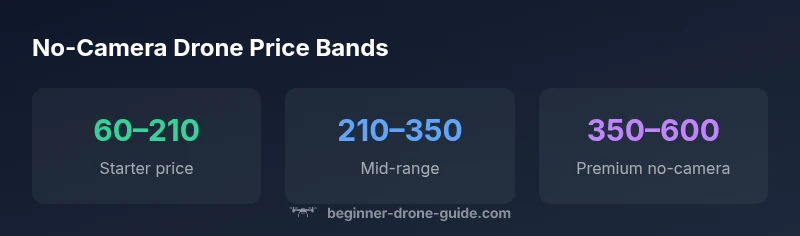
No-camera drones generally break into three broad price bands. For beginners, a starter unit can cost roughly US$60–US$210. If you want more stable flight and longer durability without the camera, mid-range models tend to be in the US$210–US$350 range. Premium no-camera drones, which may feature higher-grade frames, stronger motors, and more sophisticated stabilization, usually sit between US$350 and US$600. Remember that accessories—spare propellers, extra batteries, and a basic charger—add to the upfront cost and can turn a bargain into a fuller training kit. Brand and warranty length also influence what you pay, with some manufacturers offering better service options or extended coverage. In short, your planned use deeply shapes where you land within these bands.
What drives price when there’s no camera
Several core components determine the price of a no-camera drone. Frame material and construction quality directly affect durability and weight. The flight controller, IMU, and sensors (GPS, barometer, optical flow) influence stability and reliability in different wind conditions, while the motor quality and propellers determine efficiency and responsiveness. A robust gimbal-less stabilization system, reliable calibration tooling, and common-sense safety features (auto-return, geo-fencing, and fail-safe modes) can push costs higher even without a camera. Repairability and availability of replacement parts are also critical: a popular frame with widely available spares tends to be cheaper over the long run than a niche design. As a result, a no-camera drone can cost more than expected if you prioritize longevity and serviceability over bare-bones flight.
How to compare specs when there’s no camera
When evaluating no-camera drones, focus on flight stability, control latency, and the robustness of the powertrain rather than imaging specs. Look at the frame size and weight, motor KV ratings, and the advertised flight time with the included battery. Verify the ease of component replacement (props, batteries, motors) and whether spare parts are readily available. Check for optional upgrades like higher-capacity batteries or modular systems that let you adapt the drone for future training goals. Reading user feedback on real-world flight performance helps separate marketing claims from practical experience. A no-camera build with solid sensor fusion and strong prop protection often offers better value than a cheaper model with fragile components.
Hidden costs and total ownership
Beyond the upfront price, consider the total ownership cost. Batteries degrade over time and cost money to replace, and higher-end no-camera drones may demand more expensive batteries or faster chargers. Propeller upgrades and spare parts accumulate if you fly frequently or practice advanced maneuvers. Shipping and taxes can add up, particularly if you buy from international brands. Finally, consider training or practice time—qualitative value matters: a more stable platform can reduce learning time and the risk of crashes, which is especially important for beginners.
Practical buying scenarios for beginners
Scenario A: You’re new to flying and want a low-risk practice platform. A starter US$60–US$120 model with good stability and simple controls is a reasonable first buy. Scenario B: You want longer flight times and better durability for more frequent practice. A mid-range US$210–US$300 drone balances cost and performance. Scenario C: You’re budgeting for resilience and future upgrades, prioritizing serviceability and safety features—look at US$300–US$600 options, and plan to invest in spare batteries and propellers.
Steps to get the best value
- Set a budget that aligns with your current goals and anticipated practice hours. 2) List must-have features (stability, return-to-home, and build quality) rather than camera specs. 3) Check parts availability and warranty terms; a model with widely available spares saves money long-term. 4) Read independent reviews and user feedback to gauge real-world flight behavior. 5) Consider buying from reputable sellers who offer return policies and reliable customer support.
Common mistakes to avoid
Avoid assuming that a higher price automatically means better flight performance if there’s no camera involved. Don’t overlook the importance of replacement parts and battery compatibility. Also, avoid buying purely on aesthetic appeal or brand prestige; assess value based on durability, ease of repair, and long-term operating costs. Lastly, skip models that lack basic safety features or have limited parts availability, even if they’re cheaper upfront—these can lead to higher costs and frustration later.
What to do after purchase
After buying, spend time mastering basic controls and safety protocols in a safe environment. Practice takeoffs, landings, and basic navigation before expanding to more challenging scenarios. Keep a log of flight times, battery health, and any issues to track degradation and plan replacements. If you intend to upgrade to a camera-enabled drone later, choose a no-camera model that uses common battery types and has a compatible chassis to ease future transitions. Finally, stay informed about local drone rules and registration requirements to ensure compliant, safe operation.
Price bands for drones without cameras
| Model | Typical price (no camera) | Notes |
|---|---|---|
| Toy/mini drone | US$20-60 | Small, basic features |
| Beginner drone (no camera) | US$60-210 | Entry-level, essential flight features |
| Pro/industrial no-camera | US$200-600 | Durable, higher-end features |
Frequently Asked Questions
What is the typical price range for a no-camera drone?
Entry-level no-camera drones usually cost between US$60 and US$210; higher-end options can reach US$300–US$600 depending on durability and features. Always compare long-term value, not just upfront cost.
Most no-camera drones cost between sixty and two hundred dollars, with pricier models up to six hundred dollars for better durability and stability.
Are no-camera drones suitable for beginners?
Yes. They provide a stable platform for practicing fundamental flight skills without the extra weight and complexity of a camera. Look for features like altitude hold, GPS, and easy returns.
Yes, they’re great for beginners—focus on stability and safety features.
What features should influence price besides the camera?
Key drivers include frame durability, motor quality, sensor suite (GPS, barometer, optical flow), flight controller performance, and spare-parts availability. These determine long-term value more than the camera would.
Durability, sensors, and parts availability are big price drivers.
Do regulations affect the price of no-camera drones?
Regulatory requirements can shape model options and safety features, such as geofencing modules or compliant firmware, which may add to cost. Always verify local rules before buying.
Regulations can influence features and price through safety modules.
Is it worth buying a used no-camera drone?
Used no-camera drones can offer savings if the unit is in good condition, with checks on battery health, flight time, and known repair history. Prefer seller guarantees and documented maintenance records.
Used can be a good deal if you can verify battery and parts health.
“No-camera drones are a solid stepping stone for new pilots to master controls and safety without the distraction of a camera. Focus on build quality, serviceability, and firmware stability to get the most value.”
Quick Summary
- Set a realistic budget within the defined price bands
- Prioritize stability and build quality over camera features
- Account for ongoing costs like batteries and spares
- Check warranty and parts availability before buying
- Consider future upgrades and compatibility when choosing a model