Drone vs Quadcopter: A Practical Guide for Beginners
An analytical comparison of drone vs quadcopter definitions, use cases, and buying tips for new pilots to fly smarter, safer, and with confidence.


Drone vs quadcopter: in most contexts, 'drone' is the umbrella term for remotely piloted aerial devices, while 'quadcopter' specifies a common four-rotor design. For beginners, the difference is largely terminology; performance, planning, and safety considerations apply to both. This guide explains definitions, similarities, and practical distinctions to help you decide what to buy and how to fly.
What is a drone and how the term evolved
The word drone has evolved from military jargon into everyday language for any unmanned aerial vehicle (UAV) used for recreation, photography, inspection, or research. In the context of drone vs quadcopter, the term 'drone' is the broad umbrella that covers many configurations, from tiny nano drones to large, complex systems. For beginners, it helps to think of a drone as the overall class of remote aircraft, governed by similar flight principles and safety considerations. The real value of this distinction lies in understanding expectations: what the platform can do, what it costs, and what kinds of knowledge you need to operate it responsibly. Throughout this guide, we keep the focus practical and beginner-friendly, aligning definitions with real-world buying decisions.
What is a quadcopter and why it's a common form
A quadcopter is a drone design that uses four rotors arranged in a cross pattern to generate lift and control. This configuration is widely favored for its stability, ease of use, and compatibility with consumer flight software. Most beginner-friendly models are quadcopters because the four-rotor setup lends itself to automatic stabilization, GPS positioning, and intuitive control; these features make it easier to learn fundamentals like hover, waypoint flights, and safe landings. When you hear 'quadcopter' in product listings, think of a reliable four-rotor platform designed for predictable handling and broad support resources. The drone vs quadcopter distinction matters because it helps you calibrate expectations about learning curves and available accessories.
Core differences between drone and quadcopter: rotor count, stability, and payload implications
Differences between drone configurations often come down to rotor counts and how those counts affect stability, maneuverability, and payload. A quadcopter is one of the most common four-rotor designs and tends to deliver very stable flight with user-friendly controls that favor beginners. Other drone configurations exist, including models with more rotors or fixed-wing designs, each with its own learning curve and payload potential. When evaluating drone vs quadcopter, focus on stability features (like GPS hold and altitude hold), sensor suites (vision, obstacle avoidance, magnetometers), and how much payload you expect to carry (cameras, sensors, or other gear). The quadcopter’s predictability often translates to fewer surprises for first flights.
Control systems and flight modes: GPS, barometer, and stabilization
Modern quadcopters and many drones rely on a suite of sensors and flight-control software to stabilize and guide flights. GPS positioning provides precise hovering and automatic return-to-home behavior, while barometers support stable altitude control. IMUs (inertial measurement units) help maintain orientation and compensate for wind or movement. For beginners, fixed flight modes like stabilized mode, GPS hold, and one-button takeoff/landing are essential – they reduce the risk of crashes and build confidence. As you progress, you can explore more advanced modes, such as waypoint missions or follow-me, but mastery of basic stabilization is foundational for long-term success.
Use-case scenarios: photography, FPV, surveying
Different drone vs quadcopter configurations suit different needs. A quadcopter’s stable platform is ideal for beginner photography and stabilized video, basic mapping, or real estate shots. People who want high-speed, agile flight or immersive experiences may opt for other designs like FPV (first-person view) drones, which require more skill and safety discipline. For newcomers, starting with a quadcopter for standard aerial photography reduces complexity while you learn flight control, frame composition, and safe operating procedures. As skills grow, you can explore other categories that emphasize speed, agility, or payload customization.
Buying considerations for beginners: price, reliability, ecosystem
When choosing between drone vs quadcopter as a novice, prioritize reliability, ease of repair, and a robust ecosystem. Look for models with widely available spare parts, consistent firmware updates, and solid customer support. Consider the learning resources: official manuals, tutorial videos, and community forums. A large accessory ecosystem can simplify upgrades, such as propellers, batteries, and compatible cameras. While price is a factor, the best beginner option balances cost with safety features, stability, and post-purchase support. Remember that a strong ecosystem often translates to faster troubleshooting and fewer unexpected issues during your first flights.
Safety and regulations basics for new pilots
Safety comes first for every flight. Always fly within line-of-sight, respect no-fly zones, and check local regulations that govern hobbyist UAV use. Most regions require basic registration, a minimum age, and adherence to altitude limits and insurance requirements. Practice in open, obstacle-free spaces, keep your batteries charged, and ensure propeller guards are in place when learning. A quadcopter’s stable behavior helps you learn the basics safely, but proper safety discipline remains crucial for any drone vs quadcopter. As you gain experience, you’ll be better prepared to navigate more complex rules and airspace rules.
Myths and misconceptions about drone categories
A common myth is that more rotors automatically mean better safety or capability. In reality, rotor count affects control, power draw, and payload capacity, but it also increases complexity and cost. Another misconception is that quadcopters are universally inferior to other drone designs; in many beginner contexts, quadcopters offer the best balance of stability, availability, and instructional resources. Finally, some buyers assume 'drone' equals 'expensive' or 'advanced.' In truth, young learners can find affordable, well-supported quadcopters that teach fundamentals effectively.
How to compare models: a practical checklist for drone vs quadcopter
Use a simple comparison framework to evaluate options side by side:
- Stability features: GPS hold, altitude hold, and return-to-home
- Sensor suite: obstacle avoidance, vision systems, and IMUs
- Flight modes: beginner presets vs advanced maneuvers
- Repairability and spare parts availability
- Battery life and charging speed (while avoiding exact figures)
- Camera quality and payload compatibility
- Software and firmware support across devices This checklist keeps the focus on practical capabilities rather than marketing jargon, making the drone vs quadcopter decision clearer for beginners.
Plan your first flight and learning curve
Create a gradual learning plan that starts with indoor or open-space practice, basic hover, and tiny controlled movements before attempting longer flights. Establish a training route: mastery of takeoff, hover, gentle movement, and safe landing. Document lessons learned after each session and implement safety improvements as needed. Transition from stabilized mode to GPS-assisted flights only after you’re comfortable with the feeling of control and the responsiveness of the controls. A deliberate, stepwise approach helps you progress from a beginner-friendly quadcopter to more capable configurations with confidence.
Real-world scenarios: when a quadcopter shines vs other drones
Quadcopters shine for beginners due to their stability, forgiving control, and broad compatibility with learning resources. If your priority is straightforward aerial photography, casual exploration, or insurance against crashes while learning, a quadcopter is often the best starting point. Other drone designs may excel in specific tasks like long-range endurance, specialized payloads, or FPV racing, but these require additional skills and risk management. In most early-stage scenarios, stick with a quadcopter to build competence before expanding into other rotor configurations or more complex UAVs.
Roadmap to your first purchase: a step-by-step path
- Define your goals (photography, learning, or surveying).
- Choose a quadcopter with solid stabilization, easy repairability, and strong community support.
- Acquire a basic spare-parts kit, safe storage case, and a beginner-friendly controller.
- Practice in an open space, gradually adding more complex maneuvers.
- Review flight data, update firmware, and join community forums to share progress and get feedback.
Comparison
| Feature | Drone | Quadcopter |
|---|---|---|
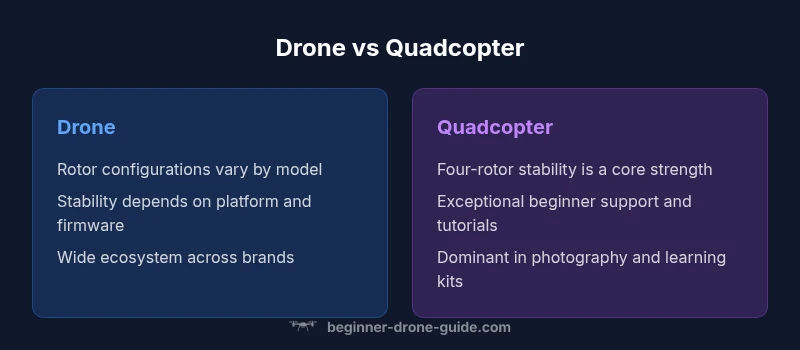
| Rotor Count / Config | Variable (multi-rotor setups beyond four). | Typically four rotors (quadcopter). |
| Stability & Learning Curve | Wide variance depending on model and weight. | Generally very stable and beginner-friendly. |
| Popularity / Accessory Ecosystem | Broad range across brands and configurations. | Large ecosystem of parts, mounts, and cameras for quadcopters. |
| Use Cases | Diverse: research, inspection, light delivery, photography. | Primarily aerial photography, beginner flights, hobbies. |
| Cost Range (entry-level) | Wide range; higher-end models vary by features. | Often affordable starter kits with good support. |
| Repairability & Upgrades | Depends on platform; some are modular. | Strong repairability and wide upgrade paths. |
| Regulatory & Safety Features | Regulatory concerns depend on application; safety features vary. | Most quadcopters include beginner-safe features like GPS hold and low-battery alarms. |
Benefits
- Terminology clarity reduces buyer confusion
- Quadcopters are widely supported with tutorials and gear
- Broad accessory and spare parts availability
- Stable, forgiving flight useful for beginners
Weaknesses
- Terminology can still mislead first-time buyers
- Rotor-count jargon may overshadow performance specs
- Some drones are not quadcopters, causing mismatch with controls
- Less versatility for specialized tasks unless you move beyond quadcopter designs
For beginners, quadcopters typically offer the fastest path to confident, safe flight.
Choose a quadcopter to build foundational skills with strong support and safety features. Move beyond quadcopters later if you need specialized capabilities.
Frequently Asked Questions
What is the practical difference between a drone and a quadcopter?
In practice, a drone is the broad term for any unmanned aerial vehicle, while a quadcopter refers specifically to a four-rotor configuration. For beginners, this distinction helps set expectations about stability, control, and available models. The two terms are often used interchangeably in casual conversation, but recognizing the quadcopter design can guide your choice and learning path.
The drone is the general term, and a quadcopter is a common four-rotor type. For beginners, think quadcopters as the easy-entry option within the drone family.
Do rotor counts affect safety and flight performance?
Rotor counts influence stability, payload capacity, and the complexity of the flight control system. Four-rotor quadcopters are especially beginner-friendly due to their stable hover and forgiving handling. Other configurations can offer advantages for specific tasks but require more skill to manage.
Rotor counts change stability and payload. Quadcopters are typically easiest for new pilots, but other designs have their niches.
Can I upgrade from a quadcopter to other rotor designs?
Yes, you can move to designs with more rotors or different configurations as you gain experience. Each jump adds complexity in flight control, maintenance, and safety checks. Start with a quadcopter to learn fundamentals before exploring higher-end or specialized UAVs.
You can upgrade later, but expect a steeper learning curve with more complex rotor setups.
Is there a licensing requirement for hobby drone pilots?
Licensing and registration rules vary by country. In many regions, hobby pilots must register the drone and follow basic safety rules. Check local aviation authority guidance and airspace rules to stay compliant as you learn.
Regulations differ by country; check your local aviation authority for registration and safety requirements.
What should beginners look for in a first purchase?
Look for a beginner-friendly quadcopter with stable flight modes, reliable stabilization, easy repair, and strong online support. Prioritize safety features, battery availability, and a robust ecosystem of spare parts and tutorials to shorten the learning curve.
Pick a beginner quadcopter with good stability, support, and spare parts so you can learn with fewer frustrations.
Quick Summary
- Define your learning goals before buying.
- Start with a quadcopter for stable, beginner-friendly flights.
- Prioritize safety features and firmware support.
- Use the practical checklist to compare models.
- Plan a gradual learning path from hover to complex maneuvers.