Drone vs Drone: Practical Comparison for Beginners
A detailed, beginner-friendly comparison of two drone categories—entry-level vs prosumer—covering features, costs, safety, and real-world use to help you decide which drone to buy.


According to Beginner Drone Guide, for most newcomers the best starting point is an entry-level drone that emphasizes stability and safety, while a prosumer model becomes the right choice as skills grow. In this drone-versus-drone comparison, we map use cases, budgets, and safety priorities to help you decide which path fits your goals.
The core goal of a drone-versus-drone comparison
In a drone-versus-drone comparison, the aim is not to crown a single winner but to align available capabilities with your actual needs. For beginners, safety, simplicity, and predictable performance matter most, while more experienced pilots pursue higher image quality, longer flight times, and broader automation. According to Beginner Drone Guide, starting with an entry-level drone reduces risk while you learn piloting basics, local regulations, and flight etiquette. As competencies grow, many pilots choose a second purchase—a prosumer model—that expands creative and professional possibilities. This section sets the stage for a practical framework you can apply to your own situation, avoiding hype and focusing on tangible use cases.
Key differentiators between entry-level and prosumer drones
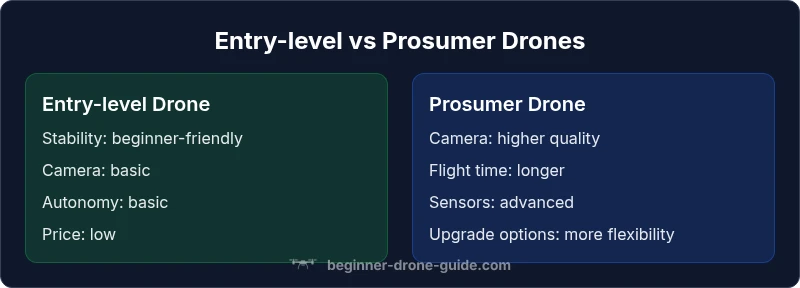
Two primary axes drive the drone-versus-drone decision: ease of use and capability envelope. Entry-level drones prioritize safety, stability, and forgiving flight controls, offering reliable GPS hover and simple modes that help beginners gain confidence. Prosumer drones bring higher performance: better cameras, larger sensors, longer flight times, more advanced stabilization, and expanded automation. You’ll notice notable gaps in image quality, post-production flexibility, payload options for specialized tasks, and the potential for accessory upgrades. If you’re teaching a child or yourself basic piloting, an entry-level model is usually the best starting point; for projects demanding professional footage, mapping, or data collection, a prosumer option tends to pay off over time.
Performance and imaging: what you get for the price
Camera systems, sensor suites, and stabilization capabilities differ markedly. Entry-level drones typically rely on smaller sensors and simpler stabilization, delivering smooth footage suitable for learning and casual videos. Prosumer models frequently employ larger sensors, higher-bit-rate video, and more robust gimbals, enabling sharper detail and broader color latitude. They also tend to offer better wind resistance and low-light performance, expanding where and when you can fly. The trade-offs include higher initial costs, heavier hardware, and the need for more careful calibration and maintenance. For many buyers, value hinges on how strongly image quality and post-production flexibility matter to their goals.
Autonomy, safety, and flight experience
Autopilot and safety features define the gap between levels. Entry-level drones generally provide dependable automatic features (return-to-home, stable hover, basic obstacle avoidance) that create a forgiving learning curve. Prosumer drones add multi-directional obstacle sensing, more precise positioning, and advanced flight plans for complex tasks like automated shoots or mapping. Beyond hardware, the pilot’s habits determine safety: always fly in legal areas, maintain line of sight when required, and perform preflight checks. Beginner Drone Guide emphasizes building muscle memory and safe routines before pushing into advanced modes, which protects both you and bystanders while you learn.
Real-world use-case scenarios: learning, hobby, content creation, and mapping
Scenario A: a beginner focuses on foundational skills—takeoffs, landings, and smooth control. An entry-level drone shines here. Scenario B: you want weekly content with higher-quality footage and easier color grading. A prosumer model can deliver richer footage and more flexible framing. Scenario C: you’re exploring lightweight surveying or mapping. The prosumer class, paired with suitable software, provides richer data and higher fidelity, albeit with more setup. Across all scenarios, outcomes depend on how well you align the drone’s capabilities with your goals, editing workflow, and maintenance discipline. Beginner Drone Guide’s guidance is to choose based on use-case fit, not price alone.
Cost considerations and value over time
Low-cost options typically have the lowest upfront price but can incur higher ongoing costs for batteries, accessories, and repairs. Prosumer models demand a larger initial investment but may offer longer service life, stronger warranties, and better resale value. When evaluating drone-versus-drone choices, consider total cost of ownership: initial price, spare parts availability, maintenance, firmware updates, and potential software subscriptions. If you anticipate upgrading within a year or two, a careful mid-range decision can yield better long-term value than repeatedly buying budget models. Thoughtful budgeting mitigates risk and ensures smoother growth.
Decision framework: a practical checklist before you buy
Use this concise checklist to decide between entry-level and prosumer: (1) Define primary tasks (learning, videography, mapping). (2) Set a realistic budget and consider ongoing costs such as batteries and software. (3) Compare camera specs, stabilization, and sensors across options. (4) Assess portability, weight, and battery availability. (5) Review safety features and compliance requirements in your region. (6) If possible, demo both classes to feel differences first-hand. (7) Plan a staged upgrade path to avoid overpaying for unused capabilities. A deliberate framework reduces buyer remorse and supports confident decisions.
Regulatory and training considerations for different drone classes
Regulatory requirements vary by country and drone weight, but many jurisdictions require registration or licensing for more capable machines or commercial use. Starting with an entry-level drone still entails learning local rules and safety practices. Upgrading to a prosumer class often brings greater regulatory obligations, including possible training or certifications for professional tasks. The Beginner Drone Guide recommends mapping out the regulatory landscape early, so you can expand your flight activities without interruptions or penalties. Staying compliant helps you fly longer and unlock more opportunities.
Comparison
| Feature | Entry-level drone | Prosumer drone |
|---|---|---|
| Ease of use | High for learning | Medium-High with more controls |
| Camera quality | Moderate/2-3-axis stabilized | High-quality with larger sensors |
| Flight time & range | Short to moderate | Longer flight time and range |
| Sensors & safety features | Basic GPS stabilization | Advanced sensors (obstacle avoidance) |
| Price range | Low to mid-range | Mid to high range |
| Best for | Learning, casual videography | Content creators, entry-level professionals |
| Upgrade path | Easily upgradable with new batteries | More upgrade options but costlier |
| Learning curve | Low | Moderate to high |
Benefits
- Lower upfront cost
- Easier to learn and fly
- Wide selection and affordable spare parts
- Great for practicing basic piloting and safety habits
- Portable and beginner-friendly design
Weaknesses
- Limited camera and feature set
- Shorter flight times and range
- Less robust build quality compared to higher-end models
- Upgrades may become necessary sooner as skills grow
Entry-level drone is best for beginners; prosumer wins for growth
Choose the entry-level option to build fundamentals and confidence. If your goals include higher-end imaging and more complex tasks, the prosumer choice offers better long-term value and capability.
Frequently Asked Questions
What is the main difference between entry-level and prosumer drones?
The main differences are camera quality, sensors, flight time, and automation features. Entry-level models prioritize ease of use and safety, while prosumer drones offer higher image quality and more advanced abilities for projects.
The main differences are image quality, sensors, flight time, and automation; entry-level favors ease of use, prosumer adds advanced capabilities.
Which drone is better for beginners?
For learners starting out, an entry-level drone is typically the better choice due to simpler controls, safety features, and lower risk. You can focus on fundamentals before upgrading.
Entry-level drones are usually best for beginners because they're easier to fly and safer to practice with.
Do you need a license to fly a drone?
Regulations vary by country and drone weight. In many places you must register and may need certification for commercial use or heavier models. Always check local rules before flying.
Regulations differ by country; check local rules and licensing requirements before flying.
Can I upgrade from an entry-level to a prosumer drone later?
Yes. Many pilots upgrade as skills grow. Plan for longer-term goals, storage, and software compatibility when choosing your first model.
You can upgrade later—just plan for compatibility and learning curve as you grow.
What safety features matter most for a beginner?
Look for beginner modes, return-to-home, stable GPS hover, geofencing, and clear manufacturer safety instructions. These features help prevent accidents while you learn.
Prioritize beginner modes and return-to-home to reduce risk while learning.
Quick Summary
- Start with an entry-level drone to build fundamentals.
- Define your goals before upgrading to avoid feature overload.
- Prosumer drones offer better cameras and sensors, not just price.
- Consider total ownership costs, not just the sticker price.
- Stay mindful of safety and regulatory requirements during growth.