Drone vs UAV: Understanding the Difference for Beginners
A rigorous, reader-friendly comparison of drone vs UAV terminology, usage, and regulations to help new pilots communicate clearly and stay compliant.


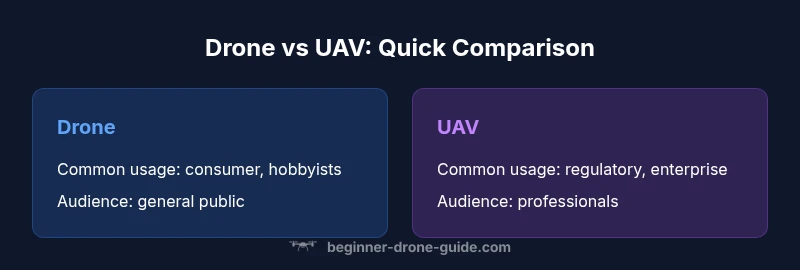
According to Beginner Drone Guide, the terms drone and UAV describe the same unmanned aircraft system, but the choice of term hinges on audience and context. In everyday usage, 'drone' is common among hobbyists and media, while 'UAV' is preferred in formal, regulatory, and technical settings. This comparison explains how to use each term effectively and why the distinction matters in communication and compliance.
What do we mean by drone vs UAV?
In this guide we examine the practical realities of terminology. A drone and a UAV refer to the same physical device: an unmanned aerial vehicle capable of autonomous or remote-controlled flight. The distinction is largely about who is listening. The word drone has become the everyday label—popular with consumers, students, filmmakers, and hobbyists who want to describe an aerial camera system. UAV, short for unmanned aerial vehicle, appears in technical manuals, regulatory documents, and vendor data sheets. For the Beginner Drone Guide audience, the key takeaway is that the core technology is the same; the difference lies in how you present it to different audiences. Master the terms, and you’ll navigate licensing, safety, and media communication with confidence.
Throughout this article we’ll explore why the distinction matters in real-world contexts and how to choose the most appropriate term for your setting.
The terminology landscape: drone, UAV, RPAS
Terminology in the drone world is not just semantic play; it shapes perception, policy, and procurement. The term UAV stands for unmanned aerial vehicle and is widely used in official language, industry standards, and military or government contexts. RPAS, short for Remotely Piloted Aircraft System, is another umbrella term used in many regulatory frameworks to emphasize the control station and ground-based elements that accompany the aircraft. In contrast, 'drone' is a broad, consumer-friendly label that reduces barriers to entry for newcomers and helps explain capabilities in plain language. The overlap can be confusing, but the practical effect is minimal for the hardware’s performance—the same motors, sensors, and controllers power both. What changes is who is listening and what they expect to hear in documents, training, and media coverage.
Core definitions and practical distinctions
From a purely technical standpoint, there is no fundamental difference in the hardware between what many call a drone and what others call a UAV. The aircraft, propulsion, flight controller, and sensors are the core components. The distinction is primarily linguistic. For many professionals, UAV is the precise, safety-focused label used in risk assessments, flight plans, and regulatory filings. For consumers and content creators, drone communicates access, ease of use, and approachable marketing language. The practical implication is that you should tailor your terminology to your audience: use UAV in formal proposals and training materials, and use drone when speaking with the public or posting about your flights. This approach minimizes confusion while preserving technical accuracy.
How the industry uses terms differently
Different sectors favor different terms, even when the same hardware is involved. Filmmaking and real estate often use drone when describing shots or equipment because the term resonates with audiences seeking approachable content. Regulators and policymakers lean toward UAV or UAS to emphasize systems, responsibility, and compliance. In manufacturing and procurement, you may see both terms used interchangeably on product sheets, which is common and generally not a sign of disparity in capability. The lesson is simple: match the vocabulary to your audience. If you’re drafting a grant, license application, or safety briefing, favor UAV/UAS language. If you’re creating a YouTube video or marketing copy, drone is typically more relatable.
Use-case oriented differences: consumer vs commercial
The consumer market trades on simplicity and storytelling. A single device can be marketed as a camera-in-the-sky, a learning platform, or a gateway to aerial photography. In commercial settings, UAV/UAS language underpins formal evaluation criteria, safety protocols, and regulatory compliance. Commercial entities often need to demonstrate controlled operations, airspace awareness, and risk mitigation—areas where regulatory terms carry weight. This does not imply superior performance; it signals that terminology communicates expectations for governance, liability, and accountability. For beginners, knowing when to switch terms helps you align your documentation with the right audience and reduces the risk of misinterpretation in formal contexts.
Operational implications: control, autonomy, and flight modes
The terms do not inherently change how a craft operates. A drone or UAV shares flight modes, GPS stabilization, return-to-home features, obstacle avoidance, and autonomous waypoint missions depending on the model. The practical impact is in how the operator communicates capabilities and limitations. When teaching flight safety, use plain language (drone) to describe what a buyer might actually experience, then switch to UAV when discussing certification requirements, operator responsibilities, or cross-border travel. As you gain experience, you’ll recognize that terminology is a tool for clear instruction and professional communication, not a limiter of performance.
Licensing, regulation, and safety considerations
Regulations differ by country and region, but the principle remains: terminology supports compliance. In many jurisdictions, official documents reference UAVs or UAS to describe the aircraft system and its operators, whereas consumer guidelines, hobbyist forums, and marketing material frequently use drone. Understanding this helps in preparing licensing exams, completing registrations, and filing flight plans. Regardless of the term, the core safety practices are the same: pilot training, pre-flight checks, airspace awareness, and payload safety. If you’re unsure which term to use in a document, consult the local aviation authority or regulator’s glossary. Safety and accountability remain the priority.
Purchase considerations: price, payloads, and hardware ecosystems
Hardware options drive both terms equally. A drone or UAV can range from a compact, beginner-friendly quadcopter to a professional-grade platform equipped with high-resolution cameras, long-endurance batteries, and specialized sensors. Brand messaging may favor one term over another, but the actual specs—flight time, payload capacity, sensor quality, transmission range—determine value. For beginners, prioritize an affordable, stable platform with strong safety features and good firmware support. If you anticipate regulatory reviews or commercial deployment, choose a model whose documentation and support align with UAV/UAS standards. This ensures your equipment is compatible with training materials, licensing steps, and future upgrades.
Real-world scenarios where the terms matter
In practice, you’ll encounter drone vs UAV in different settings. In a classroom or workshop, instructors may emphasize UAV/UAS to reflect official language and safety expectations. In an onboarding video for new hobbyists, the word drone often appears to ease comprehension. When drafting a regulatory filing or a procurement specification, UAV or UAS becomes more appropriate. The most successful pilots learn to switch between terms without hesitation, maintaining accuracy in formal contexts while staying approachable in community settings. This linguistic fluency supports smoother licensing, safer flights, and clearer communication with clients and regulators.
Common misconceptions and how to avoid them
A common misconception is that the term determines capability. In reality, performance comes from the hardware, sensors, and software, not the label. Another pitfall is assuming that UAV implies superior safety or authority; this is a semantic cue, not a technical advantage. Finally, some readers believe that one region uses only UAV while another only drone. In practice, many regions mix terms across documents, guidelines, and media. To avoid confusion, learn both terms and know your audience. Practice translating jargon: if a regulator requests a UAV in a form, supply the UAV data; if a marketing sheet speaks to consumers, describe the drone’s camera and flight features.
Emerging trends: terminology standardization and future directions
Industry groups, regulators, and manufacturers are gradually standardizing how they refer to unmanned aircraft systems. Expect more explicit wording that distinguishes the aircraft, the pilot, and the control station within a single framework. The trend toward harmonized language helps reduce cross-border barriers and accelerates training. For beginners, this means the gap between drone and UAV will narrow in practice, but the importance of accurate terminology will remain, especially in official settings, safety briefings, and licensing processes.
How to talk about drone vs UAV in practice: communication tips
Practical tips include: know your audience, use plain language when teaching or marketing, and rely on UAV/UAS in official documents. Create two quick versions of any description: a consumer-friendly drone-focused line and a regulator-facing UAV/UAS line. Keep a glossary handy and reference it when writing forms, proposals, or safety briefs. By mastering both terms, you’ll communicate with confidence, avoid confusion, and project professionalism across both casual and formal environments.
Comparison
| Feature | Drone | UAV |
|---|---|---|
| Definition (context) | Commonly used in consumer, media, and education contexts. | Formal/technical term used in regulations, policy, and procurement. |
| Typical usage | Hobbyists, videographers, content creators. | Regulators, engineers, and enterprise buyers. |
| Regulatory framing | Market-oriented language focused on consumer safety and access. | Legal/regulatory language emphasizing accountability and compliance. |
| Cost implications | Similar hardware; price depends on payloads and features, not the term. | Enterprise-grade options often priced for reliability and support. |
| Best for | Casual pilots and creators seeking approachable language. | Organizations needing precise, compliant communication. |
| Public perception | Accessible, friendly image for audiences. | Professional, technical image aimed at regulators and partners. |
Benefits
- Terminology clarity improves regulatory communication when using UAV/UAS.
- Consumer-friendly term 'drone' lowers barriers to adoption.
- Clear distinction helps in safety training and risk handling.
Weaknesses
- Overemphasis on terminology can confuse newcomers during licensing steps.
- Regulatory language may use different terms across regions, causing cross-border confusion.
- Some vendors label products with both terms, leading to mixed messaging.
Terminology is context-driven; use the audience as your guide.
In most cases, drone is best for public audiences while UAV/UAS suits formal, regulatory settings. Align your language with the listener to improve clarity and compliance.
Frequently Asked Questions
What is the difference between drone and UAV in technical terms?
Technically, there is no hardware difference between a drone and a UAV. UAV is the formal term used in regulations and technical contexts, while drone is the everyday word used in media and consumer conversations.
Technically, they refer to the same aircraft; UAV is the formal term used in official settings, while drone is the common everyday word.
Is UAV always more correct in official documents?
Not always. Some regions prefer UAV or UAS in official language, while others may use both interchangeably. Always check the local regulator's glossary.
UAV is common in official language, but local rules vary—check the regulator's glossary.
Do I need to learn both terms for legal flight?
Yes. Knowing both terms helps in licensing, registrations, and cross-border operations. Use UAV/UAS when talking to regulators and drone when communicating with the public.
Learn both terms so you can talk to regulators and the public without confusion.
Will terminology affect safety or performance?
No. Safety and performance depend on training, hardware, and procedures, not the label. Use clear language to describe capabilities and limitations.
Terminology doesn’t affect safety; focus on training and procedures.
How do regulators treat drone vs UAV?
Regulators may use UAV or UAS in official material, but the underlying safety requirements are the same. Always match the term to the document you’re completing.
Regulators may use UAV or UAS, but safety rules apply the same.
Are there differences in terminology across regions?
Yes. Different regions adopt different terms in official documents, training, and media. When in doubt, refer to the local aviation authority's terminology guide.
Regional terms vary; check the local aviation authority for guidance.
Quick Summary
- Match terminology to the audience for clarity.
- Regulatory language may favor UAV/UAS; marketing favors drone.
- Hardware remains the same; terms reflect context, not capability.
- Always check local rules when labeling documents or training.