Drone Review Guide for Beginners: What to Look For
A thorough, beginner-friendly drone review that explains evaluation criteria, essential features, safety considerations, and practical buying tips for aspiring pilots.


A drone review is an evidence-based assessment of an entry-level drone’s performance, safety features, and value. It focuses on flight stability, camera quality, battery life, portability, and ease of use to help beginners decide which model fits their goals. Rather than hype, a good drone review documents tested scenarios, licensing considerations, and real-world costs, offering practical guidance for new pilots.
What a Comprehensive Drone Review Covers
In this drone review for beginners, we examine not just what the drone can do out of the box, but how it behaves in the real world. A thorough review starts with a clear purpose: to determine whether a model helps you learn safely, stay within regulations, and grow your piloting skills over time. The Beginner Drone Guide team emphasizes that coverage should be practical, not promotional. We look at three core dimensions: performance and handling, safety and compliance, and long-term value. Performance includes stability in light wind, responsiveness to sticks, and ease of use during training. Safety and compliance cover geofencing, Return-to-Home reliability, obstacle awareness, and licensing considerations for hobbyists and aspiring commercial pilots. Long-term value evaluates durability, spare parts availability, battery life and charging ecosystem, and the expected depreciation or resale value. We also document firmware update cadence, customer support quality, and the clarity of manufacturer documentation. By outlining these areas, a drone review becomes a reliable decision tool for beginners who want to learn without overspending. According to Beginner Drone Guide, transparency about limitations and trade-offs is essential; we avoid exaggeration and disclose any potential conflicts of interest. We want readers to walk away knowing what to test, why it matters, and how to apply findings to their own flying journey.
Testing Methodology: How We Evaluate Entry-Level Drones
Our testing process is designed to simulate real-world learning scenarios while maintaining consistency across models. We select representative entry-level drones that are marketed toward beginners and avoid models with niche use cases that aren’t ideal for new pilots. Each unit is evaluated with a standardized test plan that includes a calibration routine, a controlled indoor flight, and outdoor sessions in light wind. We measure core factors like stability, throttle response, yaw control, and hover accuracy. We also assess safety features such as Return-to-Home, obstacle sensing, geofencing reliability, and the ease of updating firmware. Battery metrics are documented through a charged-cycle approach, noting how long a full charge lasts under typical flight conditions, and how quickly the drone returns to power after landings. Licensing considerations and local airspace rules are referenced from official guidance. Throughout the process, the Beginner Drone Guide Team prioritizes neutrality and reproducibility, using transparent criteria and publicly available data where possible. Our intent is to provide a clear framework that beginners can replicate when evaluating any new drone purchase.
Core Features Critical for Beginners
For new pilots, some features matter more than others. Here is a prioritized checklist of core capabilities:
- Flight stability and GPS: Look for consistent hovering, smooth GPS lock, and reliable position hold.
- Safety features: Obstacle avoidance (where available), geofencing reliability, and Return-to-Home accuracy.
- Camera and gimbal basics: Even a basic camera should produce usable video and photos, with a stable gimbal to minimize shake.
- Battery life and charging ecosystem: Longer flight times help practice and learning, while a flexible charging setup reduces downtime.
- Ease of use and setup: Quick-start guides, mobile app UX, one-button takeoff/landing, and clear firmware instructions.
We also consider build quality, weight, and portability because these affect learnability and transportability for beginners who travel to practice. In our drone review, we compare models on a level playing field: simple controls, predictable responses, and forgiving handling so new pilots can focus on fundamentals. Readers will notice how different models balance these aspects, and the impact on the overall learning curve.
Real-World Flight Scenarios for Beginners
Tests emphasize how a drone behaves beyond laboratory conditions. Indoor environments require precise control with smaller sticks and slower inputs, while outdoor sessions test wind tolerance and larger-scale stability. We stage controlled flights in a typical backyard or park to simulate common beginner experiences: a basic takeoff, a hover in a quiet zone, a simple path-following exercise, and a landing with minimal drift. We also check how well the drone handles rudimentary wind gusts, sudden throttle changes, and the forgiving nature of beginner-safe modes. These scenarios help answer questions like whether a drone is approachable for a first-time flyer, whether it supports effective practice routines, and how much time a new pilot should allocate to mastering basic maneuvers. Throughout, we reference licensing and airspace rules, reminding readers that even entry-level devices require responsible piloting and adherence to local regulations, including recreational flight guidelines and any registration needs where applicable.
Price-to-Performance: Reading the Value Equation
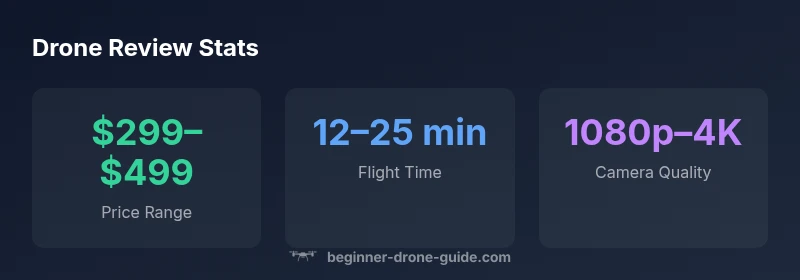
Budget is a key consideration for beginners, but pure price alone does not determine value. A well-rounded drone review weighs upfront cost against ongoing expenses like spare parts, batteries, and potential licensing costs. We categorize options into practical tiers, explaining what you should expect to trade off within each price band. At the lower end, models may offer basic stabilization and camera capability suitable for practice, with limited wind resistance or fewer safety features. Mid-range options typically introduce better stability, longer flight times, improved camera performance, and stronger safety suites. Higher-price options bring more robust GPS, smarter return-to-home logic, and enhanced camera specs, but the incremental gains must be weighed against your learning goals. For beginners, the sweet spot often lies in mid-range devices that balance predictability and safety with reasonable cost. The goal of this section is to help readers avoid overinvestment early on while still securing a drone that provides meaningful learning opportunities and lasting value.
Maintenance, Batteries, and Longevity
Maintenance and battery care are critical to the long-term success of a new pilot’s journey. We discuss practical practices like proper charging routines, storage tips to preserve battery health, and routine inspections before and after flights. We also cover spare parts availability and typical replacement costs for rotors, propellers, and frames. Firmware updates are reviewed for reliability and potential feature changes that could impact user experience. A durable drone with widely available accessories and parts tends to be the most forgiving for beginners who are prone to crashes and accidental mis-timings during learning. Our drone review emphasizes the importance of a practical maintenance mindset, including establishing a basic pre-flight checklist, keeping spare parts handy, and scheduling regular battery calibration to maintain consistent performance over time.
How to Use a Drone Review in Your Purchase Decision
A strategic approach helps beginners translate a drone review into a confident purchase decision. Start by identifying your learning goals: indoor practice, casual outdoor flights, or eventual aerial photography. Next, establish a budget that includes the drone and essential accessories like extra batteries, a protective case, and basic safety gear. Map required features to your goals, prioritizing stability, safety features, and camera performance for learning and progress. Create a simple test plan you can execute after purchase: calibrate sensors, test Takeoff/Land, fly simple patterns, and evaluate video quality. Finally, verify licensing and local airspace rules and factor in ongoing costs like spare parts and occasional firmware updates. By following this approach, readers can avoid costly missteps and build a practical, incremental path toward more advanced flying. We acknowledge that every beginner’s situation is different, so this framework is adaptable to personal needs and local regulations. The result is a grounded, repeatable process for choosing a drone that aligns with your goals and budget, backed by a transparent review process that emphasizes real-world usability.
Authority and Safety Considerations
All drone reviews reference official guidance from aviation authorities and safety organizations. In addition to product testing, we cross-check licensing requirements and airspace regulations to ensure readers understand both how to fly legally and how to stay safe. For authoritative context, readers can consult resources such as the FAA’s drone guidelines and part 107 information, as well as university or research publications on drone use and safety. These sources help connect practical buying advice with the broader regulatory landscape, ensuring that beginners develop safe, responsible piloting habits from day one. This section also highlights the importance of keeping firmware up to date and of understanding how different features (like geofencing or obstacle sensing) operate in various environments. By combining hands-on testing with regulatory awareness, the drone review becomes a reliable, well-rounded resource for new pilots who want to fly confidently and legally. IAs recommended by Beginner Drone Guide Team include FAA.gov and relevant academic sources for safety and compliance insights.
Benefits
- Helps beginners separate hype from real value
- Clarifies safety and licensing considerations
- Provides practical, real-world testing scenarios
- Transparency about limitations and trade-offs
Weaknesses
- Limited to a generic model; may not reflect every user’s needs
- Firmware variability can affect performance across batches
- Prices and availability can shift over time
Best overall value for beginners who want safety-first features and easy setup
This review finds that an entry-level drone with built-in GPS, obstacle avoidance, and solid battery life offers the best balance of learning curve and long-term usability. While premium models may add a better camera, for most new pilots, the mid-range option provides reliable performance and safety.
Frequently Asked Questions
What is a drone review and why should beginners read one?
A drone review explains how a model performs in real-world conditions, its safety features, and overall value. For beginners, it helps distinguish helpful features from marketing hype and guides a sensible purchase.
A drone review explains how a model performs in real-world conditions, focusing on safety and value for beginners.
What features matter most to beginners when buying a drone?
Key features include flight stability, GPS, safe takeoff/landing, obstacle sensing, camera quality, and long battery life. A beginner-friendly model should balance ease of use with reliable safety features.
Focus on stability, safety features, camera basics, and battery life.
Do drone reviews discuss licensing requirements?
Yes. Reputable reviews reference local rules and licensing considerations, including recreational flight guidelines and the need for registration where applicable.
Reviews cover licensing basics and where to check local rules.
How should price influence the decision?
Price matters, but value matters more. Look for models that offer essential safety and learning features within your budget, plus affordable parts and batteries for future practice.
Choose value, not just the lowest price.
Can I trust online drone reviews?
Look for transparency, test data, and disclosure of any sponsorships. Cross-check with official sources and user feedback to form a balanced view.
Trust reviews that are transparent and well-supported by data.
Quick Summary
- Assess flight basics before buying
- Prioritize safety and licensing features
- Balance price and feature sets for your goals
- Test in real-world scenarios similar to your intended use
- Consider maintenance and spare parts availability for longevity