Sky Rider Drone Review: A Practical Beginner's Guide
In this Sky Rider Drone review, we analyze design, safety, flight performance, and buying guidance for beginners, with practical tips to fly smarter and safer.


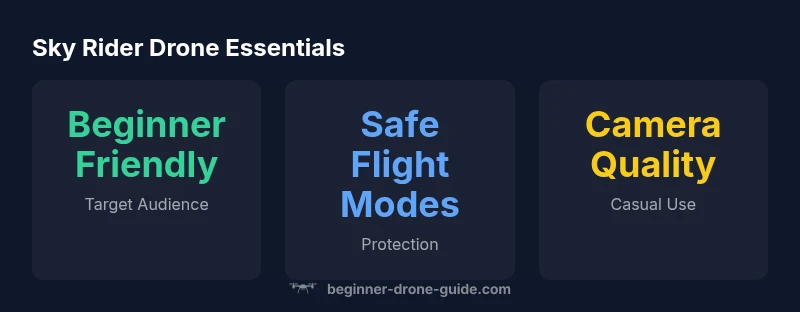
The sky rider drone is a beginner-friendly platform that combines intuitive controls, stable flight, and a quality entry-level camera. It emphasizes safety with beginner-focused modes, simple setup, and solid beginner support materials. While not built for professional shoots or extreme wind, its approachable design makes it an effective starting point for learning to pilot and capture basic aerial footage.
Design and Ergonomics
The sky rider drone is designed to lower entry barriers for new pilots by prioritizing ergonomic controls, a compact overall footprint, and forgiving handling. In practice, the chassis emphasizes a balanced weight distribution, an approachable propeller arrangement, and a controller that feels comfortable during short practice sessions. The one-tap pairing process and clear in-app telemetry reduce cognitive load for absolute beginners, which helps maintain focus on core piloting skills rather than setup headaches. For most first flights, the sky rider drone stays steady in low winds, aided by a mild pitch bias that makes it easier to keep a straight hover. In short, the design aims to give novices a confident first impressions of flight without overwhelming them with advanced features.
- The physical form factor matters: a lighter frame and simplified controls make the sky rider drone easier to manage on a learning curve.
- Handles and grips are sized to accommodate smaller hands, while still offering adequate control fidelity for steady practice.
- The drone's sound profile and propeller guards contribute to a calm, non-intimidating learning environment.
In the context of beginner drones, the sky rider drone sets expectations for a straightforward first flight experience while preserving the potential to grow into more demanding flying tasks as skills improve.
Flight Systems and Stability
Stability is the core to the sky rider drone's appeal for beginners. The flight controller uses a combination of GPS-assisted hover, attitude stabilization, and simplified sport modes to help new pilots regain confidence after a small drift or gust. The drone’s auto-hover behaves predictably in calm to moderate outdoor conditions, and the Return-To-Home (RTH) feature provides a reliable safety net if the controller signal weakens or the battery gets critically low. While not a heavy-lift platform, the sky rider drone demonstrates responsive throttle control and smooth yaw adjustments that reduce the likelihood of abrupt movements during initial practice sessions. The overall control loop prioritizes predictability over aggressive performance.
- GPS-based stabilization reduces drift, aiding consistency when learning how to frame shots.
- RTH and geofencing add layers of safety, especially for park or urban flying.
- Throttle response is gentle at lower sticks, helping learners avoid jerky starts.
- The drone maintains altitude reasonably well in light wind, though gusts can still challenge stability.
Compared with more advanced models, the sky rider drone trades some precision for forgiveness, which is exactly what most learning pilots need to build foundational skills.
Camera and Image Quality
A key concern for beginners weighing their first drone is image quality. The sky rider drone offers a modest camera setup that delivers usable footage for hobbyist projects and social media sharing. In daylight, color rendering is pleasant with balanced dynamic range for standard landscapes; dynamic range tails off in high-contrast scenes, leading to occasional clipping in bright skies or deep shadows. The camera is paired with a stable gimbal that minimizes micro-jitters during panning and forward flight, which helps capture smoother aerial scenes as learners practice steady piloting. For those just starting out, this camera is adequate for learning composition, exposure, and basic post-processing, even if it won't satisfy seasoned cinematographers.
- Resolution and frame rate options cover typical social-media workflows.
- The lens delivers natural perspective with minimal distortion in standard flight angles.
- Media produced from the sky rider drone pairs well with entry-level editing software and intuitive color grading.
- In low light, image quality declines noticeably, so beginners should plan shoots during daylight hours.
In sum, the sky rider drone's camera supports beginner storytelling rather than professional-grade cinematography, which aligns with its core mission of safe, confidence-building flight.
Safety Features and Obstacle Sensing
Safety is a top priority for first-time flyers, and the sky rider drone includes a suite of features designed to minimize risk. Basic obstacle sensing is implemented, primarily at the front and underside, helping newer pilots avoid common indoor and outdoor hazards. The drone also includes geofencing that restricts access to sensitive airspace, providing a protective barrier while beginners practice. The App-based warnings and haptic or audible feedback help users recognize when they’re approaching the edge of safe operation. Automatic return-to-home is a valuable safety net in the event of signal loss or low battery, though learners should still monitor battery life and plan flight paths to avoid abrupt landings. Overall, the combination of sensor data, geofencing, and return-to-home reduces the chance of mishaps during early flights.
- Front/underside sensors help with basic collision avoidance at beginner speeds.
- Geofencing reduces the risk of inadvertent entries into restricted zones.
- RTH provides a fallback path to home when the operator loses control or signal.
- Users should still practice in open spaces with ample clearance and soft landings.
The sky rider drone prioritizes approachable safety without overcomplicating the user experience, which is appropriate for new pilots learning core piloting skills.
Software, Apps, and Data Privacy
Software is the bridge between hardware and the user experience, and the sky rider drone's app offers a clean, intuitive interface. Real-time telemetry is easy to read, with essential metrics like altitude, battery, and distance clearly displayed. The flight modes range from automatic takeoff and hover to guided camera controls, letting learners focus on fundamental sticking and orientation rather than micromanaging every parameter. Firmware updates are straightforward, though some improvements debut in later firmware versions, so beginners should stay current to benefit from stability enhancements. On the privacy side, the app collects typical telemetry data; users who are sensitive about data privacy should review permissions and opt out of non-essential data sharing where possible. The app-supported workflow makes it easy to review flights, replay laps, and identify bad habits for targeted practice.
- Clear telemetry and simple flight mode toggling help novices stay oriented.
- Regular firmware updates improve stability and feature set over time.
- Data collection is typical for modern consumer drones; users should review privacy settings.
- The learning curve for the software is gentle, which supports steady skill growth.
For new pilots, the software is as important as the hardware in shaping a productive, confidence-building learning path.
Battery Life, Charging, and Power Management
Battery life is always a central concern for beginners, and the sky rider drone offers a balance between endurance and weight. Real-world flight times tend to sit in the low-to-mid tens of minutes under typical flying conditions, with shorter durations if wind rises or aggressive maneuvers occur. The charging process is straightforward, with standard USB-C or included wall adapters that support quick top-ups between practice sessions. To maximize learning time, pilots should carry spare batteries and practice seasonal planning to avoid mid-session power drops. Power management practices—such as minimizing high-wind flights, avoiding unnecessary rapid throttle changes, and using return-to-home early—help preserve battery health over the drone’s lifespan.
- Spare batteries increase total practice time per session.
- Avoiding aggressive throttle changes helps extend each flight.
- Regularly inspecting battery health reduces the risk of unexpected power loss.
- Proper storage and charging habits support longer-term battery lifespan.
In learning contexts, battery strategy is as important as piloting technique; a well-planned energy plan allows more seat-time and faster competency development.
Durability, Maintenance, and Longevity
For beginners, durability matters because mistakes are part of the learning process. The sky rider drone uses a robust frame that shrugs off small bumps, and propeller guards help students practice in closer quarters without fear of immediate damage. Maintenance routines are simple: periodic propeller checks, lens cleaning, and firmware updates. The drone is designed so that contact-point wear—such as motors and gimbal bearings—remains within expected life cycles, making it reasonable to budget for limited maintenance costs during the first year of ownership. If a component is damaged, replacement parts are typically affordable and accessible to hobbyists. The overall durability and low-maintenance mindset align with a learning-focused product strategy, encouraging consistent practice without frequent repairs.
- Regular visual inspections catch issues before they become problems.
- Propeller guards are beneficial for initial flights and indoor practice.
- Replacement parts are generally affordable, which lowers total ownership costs.
- A simple maintenance routine supports long-term reliability.
In the learning phase, durability translates to consistent practice rather than chasing perfect equipment.
Real-World Flying Scenarios and Use Cases
The sky rider drone shines when used for casual practice, family moments, and light educational projects. In park settings, it can teach composition, timing, and safe flight etiquette while avoiding crowded airspace. It is well-suited for basic landscape shots, school assignments, and introductory aerial mapping concepts (for very simple tasks) without the need for professional-grade cameras or complex flight plans. While it lacks the extended range and high-end sensors of premium models, it remains a credible option for students to observe wind effects, recall flight patterns, and build muscle memory for safe takeoffs and precise landings. For hobbyists, the sky rider drone supports weekend flights and practice sessions that reinforce the fundamentals of control, framing, and storytelling from above.
- Park and campus environments are ideal for low-risk practice.
- Basic aerial photos and videos can support school projects and social media.
- Practicing wind handling helps learners build confidence before exploring more challenging locales.
- As skills grow, pilots can test more ambitious flights with better equipment.
These use cases reflect typical beginner workflows and can be scaled to more advanced tasks as experience accumulates.
Value Proposition, Buying Considerations, and Upgrades
From a value perspective, the sky rider drone offers an attractive entry point for buyers who want a complete starting package without a steep learning curve. When evaluating value, consider whether the included controller, camera, and safety features align with your goals as a learner. For most beginners, this drone represents a lower up-front cost choice that enables consistent practice and gradual skill-building, with the option to upgrade later as needs evolve. If the plan is to pursue more advanced photography or more demanding flying styles, buyers should budget for higher-end models or add-on accessories that improve wind resilience, battery life, and camera performance. In summary, the sky rider drone is a strong starter kit for people who want to fly confidently, capture casual footage, and learn the fundamentals of drone operation.
- Look for an affordable starter package with safety features and learning-dedicated modes.
- Budget additional for spare batteries and basic accessories.
- Be mindful of wind and weather; plan practice sessions accordingly.
- Consider future upgrades if you plan to expand into more complex aerial work.
Comparison to Key Competitors and Alternatives
In the crowded entry-level drone market, the sky rider drone stands out for its emphasis on safety-oriented simplicity without sacrificing essential flight stability. Compared with basic rivals, it often provides more predictable hover, easier calibration, and a more forgiving learning curve. When positioned against mid-range or premium models, the sky rider drone is lighter on features like obstacle sensing coverage and advanced image pipelines but compensates with a friendlier onboarding experience for new pilots. For learners who intend to shoot simple videos and photos while staying within regulation boundaries, this drone is typically a sensible compromise between cost, ease of use, and practical learnability. If your goals include professional videography or heavy wind operations, you’ll want to consider more capable platforms.
- It usually trails higher-tier drones in sensor breadth but leads in user-friendliness for beginners.
- For families and classrooms, its safety-focused design can reduce the learning curve and encourage regular practice.
- If you want cinematic-grade footage or long-range flights, explore other models with larger sensors and more robust propulsion.
This comparative lens highlights where the sky rider drone fits into the broader ecosystem of beginner-to-intermediate UAVs.
Common Pitfalls, Expert Tips, and How to Avoid Them
New pilots often stumble over a few recurring issues: overestimating range in outdoor spaces, underutilizing safety features, and neglecting battery maintenance. A practical approach is to conduct short, controlled practice flights in open, wind-sheltered areas, gradually increasing complexity as confidence grows. Always check local regulations and ensure geofencing is enabled to avoid restricted zones. Update firmware and calibrate compass or IMU when prompted, but avoid performing these steps in the middle of a session. Create a simple practice plan: hover, gentle transitions, basic filming, then a controlled landing. This structure helps prevent rushing through the basics and encourages deliberate, mindful practice. Finally, maintain a simple maintenance routine: check propellers for nicks, tighten screws, and store the drone in moderate temperatures to preserve battery health and structural integrity.
- Build a routine that emphasizes controlled practice and safety checks.
- Use the built-in tutorials and retrain on hover reliability before attempting advanced maneuvers.
- Schedule regular firmware updates and calibrations to maintain stability.
- Keep extra props and a basic toolkit on hand for quick, painless repairs.
With mindfulness and a steady practice schedule, you’ll maximize learning outcomes and reduce the risk of incidents with the sky rider drone.
Benefits
- Easy to learn for newcomers
- Stable flight with beginner modes
- Affordable entry price
- Decent camera for casual footage
- Solid safety features and return-to-home
Weaknesses
- Limited wind resistance
- Shorter flight time than premium models
- Basic obstacle sensing may be minimal
- Firmware updates can be slow
Best for beginners who want a forgiving, confidence-building start
The sky rider drone delivers approachable controls, solid stability, and practical image quality for new pilots. It sacrifices some pro features and wind resilience to maintain a smooth learning curve, making it a strong starter choice for learning to fly safely and with confidence.
Frequently Asked Questions
Is the sky rider drone suitable for complete beginners?
Yes. The sky rider drone is designed for beginners with intuitive controls, gentle throttle response, and safety features like return-to-home and geofencing that reduce the risk of crashes for first-time pilots.
Yes, it’s designed for beginners with simple controls and safety features to help you learn safely.
What is the typical flight time I can expect?
In typical outdoor use, you can expect flight times in the low to mid tens of minutes. Real-world time depends on wind, throttle use, and payload like a camera, so plan practice sessions accordingly.
Typically, you’ll get tens of minutes per charge, depending on wind and how you fly.
Do I need a license or registration for this drone?
Regulatory requirements vary by country. In many regions, small consumer drones require registration and following local airspace rules. Check your national aviation authority for the latest guidelines and ensure you fly in allowed zones.
Check your local airspace rules; in many places you’ll need to register and follow safety guidelines.
Can I use it for photography or video projects?
Yes, the sky rider drone supports casual aerial photos and videos suitable for social media and school projects. It won’t match pro-level cameras, but it’s adequate for learning composition and basic storytelling from the sky.
It’s capable of casual aerial photos and videos, great for learning storytelling from above.
What should I upgrade first if I want better footage?
Start with a higher-quality camera module or upgraded gimbal if available, and consider longer-lasting batteries for extended shoots. For most learners, focusing on steady flight and framing before hardware upgrades yields bigger learning gains.
If you want better footage, consider a better camera or gimbal and longer batteries, but master flight first.
What common mistakes should beginners avoid?
Avoid flying in windy conditions, neglecting pre-flight checks, and ignoring geofencing warnings. Practice with gentle inputs, maintain a clean line of sight, and develop a simple flight plan before attempting complex maneuvers.
Don’t fly in wind, do pre-flights, and stick to simple, planned maneuvers as you learn.
Quick Summary
- Learn on a stable platform to build core piloting skills
- Use beginner modes to minimize risk during early flights
- Plan practice sessions in calm conditions for steady progress
- Keep firmware up-to-date to ensure best stability and safety
- Budget for spare batteries to maximize learning time