Can a Drone Carry 10kg? A Practical Guide for Beginners
Explore the feasibility of a drone carrying 10kg, including design considerations, safety, regulations, and practical applications for beginners and professionals alike. Learn what it takes to lift heavy payloads responsibly.


Yes. A drone can carry 10kg, but only with purpose-built, heavy-lift platforms designed for high payloads. Typical consumer drones cannot; achieving 10kg requires industrial-grade multicopters, reinforced frames, high-thrust motors, upgraded batteries, and strict safety and regulatory compliance. In practice, carrying 10kg is a specialized use, not a beginner feature. Operators typically perform controlled tests and require tailored mission planning, fail-safes, and licensed pilots.
Why payload capacity matters for heavy-lift drones
Payload capacity defines what a drone can physically haul, how the flight dynamics behave, and what safety margins are available. For a drone can carry 10kg, designers must balance thrust, weight, and power to maintain controllability and stability. The Beginner Drone Guide team emphasizes that payload planning is as important as the flight plan itself: even small shifts in weight or CG can dramatically affect lift and maneuverability. In practical terms, high-payload operations demand rigorous pre-flight checks, load distribution analysis, and mission-specific risk assessments. For beginners, this topic illustrates why high-payload missions are generally out of reach without specialized training and equipment.
Key design considerations for high-payload drones
High-payload platforms require reinforced frames, high-thrust motors, larger propellers, and high-capacity batteries or hybrid power. Achieving a 10kg payload means extending motor torque, optimizing propeller efficiency, and implementing robust battery management to prevent voltage sag. Redundancy across critical systems—motors, ESCs, and power paths—helps mitigate failure risks during ascent, hover, and payload release. Weight distribution is crucial: a forward-shifting CG can make pitch control unstable. In many configurations, engineers incorporate ballast or counterweights to stabilize the platform under load. These design choices come with trade-offs in weight, cost, and potentially flight time.
Real-world payload scenarios for 10kg payloads
Industrial inspections of large structures, livestock feed distribution, and light logistics are common heavy-lift use cases. A drone capable of 10kg can transport mid-sized tools, sensors, or packages to remote sites where ground access is limited. In photography and surveying, heavier payloads enable advanced sensor suites, such as multi-spectral cameras or environmental monitors, that empower new insights. When planning such missions, operators must account for weather conditions, barometric pressure effects on lift, and the additional risk they introduce to people and property on the ground. Real-world deployments are typically performed under controlled environments with clear demarcations and safety observers.
Regulatory and licensing implications for heavy payloads
Heavy-lift operations almost always require national or regional approvals, beyond basic drone registration. Operators may need remote-pilot licenses, waivers for beyond-visual-line-of-sight (BVLOS) operations, and explicit permissions for carrying external loads. Compliance often includes payload-release procedures, geofencing overrides, and post-flight logging. The best-practice approach is to align with local aviation authority guidelines and maintain up-to-date training records. In many jurisdictions, commercial payload flights also demand insurance coverage and pre-mission risk assessments to minimize liability and safety risks.
Safety considerations when flying with 10kg payloads
Safety starts with load securement and CG management. A loose payload or misaligned weight can cause oscillations or sudden pitch changes. Pilots should perform structured pre-flight checks, including torque tests for each motor, battery health inspection, and verification of payload attachment points. Redundancy—such as dual batteries and ESC protection—reduces risk of mid-flight power loss. Operational safety also extends to airspace awareness, obstacle avoidance, and establishing safe drop zones if payload release is required. Regular maintenance and post-flight debriefs improve reliability over time.
Flight performance expectations with heavy payloads
Heavy payloads reduce acceleration and reduce top speed due to increased mass. Climb rates may slow, and endurance typically decreases compared with unloaded flights. Real-world performance varies with drone size, propulsion, and weather. Operators should expect shorter hover stability windows and longer settling times after a maneuver. Training to fly precise, controlled payload delivery or release requires simulator practice and incremental payload tests that build confidence before executing critical operations.
Battery and propulsion strategies to support 10kg payloads
Typical heavy-lift rigs rely on high-capacity, warm-temperature-tolerant batteries and efficient propulsion to maximize performance. Battery management strategies, such as active cooling, health monitoring, and optimized discharge profiles, support stable power delivery under load. In some platforms, swappable batteries minimize downtime between missions. The energy-to-weight ratio remains the limiting factor; planning missions around reserve capacity and safe landing margins is essential.
How to evaluate drones that can carry 10kg
Prospective buyers should compare thrust-to-weight ratios, rotor counts, frame rigidity, and long-term reliability. Look for proven test data and independent performance demonstrations under payload conditions. Consider software features such as advanced flight controllers, telemetry, and fail-safes. Budget for training and certifications, as well as liability insurance. For beginners, seek hands-on education and mentorship before attempting heavy payload operations.
Common myths and limitations about heavy payloads
A frequent myth is that adding more batteries will automatically enable heavier payloads. In reality, the relationship between power, weight, and lift is complex; excessive payload reduces efficiency and increases risk. Another misconception is that all heavy-lift drones are expensive and impractical for real-world use. While costs are higher, there are scalable options; the key is to match mission requirements with a capable, well-maintained platform and trained operators.
Practical planning checklist for a 10kg payload mission
- Define mission objectives and success criteria
- Verify airspace approvals and weather windows
- Confirm payload securement and CG balance
- Run simulator training and incremental test flights
- Prepare redundancy plans and emergency procedures
- Inspect maintenance logs and power systems beforehand
- Establish clear ground safety zones and observers
- Document post-flight data for safety and compliance
Overview of payload-capable drone categories and typical uses
| Drone Type | Payload Capacity | Typical Use |
|---|---|---|
| Consumer quadcopter | 1–2 kg | Light aerial photography |
| Industrial mid-size drone | 6–12 kg | Site inspection, sensors |
| Dedicated heavy-lift platform | 10–15 kg | Logistics, heavier payloads |
Frequently Asked Questions
Can a hobby drone ever carry 10kg?
Generally no. Carrying 10kg requires industrial-grade, heavy-lift platforms with reinforced frames and high-thrust propulsion. Hobby models are not designed for such loads and pose substantial safety risks.
Most hobby drones can't lift 10kg; heavy-lift platforms are needed with proper safety measures.
What licenses or approvals are needed?
Regulatory requirements vary by country but typically include a remote-pilot license, airspace approvals, and payload-specific waivers. Always verify local aviation authority rules before attempting a 10kg payload mission.
You usually need a license and written approvals for heavy payload operations.
What are realistic flight times with a 10kg payload?
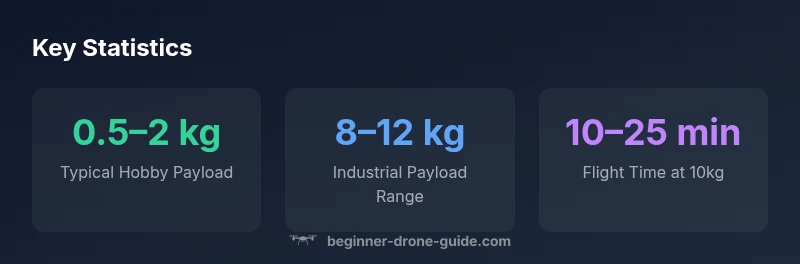
Flight time drops as payload increases; realistic estimates range from roughly 10 to 25 minutes depending on platform, battery capacity, and weather. Always plan for reserve power.
Expect shorter flights—often under 30 minutes—when carrying 10kg.
What safety features are essential for heavy payloads?
Redundant propulsion and power, secure payload attachments, GPS-based geofencing, obstacle avoidance, and an automatic return-to-home mode are critical for heavy-payload flights.
Redundancy, secure attachments, and good pilots are essential.
How should I test a 10kg payload safely?
Use a staged approach: begin with no payload, then light loads, and gradually increase while monitoring performance. Conduct tests in controlled environments with trained personnel and emergency procedures.
Test progressively in a safe area with observers.
Are there alternative solutions to avoid lifting 10kg?
Yes. Consider tethered payload systems, ground-based winches, or hiring a professional service with appropriate equipment and certifications.
If you don’t need mobility, ground-based options can be safer.
What maintenance is critical after heavy payload flights?
Inspect motors, gears, and propellers for wear, check battery health, and review logs for anomalies. Regular post-flight checks are crucial for reliability with heavy loads.
Inspect gear, motors, and batteries after flights.
“"Heavy payload operations demand rigorous planning, robust hardware, and disciplined safety practices. End-to-end preparation is non-negotiable for reliable results."”
Quick Summary
- Assess payload feasibility before starting a heavy-lift project.
- Choose industrial-grade platforms with redundant systems for safety.
- Plan regulatory compliance and pilot licensing early.
- Prioritize payload securement, CG balance, and mission planning.
- Test incrementally and document every flight for safety.