Can DJI Drones Carry Things? A Practical Beginner's Guide
Discover whether DJI drones can carry payloads, how limits vary by model, and safe practices for beginner pilots, including mounting, flight planning, and regulatory considerations.


Yes—can dji drones carry things? In practice, some DJI models can carry light payloads with proper mounts, but capabilities vary by model and configuration. For safe flight, keep payloads small and balanced, verify official guidance, and follow local regulations. This is not universal across all DJI drones and requires careful planning and testing.
Payloads and The DJI Ecosystem: A Practical Overview
For beginners wondering whether can dji drones carry things, the short answer is: it depends on the model and the mounting setup. DJI's consumer and professional lineups support payload-carrying capabilities in different ways. The Beginner Drone Guide team emphasizes that payloads are not interchangeable features; they require careful alignment with the drone's center of gravity, motor power, and propulsion characteristics. In practice, you’ll find lightweight, purpose-built accessories that attach securely to a designated mounting point, after which you must recalibrate sensors and adjust flight plans. The benefits include expanded test capabilities, short-range sensing experiments, or lightweight sampling tasks in controlled environments. However, the safety margin narrows as you increase weight, and stability must be maintained in wind and at higher yaw rates. Always consult official manuals and use only manufacturer-approved mounts or accessories to minimize risk.
Model Variety: What It Means for Carrying Things
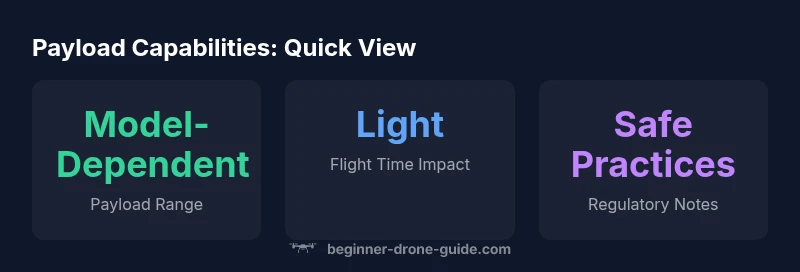
Payload-carrying capabilities are not one-size-fits-all. Consumer-grade drones commonly support small, approved payloads via specific mounting points or accessory kits, while professional platforms offer more robust payload systems designed for higher stability and balance. The key takeaway for beginners is that capability is highly model-dependent and frequently requires calibrated payloads, precise CG adjustments, and controlled testing. Always verify compatibility with your exact drone variant and any official accessory guidelines before attempting any carry operation. Remember, this isn’t a universal feature across the entire DJI ecosystem, and attempting payloads outside approved configurations can void warranties or create safety risks.
Safe Mounting and Flight Planning for Light Payloads
Safety starts with a secure mount. Use only manufacturer-approved accessories and mounts designed for your drone. Before flight, measure the payload and confirm that its weight does not exceed the recommended limits. Rebalance the payload to maintain center of gravity and recheck propeller clearance. Perform a ground test hover and gradual power tests with the payload secured. Plan shorter, lower-altitude flights in calm weather to build confidence before broader testing. Always carry a ready-to-use failsafe plan and keep line-of-sight control. For can dji drones carry things, prioritize lightweight payloads and conservative flight profiles to minimize risk.
Common Use Cases for Light Payloads
Practical tasks for light payloads include environmental sampling, light sensing equipment, or small-object retrieval experiments in controlled spaces. Payloads should stay within safe weight ranges and be aligned with the drone’s balance so that flight characteristics—pitch, roll, and yaw—remain predictable. Use cases like data collection or sensor logging can be conducted with close-range, low-risk payloads to build pilots’ confidence. Remember that real-world effectiveness depends on environmental conditions, pilot skill, and adherence to safety protocols.
Testing, Calibration, and Pre-Flight Checks
Payload configurations require meticulous pre-flight checks. Calibrate compass and gravity sensors after attaching any payload, verify GPS lock, and confirm that the motor accelerations respond normally with the payload mounted. Run a controlled hover test, then progress to short hops at increasing altitude with a spotter nearby. Document any changes in throttle response, vibration, or noise, and revert to a no-payload baseline if anomalies appear. Regular maintenance checks on mounting points, screws, and quick-release mechanisms are essential for long-term reliability.
Regulatory Considerations and Licensing
Legal requirements for payload-carrying flights vary by country and region. In many jurisdictions, adding payloads elevates the risk profile and may trigger additional licensing, waivers, or flight restrictions. Always review local aviation authority guidance, airspace rules, and manufacturer recommendations. Engage with any required training or certification programs before attempting flights with payloads, and ensure your operations remain within the limits of your license and the local rules.
How to Assess If Your Drone Can Carry Your Item
Start with a simple checklist: confirm model compatibility, use approved mounts, weigh the payload, balance CG, and test in a safe environment. If the item is beyond what your drone can safely carry, explore alternative approaches, such as using tethered or passive sensing methods. If unsure, contact the manufacturer or consult a qualified instructor. This careful, stepwise approach aligns with the Beginner Drone Guide philosophy for responsible payload experimentation.
DJI payload capability overview
| Aspect | Consumer Model Approach | Professional Model Approach |
|---|---|---|
| Payload handling | Mounted via accessory kits; limited payloads | Dedicated payload systems; higher payloads with certified mounts |
| Flight time impact | Minor for small payloads | Greater reduction for heavier payloads |
| Safety and stability | CG sensitivity; wind affects stability | Better stability with robust systems and sensors |
| Regulatory considerations | Same governing rules | Potential additional waivers depending on operation |
Frequently Asked Questions
Can consumer DJI drones carry payloads safely?
Yes, some consumer DJI drones can carry light payloads when using approved mounts and configurations. However, safety and stability depend on model-specific limits and proper setup. Always follow official guidance and start with small, balanced payloads.
Yes—some consumer DJI drones can carry light payloads using approved mounts, but it must be done carefully and within model limits.
Does payload affect flight time or maneuverability?
Yes. Adding any payload increases thrust demand and can reduce flight time and responsiveness. The impact depends on payload weight, balance, wind, and battery capacity. Plan conservative missions with a light payload.
Payload can reduce flight time and make handling feel heavier; plan carefully.
Do I need a license to operate payload-carrying drones?
Regulations vary by country. In many places, payload operations require additional training, waivers, or licensing beyond basic drone certification. Check your local aviation authority for specifics.
Regulations differ by country; check local rules and obtain any needed licenses for payload flights.
How should I mount payloads safely?
Use only manufacturer-approved mounts, ensure secure fastening, and check balance before flight. Avoid makeshift solutions and perform ground tests with the payload detached if possible.
Use the approved mounts and safety checks before any payload flight.
Which DJI drones are best for payload experiments?
Professional or enterprise models with certified mounting options are typically best for payload experiments. Consumer models can work for light payloads if supported by official accessories and guidance.
Professional DJI models with certified payload options are usually best for experiments.
“Payload carrying is a specialized capability that should be treated with the same caution as any flight risk. Always follow manufacturer guidance and local regulations when experimenting with payloads.”
Quick Summary
- Verify model support before attempting payloads
- Balance payloads to maintain stability
- Use manufacturer-approved mounts and accessories
- Understand local rules before flight
- Test in controlled environments before real tasks