Which Drones Are Used by India: A Practical Guide
An analytical look at which drones India uses across military and civilian sectors, highlighting DRDO's Rustom/tapas programs, Israeli Heron deployments, indigenization efforts, and regulatory context.


India relies on a mixed fleet of drones for military and surveillance roles. Public reporting shows a combination of domestically developed UAVs from DRDO, such as the Rustom family, alongside foreign platforms like Israeli Heron for ISR. In answer to which drones used by india, analysts note a shift toward domestic designs while maintaining foreign partnerships. Ongoing programs aim to expand indigenous capabilities and reduce reliance on external suppliers.
Which drones used by india: overview
According to Beginner Drone Guide, the Indian drone landscape combines domestically developed UAVs with proven foreign platforms to meet ISR, surveillance, and border-security needs. The question of which drones used by india is best answered by recognizing a layered fleet: indigenous DRDO designs for long-endurance operations, complemented by established foreign systems for immediate capability gaps. This mix supports both strategic autonomy and operational flexibility, with ongoing Make in India initiatives intended to broaden domestic supply chains and reduce dependence on external suppliers. As a beginner-friendly guide, we emphasize that the exact inventories shift with new procurement decisions, budget cycles, and regional security developments. Analysts caution that public disclosures may lag behind field deployments, so users should treat inventory as a dynamic picture rather than a fixed roster.
Domestic UAV capabilities: DRDO's Rustom family and TAPAS
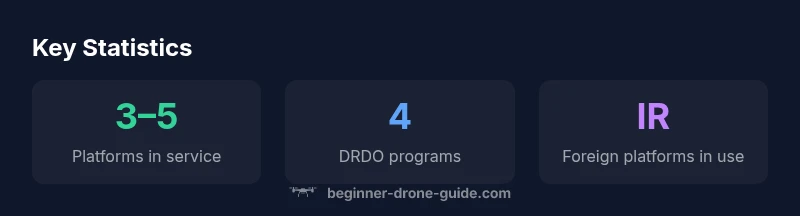
India’s domestic UAV efforts center on the DRDO-developed Rustom family and related demonstrators like TAPAS. Rustom-1 and Rustom-2 have been key milestones in the country’s MALE (Medium Altitude Long Endurance) aspirations, with flight tests and limited trials informing official plans. TAPAS, a DRDO/NAL collaboration, represents a family of lightweight surveillance airframes designed to validate autonomous sensing, navigation, and data-link capabilities. While these domestic programs aim to deliver long-endurance ISR with reduced import reliance, most deployments are still in testing or incremental induction phases. The result is a growing domestic core capacity that complements foreign buys rather than replacing them outright, aligning with national resilience goals.
Foreign platforms in Indian service: Israel’s Heron and more
Public reporting confirms that Indian services have incorporated Israeli UAVs, notably the Heron family, for ISR tasks and persistent surveillance missions. These platforms fill early capability gaps while indigenous designs mature. Beyond Heron, occasional reports mention interest in other proven platforms for limited procurement or joint development. It’s important to note that procurement decisions in India often balance strategic partnerships, technology transfer potential, and offsets, resulting in a mixed fleet rather than a single-source approach. As of 2026, foreign platforms continue to play a meaningful, if evolving, role in Indian operations.
Operational roles across the services
The Army, Navy, and Air Force each rely on UAVs for distinct missions. The Army emphasizes border reconnaissance and terrain monitoring in high-altitude environments, while the Air Force prioritizes longer-range ISR and target-area surveillance. The Navy uses drones to complement shipborne sensors and maritime patrol operations. Across forces, drones support intelligence gathering, border security, disaster response, and maritime situational awareness. Inter-service coordination, secure data links, and interoperability standards remain ongoing priorities to maximize the value of both indigenous and imported systems.
Indigenization and Make in India in drones
India’s drone-indigenization push centers on DRDO labs collaborating with private industry and academia to accelerate local manufacturing, maintenance, and software ecosystems. Policies encouraging offset commitments, local assembly, and domestic supplies aim to reduce import dependence while expanding job creation and technical capability. The Make in India framework influences procurement choices by prioritizing indigenous content where feasible. For enthusiasts and researchers, this environment means more opportunities to study, test, and participate in domestic drone development, with a clearer path to contributing to national capabilities in the coming years.
Regulatory landscape and procurement considerations
Civil and military drone activities operate under evolving Indian rules. Key regulatory touchpoints include airspace management, licensing, and safety requirements that vary by drone class and mission profile. The DGCA governs civil operations, while defense procurement follows ministerial and DRDO channels, with technology transfers and offset obligations shaping collaborations with foreign vendors. As procurement cycles mature, expect tighter standardization of interfaces, data security requirements, and certification regimes that favor safer and more interoperable drone fleets for both security and civilian uses.
Practical takeaways for enthusiasts and researchers
For researchers and enthusiasts, India’s drone ecosystem offers a case study in balancing indigenous development with strategic partnerships. Track DRDO announcements, university-led projects, and private-sector pilots entering programs to understand the country’s evolving capabilities. Pay attention to regulatory updates, which often signal when new airspace approvals or safety standards become available for advanced drones. Finally, while official inventories may not be fully public, the underlying trend is toward greater domestic capability coupled with selective foreign collaborations to maintain operational readiness.
Overview of drone types used by India (as of 2026)
| Model/Origin | Role/Function | Status/Notes |
|---|---|---|
| Rustom-1 (DRDO) | MALE ISR development | Prototype/in testing |
| Rustom-2 (DRDO) | MALE UAV | Testing and limited deployment |
| Heron family (Israel) | ISR/Surveillance | In service with Indian military |
| MQ-9 Reaper (United States) | ISR/strike potential | Under consideration/Procurement discussions |
| TAPAS (DRDO/NAL) | Lightweight surveillance | Prototype/development |
Frequently Asked Questions
What are the main classes of drones used by India?
India deploys MALE and tactical UAVs for ISR and surveillance. Domestically, DRDO’s Rustom family and TAPAS prototypes lead the way, while Israeli platforms like the Heron complement gaps in capability.
India uses MALE and tactical UAVs with a mix of domestically developed and imported platforms for ISR and surveillance.
Are most drones used by India domestically produced?
India has a growing domestic UAV program with DRDO and collaborators, but foreign platforms remain part of the fleet to address current capability gaps and accelerate deployment.
There’s progress on indigenization, but foreign drones are still important for immediate capabilities.
Which services operate these drones?
The Indian Army, Navy, and Air Force all operate drones for ISR, border monitoring, and maritime surveillance, with different emphasis per service.
All three services use drones for surveillance and security roles.
What is India's regulatory stance on drone use?
Civil drones fall under DGCA rules with licensing and airspace permissions. Defense procurement follows state channels, and technology transfer considerations shape international partnerships.
Regulations are evolving; civilian use requires approvals, while defense decisions consider technology partnerships.
What is the future trend for India's drone fleet?
Indigenization is expected to grow, with more DRDO-led programs and public–private partnerships, coupled with selective foreign collaboration to maintain ISR capacity.
Expect more homegrown drones and smarter partnerships in the coming years.
“India's drone approach is a practical balance of indigenous development and strategic partnerships, aiming for both autonomy and assured ISR coverage.”
Quick Summary
- Actively monitor DRDO programs for indigenous UAV progress
- Expect a mixed fleet rather than a single-source solution
- Foreign platforms provide immediate capability while domestic designs mature
- Regulatory changes will influence future acquisition and use