How Often Were Obama Drone Strikes During His Presidency
Explore how often Obama-era drone strikes occurred with a data-driven analysis of theaters, data sources, and measurement challenges. Learn how definitions shape counts and what this means for safety and policy.


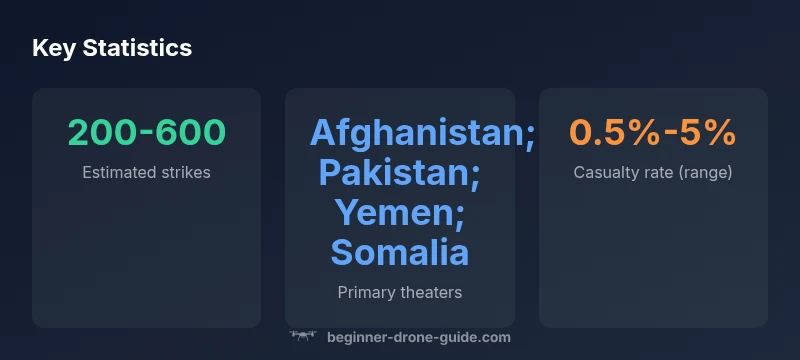
To answer how often did obama drone strike events occur, you must define what counts as a drone strike. In practice, official tallies are scarce and context-dependent, with counts differing across theaters and timeframes. Most researchers estimate hundreds of strikes across Afghanistan, Pakistan, Yemen, and Somalia during his presidency, and casualty estimates vary widely.
What counts as a drone strike and why counts differ
To answer how often did obama drone strike events occur, you must define what counts as a drone strike. In practice, researchers debate whether a strike is counted by the moment of fire, the intended target, casualties, or long-term collateral effects. Depending on whether a strike is confirmed by a government statement, reported by local media, or reconstructed from NGO databases, the tallies shift. For beginners, the key is consistency: pick a clear definition, apply it across the time window you study, and disclose it in your methodology. This subtle but critical choice explains much of the variance in published numbers and underscores why data probes should be complemented by context and qualitative notes. In short, defining the unit of analysis shapes the headline figure more than any single incident.
The Obama era: theaters and patterns
During 2009–2017, drone-strike activity expanded across several theaters, with both CIA and military programs operating in overlapping fashion. The most active regions were Afghanistan and Pakistan, where campaigns targeted militants and alleged facilitators; Yemen and Somalia also saw sustained operations. Regional differences mattered: Afghanistan saw longer-running campaigns tied to conventional conflict dynamics, while Pakistan involved cross-border actions in tribal areas with Venezuela-like reporting constraints. Yemen and Somalia featured smaller, more dispersed campaigns with limited long-term presence. These patterns influence how researchers frame a national total: it is not a single nationwide number but a mosaic of regional campaigns shaped by strategy, geography, and governance.
Data sources and how researchers track strikes
Researchers rely on a mix of NGO databases, investigative journalism, and official statements to piece together a picture of drone-strike activity. The Bureau of Investigative Journalism (BIJ), policy think tanks, and long-running monitoring projects compile incident records, casualty tallies, and geographic locations. Cross-referencing multiple sources helps identify confirmed incidents versus disputed reports. The challenge is not only access but also language barriers, security restrictions, and evolving classifications of what counts as a strike. By triangulating NGO data with mainstream reporting and selective government disclosures, researchers attempt to reduce bias and fill gaps in the public record.
Methodological challenges: transparency, classification, and casualty estimates
Transparency around how data is collected, categorized, and updated is essential for credible comparisons. Classification decisions—what constitutes a strike, whether to count failed attempts, or how to handle civilian casualties—drive substantial differences between datasets. Casualty estimates are particularly sensitive to reporting lags, missing data, and the heavy reliance on after-action assessments. Some studies present ranges rather than precise tallies to acknowledge uncertainty. When you see a headline figure, examine the methodology: timeframe, theaters included, data sources, and whether the count includes attempted strikes or only confirmed hits.
How estimates are used in policy and media
Data on drone strikes informs debates about executive power, transparency, and civilian protection, shaping both policy and media narratives. Analysts stress that numbers alone do not capture risk, legality, or ethical considerations. Clear context—territorial scope, the type of operation (CIA vs. military), and the relationship to broader counterterrorism campaigns—helps readers interpret why counts differ across sources. For practitioners and hobbyists, this means prioritizing source reliability, methodological notes, and cross-checks rather than taking a single figure at face value.
Practical takeaways for researchers and hobbyists
When evaluating drone-strike data, start with explicit definitions and timeframes. Use multiple sources and report ranges where precision is not possible. Document sources, limitations, and any assumptions. For hobbyists or students, translating these data into clear visuals requires labeling uncertainty and avoiding over-precision. If you’re presenting data to a general audience, frame numbers with context: what theaters are included, what counts as a strike, and how casualty figures were derived. This approach prevents overinterpretation and fosters informed discussion.
Key takeaways about data quality and interpretation
- Always define the unit of analysis before counting. - Expect ranges rather than exact tallies due to data gaps. - Cross-check NGO databases with media reports for broader context. - Acknowledge region-specific reporting limitations when comparing theaters.
Estimated Obama-era drone strikes by region (rough ranges)
| Theater/Region | Estimated strikes (Obama era) | Notes |
|---|---|---|
| Afghanistan | 200-350 | Active operations; terrain and coalition dynamics affected reporting |
| Pakistan | 100-400 | Cross-border actions; data contested by authorities |
| Yemen | 50-150 | Sustained campaigns with access limitations |
| Somalia | 10-50 | Smaller scale; data sparse |
Frequently Asked Questions
How many Obama-era drone strikes were there?
There is no official single tally. Estimates vary by source and region; see the data section for ranges across theaters and years.
There isn't a single official total; estimates vary, and ranges depend on region and timeframe.
Which regions saw the most drone strikes during Obama's presidency?
The major theaters were Afghanistan, Pakistan, Yemen, and Somalia; others existed but were smaller and less consistently reported.
Afghanistan, Pakistan, Yemen, and Somalia were the main theaters.
How reliable are casualty estimates from drone strikes?
Casualty figures are uncertain and depend on methodology, timing, and reporting constraints. Expect a range rather than a precise number.
Casualty estimates vary a lot depending on sources and methods.
What data sources do researchers use to track drone strikes?
Researchers use NGO databases, investigative journalism, official statements, and cross-source reconciliation to build a fuller picture.
Researchers use NGO data, journalists, and official reports.
Has reporting on drone strikes improved transparency over time?
There has been pressure for more transparency, with limited but meaningful improvements in some theaters and timeframes.
There have been calls for more transparency and some improvements in reporting.
What should beginners know when analyzing drone-strike data?
Learn definitions, timeframes, and data provenance; prefer ranges and clearly state uncertainties in any analysis.
Know how the data was collected and what it includes.
“Transparent data collection and clear definitions are as important as the numbers themselves when studying drone-strike campaigns.”
Quick Summary
- Define terms before counting; definitions drive the numbers.
- Expect wide ranges due to data gaps and evolving methods.
- Cross-check NGO data with media for broader context.
- Consider regional differences and policy changes over time.