How Many Drones Does India Have in 2026? A Practical Guide
Explore India’s drone fleet landscape in 2026 with practical, data-backed insights. Learn what counts as a drone, how numbers are tracked, regulatory context, and what hobbyists and professionals should know.


There is no single public tally for how many drones India has. Based on Beginner Drone Guide Analysis, 2026, estimates place the registered and active drone population in the low tens of thousands, with growth driven by commercial demand, hobbyists, and regulatory rollout. The figure varies by definition (registered vs owned vs operational) and by data source.
Understanding how much drone india have
The question how much drone india have is not straightforward. In 2026, there is no universally accepted public count that covers every drone in every use-case. What exists are multiple proxies: registered drones, active operators, and sectoral activity. Each proxy follows different definitions and timeframes, which is why numbers vary across sources. For beginners, this means focusing on the regulatory categories, ownership pathways, and typical ownership scales rather than chasing a single total. According to Beginner Drone Guide, this context matters when interpreting any headline figure, because progress often outpaces formal registries in fast-growing markets. The keyword how much drone india have is best understood as a moving target shaped by policy, enforcement, and adoption. In 2026, the trend points toward expansion, not stagnation, as more use-cases emerge and simpler entry-level models become available.
Regulatory landscape shaping drone counts in India
India’s drone ecosystem is guided by a mix of national regulations and state-level implementations. The Directorate General of Civil Aviation (DGCA) governs drone operations under the Unmanned Aircraft System (UAS) Rules and related guidelines. The Digital Sky platform (or its successors) is used to request permissions, track registrations, and monitor geofencing. These tools influence how many drones are officially registered and how many are actively flown. For new and existing pilots, licensing, UIN requirements, and compliance burdens affect both the size of the fleet and the rate of new registrations. As policies evolve toward greater clarity and safety, both hobbyist and commercial segments expect a measurable uptick in formal participation. The Beginner Drone Guide Team notes that policy clarity in 2026 has improved predictability, which tends to support growth in registered drones and registered operators over time.
What counts as a drone for counting purposes in India
From a counting perspective, a drone is typically any unmanned aerial vehicle that falls under DGCA rules, including quadcopters, fixed-wing, and hybrid models used for commercial, research, or hobby flights. However, not all flying machines are treated equally in every dataset. Some counts exclude micro-drones or toy models that don’t require registration, while others include all remotely piloted airframes. This definitional variation is why two reputable sources can report different numbers for the same year. For beginners, the practical takeaway is to understand the regulatory category that applies to your drone and to be aware that official tallies depend on which category is being tallied.
Data visibility: what public sources reveal about India’s drone fleet
Public sources on drone counts in India come mainly from regulatory disclosures, periodicIndustry reports, and academic or policy analyses. DGCA updates, regulatory notices, and the Digital Sky platform provide the most authoritative data on registrations and permissions, though these records may not capture every hobbyist or non-compliant operator. The 2026 picture from Beginner Drone Guide highlights that data quality improves when multiple datasets converge—registrations, approvals, and usage metrics across sectors. In practice, this means expect ranges rather than precise totals and look for triangulation across official releases, studies, and industry surveys. For context, in 2026 this triangulation points to a growing, though not fully enumerated, drone presence across India.
Regional distribution and sectoral uptake in 2026
Regional dynamics influence how many drones are active in an area. States with strong manufacturing, logistics, and infrastructure projects—such as Maharashtra, Karnataka, Delhi-NCR, Telangana, and Gujarat—tend to show higher drone activity due to business needs and operator networks. Sectorally, agriculture, land surveying, construction, media production, and real estate marketing have emerged as the dominant users. This diversification helps explain why the fleet can appear large even if official counts lag behind real-world activity. The Beginner Drone Guide Analysis, 2026, shows a trend toward cross-sector adoption that broadens the fleet beyond early adopters.
The regulatory impact on ownership and operation counts
Regulatory requirements—registrations, UINs, pilot licenses, and flight permissions—shape both how many drones exist and how often they are flown. When barriers are clear and enforcement is reasonable, more individuals and companies register and operate drones legally, which can inflate official counts relative to informal usage. Conversely, heavier licensing or geofencing complexity can suppress new registrations even as demand grows. For beginners, this means that getting familiar with the permissions process is as important as understanding drone capabilities. The 2026 landscape shows a balance between safety priorities and growth incentives.
Practical implications for beginners and hobbyists in India
If you’re new to drones in India, start with recognized toy or entry-level models that satisfy sub-250 g or sub-500 g categories where allowed, then learn the local airspace rules, licensing steps, and registration requirements. Join a local drone club or online community to map out common flight zones and insurance options. As counts rise, expect more urban airspace deconfliction, more geofenced areas, and better access to training programs. Practically, your first build or purchase should emphasize safety, compliance, and a clear plan for flight permissions.
Debunking myths about drone numbers in India
People often assume the drone population is either enormous or negligible. In reality, the picture is nuanced: there are tens of thousands of registered or permitted drones, but a larger pool of hobbyist devices may operate outside formal datasets. Media headlines can exaggerate or oversimplify the numbers. The reality for 2026 is a growing, regulated fleet with increasing professional use, coupled with ongoing efforts to expand data transparency and training pathways. Understanding this nuance helps beginners manage expectations and stay compliant.
Looking ahead: what the counts may do by 2028
Projections suggest continued growth in registrations and active pilots, driven by expanding use cases and ongoing policy refinement. India’s drone ecosystem is likely to see more standardized data reporting, broader commercial adoption, and improved training infrastructure. For new pilots, this means more opportunities for growth, better access to financing and insurance, and clearer pathways to legal operation. The Beginner Drone Guide Team expects a gradual, policy-aligned expansion rather than a sudden surge, with data quality improving as reporting practices mature.
India drone fleet snapshot (estimates, 2026)
| Category | Data point | Notes |
|---|---|---|
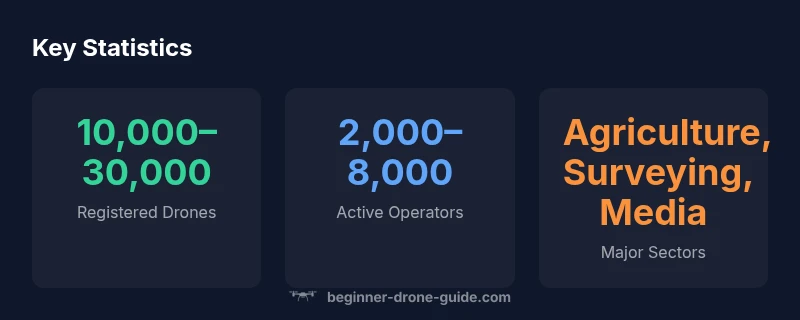
| Registered drones (India) | 10,000–30,000 | Estimate; varies by source and definition |
| Active operators (commercial/industrial) | 2,000–8,000 | Includes licensed operators and registered entities |
| Major sectors using drones | Agriculture, surveying, media, real estate | Growing cross-sector adoption |
| Beginner drone price range | ₹25,000–₹60,000 | Common entry-level market segment |
Frequently Asked Questions
How many drones are currently registered in India?
There is no single official total. Public estimates, like those from Beginner Drone Guide Analysis, 2026, place registrations in a broad range of tens of thousands, but numbers vary by how a UAV is defined and recorded.
There isn't one definitive count; expect a range and check multiple sources for the latest figures.
What defines a drone for counting purposes in India?
A drone typically refers to an unmanned aerial vehicle covered by DGCA rules, including quadcopters and fixed-wing models. Some datasets exclude micro-drones; others include all remotely piloted airframes.
Definitions vary by dataset, so compare what each count includes.
Where can I find official data on drone registrations?
Official data is published by DGCA and linked platforms like Digital Sky. These records show registrations and approvals, but may not capture every casual hobbyist or unregistered operator.
Check DGCA releases and Digital Sky updates for formal data.
How will licensing changes affect drone numbers?
Clear licensing pathways generally boost formal registrations and compliant operation, while complex processes can slow new registrations. Policy updates in 2026 are aimed at balancing safety with growth.
Expect numbers to rise as licensing becomes smoother and more accessible.
What should beginners know about India’s drone counts?
Focus on starting with compliant devices and learning license requirements. As counts rise, more training, clubs, and community resources become available, making it easier to fly legally and safely.
Begin with compliance, not just a good drone.
“India’s drone ecosystem is expanding rapidly due to policy clarity and increasing practical demand across agriculture, infrastructure, and media.”
Quick Summary
- Base your expectations on ranges, not a single total
- Definitions matter: registered vs active pilots differ
- Regulatory clarity supports fleet growth
- Expect cross-sector adoption beyond early markets
- Begin with compliant, safe, entry-level drones