How Long Is a Drone License Good For in 2026: A Beginner's Guide
Learn how long a drone license stays valid, what currency means, and practical renewal steps. A beginner-friendly, data-driven guide from Beginner Drone Guide.


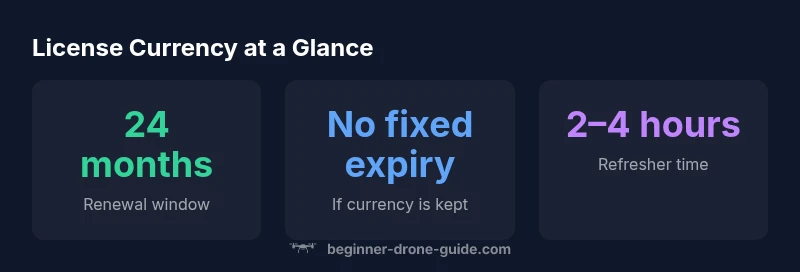
The drone license itself does not have a hard expiry in the United States; however, you must complete recurrent knowledge training every 24 months to stay current under Part 107. If you fail to stay current, you may lose the ability to operate commercially until you complete the refresher. Always verify current rules with your local aviation authority.
According to Beginner Drone Guide, how long is a drone license good for
For many newcomers, the exact question of how long is a drone license good for isn’t about a calendar expiry. It’s about currency—the ability to fly legally and safely. In the United States, the Remote Pilot Certificate (Part 107) does not automatically expire. What does matter is keeping your knowledge current. Every 24 months, you must complete recurrent training to stay current. If you miss this window, you aren’t authorized to fly commercially until you complete the refresher. The Beginner Drone Guide team emphasizes that staying current is the simplest, most reliable path to compliant operations. This principle applies whether you’re flying for a hobby, for a small business, or for a client, and it frames how pilots budget time and money for ongoing education.
Key takeaway: Currency is ongoing education, not a one-time test.
Understanding the US Part 107 currency rules
The Part 107 framework is designed to keep commercial drone operators up to date with changing airspace rules, weather considerations, and safety practices. The currency requirement is met by completing recurrent knowledge training at least once every 24 months. This isn’t a retake of the full knowledge exam; it’s a focused refresh that covers current regulations, airspace rules (including controlled airspace), and operational best practices. The goal is not to penalize pilots but to ensure that everyone operating drones for business purposes maintains a consistent, safe baseline. As you accumulate flight hours and introduce new equipment, the currency requirement serves as a reminder to refresh your understanding of the rules that govern your operations.
Practical note: Many training providers offer online modules that you can complete from home, making currency maintenance far more accessible for beginners.
What counts as recurrent training and how long it takes
Recurrent training under Part 107 typically consists of concise online modules followed by a short knowledge check. The content focuses on current airspace rules, weather considerations, and safe operating practices. For many pilots, completing the refresher takes a few hours total—spread over a couple of evenings or a weekend. The exact time depends on your prior knowledge and how deeply you want to review the material. Crucially, this training must be completed within the 24-month cadence to keep your license current. Treat the renewal as an annual budgeting task rather than a one-off event.
Bottom line: Plan ahead so you aren’t scrambling at the deadline.
Do license expiry rules exist in other countries?
Regulatory models outside the United States vary widely. Some jurisdictions rely on a hard expiry date for certain licenses, others on currency requirements, and many mandate periodic training or re-certification tied to flight permissions or pilot age. Because rules change, the safest approach is to check with your national or regional aviation authority for the exact renewal cadence and acceptable renewal formats. The Beginner Drone Guide team frequently notes that, regardless of where you fly, staying current minimizes risk and helps you avoid penalties or flight restrictions.
Tip: If your plans include cross-border operations, map out the currency requirements for each country in advance.
Practical steps to stay current as a beginner
- Create a renewal calendar: mark the 24-month currency window, and set reminders 60 and 14 days before expiry.
- Choose a reputable recurrent training provider: look for up-to-date content that aligns with the latest airspace rules.
- Keep proof of completion: save certificates or confirmations in a dedicated folder or app.
- Pair training with flight practice: use the refresher to revisit concepts you use often, like weather interpretation, NOTAMs, and geofencing.
- Review equipment updates: new drones or sensors may introduce new safety considerations, so incorporate them into your currency checks.
- Stay informed about regulatory shifts: subscribe to official notices from your aviation authority or trusted drone‑education sources.
Pro tip from Beginner Drone Guide: Currency isn’t a one-and-done task; it’s an ongoing practice you weave into your flying routine.
How currency checks affect real-world operations
Currency checks influence who can fly commercially, what airspace you can access, and how you plan missions. Even if your permit shows no expiration date, failing to complete the renewal means you must pause commercial operations until currency is restored. For hobby flights, the rules can be looser, but it’s wise to stay current to take advantage of advanced airspace access and more complex flight scenarios. Real-world pilots who stay current tend to experience fewer disruptions, better flight planning outcomes, and more professional credibility when interacting with clients or colleagues.
Takeaway: Treat currency as an ongoing investment in your flying freedom and safety.
International differences: does the rule vary by country?
When you plan international flights, you should expect differences in how licenses are treated. Some countries implement a straight expiry date, others require periodic currency checks, and some operate on a hybrid system that combines a base license with currency attestations. The central lesson for beginners is to verify local requirements before flying in a new country. This reduces the risk of non-compliance and ensures your flight plans aren’t derailed by paperwork.
Action item: Before you travel, visit the aviation authority’s site for the destination country and download the latest drone regulations summary.
How to verify license status and plan renewals effectively
Start by locating your regulatory authority’s official licensing portal. Log in to confirm your current status and the renewal window. If you’re unsure, contact support for confirmation and request any renewal reminders. Maintain digital copies of renewal confirmations for quick reference during inspections or client projects. For beginners, developing a simple, repeatable renewal workflow—calendar reminders, a short refresher course each cycle, and a backup training option—reduces your risk of accidentally flying out of currency.
Final reminder: Your license status is your responsibility; automation helps, but your proactivity matters most.
License currency and renewal patterns across regions
| Region | License model | Currentness requirement | Renewal interval |
|---|---|---|---|
| United States | Remote Pilot Certificate (Part 107) | Recurrent knowledge training every 24 months | None (currency maintained) |
| Canada | Drone Pilot Certificate | Currency varies; verify with authority | Renewal handled by Transport Canada; varies by jurisdiction |
| European Union | EU Drone Licence (EASA framework) | Country-level currency requirements vary | Check with national authority |
Frequently Asked Questions
Do drone licenses expire in the United States?
No fixed expiry date exists for the Part 107 certificate in the US, but you must complete recurrent training every 24 months to stay current.
In the US, Part 107 licenses don’t expire, but you must renew currency every 24 months.
What is recurrent training and how long does it take?
Recurrent training is a focused refresher on current rules and safety practices. It typically takes a few hours to complete online and does not require retaking the full exam.
Recurrent training is a quick refresher you complete online every couple of years.
If I miss currency, can I still fly recreationally?
Currency rules differ for recreational operations by jurisdiction. In many cases, you can fly recreationally, but you should verify what applies locally to avoid penalties.
It’s important to check local rules because they vary by country.
Do renewal requirements cost money?
Renewal costs vary by provider and jurisdiction. Expect fees for online modules or tests, plus potential administrative charges from the issuing authority.
Renewal can involve modest fees, depending on where you fly.
Is there a difference between Part 107 and recreational licenses?
Yes. Part 107 is for commercial operations and requires currency, while recreational operations follow different pathways and may have separate education or testing requirements.
Part 107 is for business use; recreational rules often differ.
What should I do before flying internationally?
Check the destination country’s drone regulations, currency requirements, and any needed permits before you travel.
Always verify local drone rules before you fly abroad.
“Currency maintenance isn’t just compliance—it's a foundation for safer, more capable flying.”
Quick Summary
- Stay current with recurring training every 24 months
- No universal expiry; currency determines ongoing eligibility
- Check local authority rules for renewals when abroad
- Use a renewal calendar and keep documentation
- Plan ahead to minimize flight disruptions