UK Drone Licensing: Do You Need a License to Fly in the UK?
A practical, beginner-friendly guide explaining UK drone licensing requirements, thresholds, and how to fly legally. do you need a license to fly a drone uk? This article breaks down Open, Specific, and registration rules for new pilots.


Do you need a license to fly a drone uk? Not always. In the UK, licensing depends on weight, use, and the risk level of the operation. For hobby flights that stay within the Open category, you typically register the drone and obtain a Flyer ID; commercial or higher-risk flights fall under the Specific category and require additional permissions. Always check the CAA rules for your exact situation.
What licensing means in the UK: a clear framing
According to Beginner Drone Guide, licensing in the UK is not a binary yes/no, but a framework based on weight, use, and risk. The country uses a tiered system that separates recreational, commercial, and education use into categories. The most important takeaway for new pilots is that you must understand three things before you fly: (1) your drone's weight class, (2) where you plan to fly (open airspace or controlled airspace), and (3) the type of operation (recreational, professional, or enterprise). Within that framework, the UK’s Civil Aviation Authority (CAA) requires some form of identity verification and, for many open-air or commercial flights, additional permissions. This section sets the stage for practical steps and plain-language guidance you can apply this week to stay compliant while learning to fly with confidence.
Weight thresholds and registration
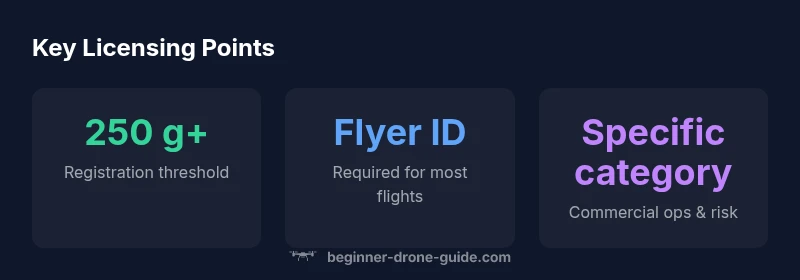
The UK regulates drones by weight and intended use. A common starting point is the 250 g threshold: if your drone weighs 250 g or more, you’ll need to register and usually obtain a Flyer ID before flying outdoors. Registration is tied to the drone operator and is part of the broader education scheme that helps pilots understand airspace safety. Even if your drone sits just under the threshold, consider the flight context; higher-risk environments and certain operations may trigger additional requirements. In all cases, keeping your registration and ID current is essential for lawful operation and easy proof of compliance.
Open vs Specific vs Certified: what they mean for you
The UK splits drone operations into three broad categories. The Open category covers low-risk flying with certain weight and distance limits. The Specific category applies to higher-risk flights or operations that don’t fit neatly into Open. In this tier, operators often need authorization or a risk assessment approved by the CAA, and pilots may be required to demonstrate competency through additional training. The Certified category is rare for hobbyists and targets large, complex, or critical-airspace operations with stringent safety checks. For beginners, understanding which bucket your intended flight falls into is the difference between a quick start and a lengthy approval process.
Registration, IDs and what you actually need to fly legally
To fly legally in many common situations, you’ll need to register as an operator and obtain a Flyer ID. The Flyer ID demonstrates you’ve learned essential safety rules, while the Operator ID is tied to the drone itself, ensuring accountability for its use in airspace. Always carry proof of registration and ID when flying, especially in urban or controlled airspace. If your flight is for business or study, plan for additional permissions or training aligned with the Specific category requirements. This is where beginners often run into questions, so double-check the latest guidance before taking off.
How to obtain permissions for commercial or high-risk flights
If your intended operation falls into the Specific category or requires a higher level of risk management, you’ll need formal permissions. Steps typically involve outlining your operational plan, conducting a risk assessment, and obtaining approval from the relevant authority (CAA in the UK). You may also need to demonstrate competency through recognized courses or certifications. Start by identifying your drone’s weight and your flight scenario, then map your path through the Open-to-Specific workflow. Planning ahead reduces delays and increases safety for everyone in the air.
Practical steps for beginners: a simple plan
Begin with a clear action plan to build confidence safely. 1) Determine your drone’s weight and choose the appropriate category. 2) Register and obtain your Flyer ID; 3) Review airspace maps and local restrictions; 4) Practice in a safe, open area far from people and property; 5) If you intend commercial work, outline a Specific-category application and start a training pathway. By taking these steps, beginners can fly smarter and safer, and steadily grow to more complex operations.
Real-world scenarios and licensing implications
Consider a few common situations beginners face. Aerial videography for a small property is often Open category—with registration and ID enough if you stay in permitted airspace. A real estate shoot next to a busy road may trigger stricter rules and necessitate coordination with air traffic or local authorities. A commercial mapping project at a construction site would almost certainly fall under Specific, requiring risk assessments and potentially operator approvals. Understanding how your activity translates to the category framework is essential to avoid delays or penalties.
Common myths and misconceptions about UK drone licensing
Many beginners think a general 'drone license' exists for all situations. In reality, the system focuses on safety risk and category-specific permissions rather than a single universal license. Also, some assume weight alone dictates requirements; while weight matters, the flight context—such as urban density, near people, or controlled airspace—can change what you need. Never rely on rumor; consult official sources for up-to-date guidance and plan your flights accordingly.
Staying compliant: ongoing duties and best practices
Licensing is not a one-off task. Keep your operator and Flyer IDs current, renew training as required, and stay informed about airspace changes, NOTAM updates, and local regulations. Record flight details, maintain equipment checks, and rehearse emergency procedures. For ongoing safety, consistently review your operations against official airspace maps and the latest CAA guidance. Regular refreshers protect you, others, and your ability to fly in the UK.
Licensing categories overview
| Category | Who it Applies To | Permissions/Requirements |
|---|---|---|
| Open | Most hobbyist or educational flights | Registration + Flyer ID; basic knowledge checks; follow safety rules |
| Specific | Commercial or higher-risk operations | Operational authorization; risk assessment; case-by-case approval |
| Certified | High-risk, large-scale flights | Full certification for operator and remote pilot; stringent safety measures |
Frequently Asked Questions
Do you need a license to fly a drone under 250g in the UK?
Drones under 250g can be exempt from some registration requirements in certain hobby contexts, but you should still follow general safety rules and local airspace restrictions. Always verify the latest guidance for your specific situation.
Drones under 250 grams may not require full registration, but you still must follow safety rules and airspace rules. Check current guidance before flying.
Is there a difference between a license and registration?
Yes. In the UK, you typically register your drone and obtain a Flyer ID; a license (in a sense) relates to the Specific category permissions or formal certifications for commercial operations.
Registration and a Flyer ID cover most hobby flights; more complex operations may need Specific-category permissions.
How do I register for the UK drone rules?
Register with the UK drone rules system, obtain an Operator ID for your drone, and secure a Flyer ID for yourself. These identifiers demonstrate compliance with airspace safety requirements.
Create an account in the official drone rules system, then get an Operator ID and a Flyer ID.
What is the A2 CofC and do I need it?
The A2 Certificate of Competency relates to specific open-category training. Whether you need it depends on your drone type and planned operations within the Open category. Check current requirements for your exact drone and flight plans.
The A2 CofC is a training credential for some open-category flights; it’s not always required.
What happens if I fly in a restricted area without permission?
Flying in restricted airspace or near people without proper authorization can lead to penalties, flight bans, or police involvement. Always verify airspace restrictions and obtain necessary permissions before flight.
Avoid restricted airspace. If unsure, don’t fly and consult official guides.
“Licensing in the UK is a structured risk framework rather than a single, universal license; beginners should focus on registration, IDs, and category-based permissions.”
Quick Summary
- Know your drone's weight and category before flying
- Register and obtain a Flyer ID for most open-category flights
- Commercial work typically requires Specific-category permissions
- Check official sources for the latest rules before each flight
- Plan ahead with airspace maps and risk assessments