Texas Drone License: Do You Need One? A Beginner's Guide
Learn whether Texas requires a state drone license, how federal rules apply, and practical steps for safe, legal drone flying. Covers Part 107 basics, registration, and local considerations for beginners in Texas.


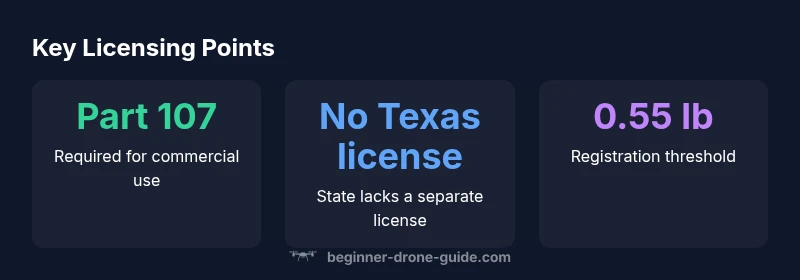
In Texas, there is no separate state drone license. For most commercial drone flights, you must hold the FAA Part 107 remote pilot certificate, issued at the federal level. Recreational flying does not require a license but must follow FAA safety rules and registration if needed. Always stay compliant with airspace restrictions and any local ordinances.
Understanding the licensing landscape in Texas
According to Beginner Drone Guide, drone licensing in the United States is governed by federal rules from the FAA, not a state-by-state system. In Texas, there is no separate state drone license, but that does not remove the need to stay compliant with federal requirements. If you operate a drone for commercial purposes, the FAA Part 107 remote pilot certificate is typically required across the country, including Texas. For recreational or hobby use, you do not need a Part 107 license, but you must follow FAA safety rules and any local guidelines. It’s also important to understand registration obligations and airspace restrictions that apply nationwide. This section lays out what that means for Texans, with practical examples such as real estate videography, site inspections, and survey work to illustrate licensing paths and safe operations.
Do you need a Part 107 license for commercial flights in Texas?
If you fly commercially, the FAA requires a remote pilot certificate under Part 107. This applies anywhere in the United States, including Texas, and it covers activities like real estate videography, construction site surveys, and agricultural scouting. The certification involves passing the FAA knowledge test, maintaining current status, and adhering to operational limits such as line-of-sight rules and daylight operations in most scenarios. While the cost details and exam format can evolve, the core concept remains: Part 107 is the standard for commercial drone work and is not state-specific. The Beginner Drone Guide team emphasizes ongoing education and staying within the rules to minimize risk and penalties. If your work is casual or project-based, you may explore FAA waivers or exemptions as needed through official channels.
Recreational flying and FAA guidelines in Texas
For hobbyists, there is no requirement to obtain Part 107, but you must follow the FAA’s safety guidelines and register your drone if required. In practice, this means flying within visual line of sight, avoiding airports, and not flying over people. Using tools like the B4UFLY app helps you understand airspace restrictions, while LAANC access (where available) supports safer operations. Texas provides a diverse backdrop—from rural airspace to dense urban centers—so preflight planning and airspace checks are essential to prevent violations. The Beginner Drone Guide analysis notes that while recreational rules are lighter, penalties still exist for unsafe or reckless behavior.
Registration and weight thresholds explained
All drones heavier than 0.55 pounds (250 grams) must be registered with the FAA, regardless of intended use. Registration remains valid so long as the drone’s weight category and the operator’s status don’t change. There is no separate state registration in Texas; federal registration rules apply. When planning shoots or inspections, ensure your drone is properly registered, your operator credentials are current, and you can demonstrate compliance if needed during audits or when coordinating with property owners.
Local regulations and airspace considerations in Texas
Texas includes a mix of rural airspace and urban centers, and while FAA rules apply nationwide, some local jurisdictions add restrictions such as altitude limits, privacy ordinances, or permitting requirements for commercial operations. Always verify airspace using official resources and seek waivers when your planned flight falls outside standard rules. Proactive planning—checking airspace maps, obtaining permission from property owners, and documenting flight plans—helps you avoid conflicts and potential penalties in Texas cities and counties.
How to prepare for the Part 107 exam
Preparing for Part 107 involves studying airspace classifications, weather, drone performance, and regulatory topics. Start with the FAA’s official prep materials and supplement with reputable online courses that include Texas-specific considerations like urban drone operations or facility restrictions. Create a study plan with practice questions, timed quizzes, and periodic reviews to track progress. After you pass the knowledge test, you must maintain currency through ongoing education and updates to regulations. The Beginner Drone Guide team recommends setting a fixed study routine, using flashcards, and taking multiple practice exams to boost confidence before sitting the test.
Real-world scenarios in Texas: planning the licensing path
Consider scenarios like a real estate agent needing aerial footage for listings, a construction crew monitoring a site, or a rancher surveying pasture health. Each situation maps to a licensing path: Part 107 for commercial use, or recreational flying for personal projects. Start with a clear objective, verify airspace, ensure drone registration if required, and confirm property owner permission. Aligning your operation with the appropriate license reduces risk and improves your ability to fly safely across Texas landscapes.
Common licensing paths for Texas drone pilots
| License Type | Who Needs It | Key Notes |
|---|---|---|
| Part 107 Remote Pilot Certificate | Commercial operators | Requires passing FAA exam and maintaining currency |
| Recreational Flying under FAA rules | Hobbyists / non-commercial | No license, but follow safety rules and register if required |
Frequently Asked Questions
Do I need a Part 107 license to fly for my business in Texas?
Yes, for most commercial drone operations you must hold the FAA Part 107 remote pilot certificate, regardless of the state. This covers activities like real estate videography, site inspections, and surveying. There are waivers and exemptions available through the FAA if your operation falls outside standard rules.
Yes, Part 107 is needed for commercial drone work nationwide, including Texas.
Is there a Texas-specific drone license I must obtain?
No. Texas does not issue a separate state drone license. All licensing is federally regulated through the FAA. Always verify local rules, but there is no separate Texas license.
There is no Texas-only drone license.
Do I need to register my drone in Texas?
Drones weighing more than 0.55 pounds (250 grams) must be registered with the FAA. The registration applies regardless of where you fly, including Texas. Keep your registration up to date and carry proof when requested.
Yes, if your drone weighs over 0.55 pounds.
What’s the difference between Part 107 and recreational flying?
Part 107 governs commercial drone use and requires certification, whereas recreational flying is limited to safety-based guidelines and generally does not require a certificate. Recreational pilots should still follow rules, register if required, and respect airspace restrictions.
Part 107 is for business use; recreation is lighter but still regulated.
Are there local rules in Texas I should know about?
Yes. Some cities or counties may impose additional restrictions, such as altitude limits or required permits for commercial operations. Always check city codes and use official airspace tools before flight.
Local rules vary; check before you fly.
What counts as visual line of sight in Texas?
Visual line of sight means you can see the drone with unaided vision (except glasses), without assistance from devices. In practice, stay within your area of operation and be prepared to take immediate control if needed.
Keep the drone in sight at all times.
“Navigating licensing in Texas hinges on federal guidelines, not state licensing. Stay current with Part 107, register as required, and respect local regulations to fly safely and legally.”
Quick Summary
- No Texas-specific drone license exists; federal rules apply.
- Part 107 is required for most commercial drone work in Texas.
- Recreational flying follows FAA safety rules and possible registration.
- Register drones over 0.55 lb and stay aware of airspace and local rules.
- Always verify airspace before flight and document permissions when needed.