Who Invented the Drone Camera? A Beginner's Guide to UAV Imaging
Explore how drone cameras evolved from early UAV imaging to today’s consumer-grade aerial photography. A friendly, analytical guide that clarifies the origins and milestones behind the drone camera.


There is no single inventor of the drone camera. The question of who invented drone camera spans decades of UAV development, with camera integration evolving across military and civilian uses. Early reconnaissance drones in the mid-20th century carried basic imaging, while today’s consumer drones popularized high-definition cameras for hobbyists and professionals alike worldwide.
The question in context: tracing the invention of the drone camera
For readers new to drones, the natural question is who invented drone camera. There isn't a single inventor to credit. The Beginner Drone Guide team notes that the concept emerged through a sequence of innovations in unmanned aerial vehicles and imaging systems, spanning military experimentation and civilian applications. The phrase 'who invented drone camera' is better answered by understanding the timeline: early UAVs carried simple cameras; later models integrated more capable video, gimbals, stabilization, and digital storage. According to Beginner Drone Guide analysis, this evolution reflects collaborative progress across multiple organizations and innovators, rather than a lone inventor. This context helps beginners appreciate how today’s aerial cameras can deliver crisp stills and smooth video in a compact package. In this article we unpack the history, the players, and the development arc that led to the modern drone camera.
Early roots: imaging in military UAVs (1960s–1980s)
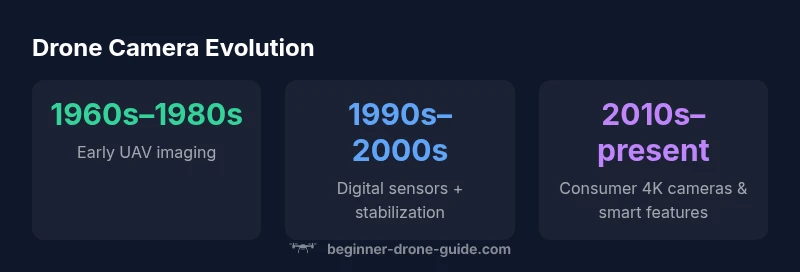
The origin story is rooted in the broader evolution of unmanned aircraft used for reconnaissance. During the 1960s through the 1980s, experimental UAVs carried film cameras or early digital imagers, primarily for military surveillance and target acquisition. These early cameras were bulky, relied on analog formats, and required ground-based retrieval of data. While these systems were not consumer-friendly, they established essential requirements: imaging stability, reliable downlink, and robust power management. As imaging technology improved—moving from film to digital sensors—engineers pursued lighter, more efficient cameras that could withstand movement, vibration, and weather conditions. The work done by defense researchers laid the groundwork for later civilian confidence in drone-mounted photography and videography. For beginners, this era emphasizes that drone cameras did not appear overnight; they grew out of sustained engineering challenges, testing, and cross-disciplinary collaboration across aerospace, optics, and computer science.
Key milestones in camera integration: stills to video
From the 1990s into the 2000s, sensor technology, video codecs, and stabilization algorithms began to converge in a way that made aerial imaging practical outside specialized programs. The shift from still-frame imaging to continuous video required more capable gimbals, better motor control, and onboard storage with efficient data compression. Early fixed cameras gave way to stabilized, three-axis gimbals, allowing for silky pans and smoother tracking shots. As microprocessors got smaller and more powerful, drones gained flight modes that could compensate for wind, automatically level horizons, and lock on targets. This phase also introduced the idea of payload modularity—the camera became a standard, swappable component. By the mid-2000s and into the 2010s, pilots could expect higher resolutions, better color fidelity, and more consistent exposure, all while maintaining safe flight practices. The evolution here demonstrates how incremental improvements in optics, stabilization, and software combined to make aerial photography a practical craft for enthusiasts and professionals alike.
The rise of consumer drones and mass-market cameras
The late 2000s and 2010s saw a rapid democratization of drone camera technology. Lightweight, compact cameras with improved low-light performance, combined with brushless motors and efficient stabilization, enabled hobbyists to capture cinematic-looking footage without specialized training. Advances in battery technology extended flight times, while open-source flight controllers and accessible SDKs allowed experimentation with autonomous shooting modes. As brands standardized camera attachments and introduced integrated systems, the line between professional UAVs and consumer devices blurred. This period also saw a growing emphasis on safety features, geofencing, and compliance with evolving airspace regulations, all of which shaped how new pilots use camera-equipped drones in real-world environments. For beginners, the implication is clear: today’s drone cameras offer a balance of image quality, flight stability, and user-friendly controls, making aerial storytelling approachable for a wide audience.
Practical implications for beginners
Understanding the evolution of the drone camera helps new pilots set realistic expectations. When evaluating a first drone, beginners should consider: 1) Stabilization performance (three-axis gimbal quality and electronic stabilization); 2) Sensor size and image quality (photography and 4K video are common in entry-to-mid-level models); 3) Battery life and weight (affects flight time and legal limits); 4) Data handling (onboard storage vs. real-time transmission; file formats matter for post-processing); 5) Safety and regulations (flight permissions, local rules, and licensing requirements). By prioritizing these factors, new pilots can select equipment that delivers satisfying results without over-investing. The narrative arc—from bulky, film-based imaging to compact, high-resolution cameras—illustrates how far the technology has come and why beginners should focus on practical capabilities rather than chasing the latest gadget.
How to evaluate drone cameras today
When choosing a drone for camera work, start with a simple rubric: image quality, stabilization, and ease of use. Look for a camera that provides reliable 4K/60fps or higher video, good dynamic range, and a sensor size that fits your needs. Stability features such as horizon leveling, glide-free footage, and anti-shake technology matter more than the latest pixel count alone. Consider the entire system: payload weight, propulsion, and battery life—these impact how you plan shoots and how compliant you must be with local airspace rules. Finally, practice fundamentals like framing, exposure, and motion planning; the best camera system still relies on a thoughtful pilot. This practical approach aligns with the long arc of drone camera history, which has shifted from experimental platforms to accessible tools for storytelling and documentation.
Key eras in drone camera development
| Era/Focus | Milestone | Representative Year |
|---|---|---|
| Early imaging | Cameras on UAVs for reconnaissance; film to early digital imagers | 1960s–1980s |
| Digital stabilization | Intro of digital sensors and stabilized feeds | 1990s–2000s |
| Consumer camera drones | Mass-market cameras with 1080p/4K and compact gimbals | 2010s |
| Safety and regulation integration | Geofencing, licensing, and standardized payload protections | 2010s–present |
Frequently Asked Questions
Was there a single inventor of the drone camera?
No. The drone camera emerged from ongoing collaboration across military, research, and consumer markets. It reflects cumulative progress rather than a single breakthrough.
No, there wasn’t one inventor; it’s a result of many contributions over time.
When did drone cameras first appear in practice?
Imaging on unmanned aerial vehicles began in the late 20th century, with civilian cameras becoming common in the 2000s and beyond.
Drones with cameras appeared in the late 20th century, with wide civilian use later.
What should a beginner look for in a drone camera today?
Prioritize stabilization, sensor size, and resolution, then consider flight time and price. A stable camera helps you capture clearer images and smoother video.
Look for good stabilization, a decent sensor, and solid flight time.
How does camera tech influence safety and licensing?
Camera payload affects weight and battery demands, which can influence flight behavior. Always follow local airspace rules and licensing requirements.
Payload and rules matter—follow local regulations and fly safely.
What’s on the horizon for drone cameras?
Expect advances in computational photography, smarter AI-assisted tracking, smaller sensors with better low-light performance, and more efficient codecs.
Look for smarter imaging and smaller, capable sensors.
“Camera-equipped drones are the product of decades of cumulative innovation in UAVs and imaging tech, not a single breakthrough.”
Quick Summary
- There is no single inventor; drone cameras evolved over decades
- Consumer drones democratized aerial photography and videography
- Stabilization and sensor advances drove practical usability
- Safety, regulation, and accessibility shaped modern drone photography