how to use recon drone bf6: A Practical Beginner's Guide
Learn how to safely operate the BF6 recon drone with practical, beginner-friendly steps. This guide covers pre-flight checks, calibration, flight planning, and safe recovery to help new pilots fly smarter and with confidence.


You will learn how to use the BF6 recon drone safely and effectively. This quick guide covers pre-flight checks, calibration, basic controls, flight planning, and safe landing. Essential requirements include a charged BF6 battery, the official BF6 controller, the BF6 app, and a clear outdoor area free of people and obstacles.
how to use recon drone bf6: Getting Started
Getting started with the BF6 recon drone means understanding its purpose, legal use, and the basics of safe operation. In this section you will learn the prerequisites, the initial setup, and the mindset that helps new pilots fly with confidence. The BF6 is designed to gather situational awareness in a controlled, civilian-friendly way, and this guide explains how to use recon drone bf6 effectively while staying within local rules. Before your first flight, ensure you have permission where required, a charged battery, and the proper controller and app. Always review the flight area for people, pets, and obstacles, and create a simple flight plan that keeps you within line of sight. With these basics in place, you can move through calibration, controls, and flight execution with reduced risk.
Safety, Regulations, and Ethical Use
You are not just flying a gadget; you are operating in shared airspace and potentially sensitive environments. This section covers the safety mindset, regulatory basics, and the ethics of recon operations. Start by learning your local drone regulations and whether operating the BF6 recon drone requires registration, remote ID disclosures, or waivers. Geofencing, altitude limits, and speed restrictions are common safeguards that help prevent accidents. Always obtain explicit permissions for private properties or restricted zones, and respect privacy considerations when capturing imagery. The BF6 is intended for lawful, responsible use; ignoring rules can compromise your safety and your ability to fly in the future. When flying in groups or near crowds, keep your distance and communicate clearly with others. This discipline reduces risk and sets a standard for responsible use of sensing capabilities during recon missions.
Core Features You Need to Know for Recon Missions
The BF6 recon drone includes essential features designed for beginner-friendly reconnaissance. Key aspects to focus on are the camera stability, obstacle sensing, GPS-based positioning, and return-to-home safety. Understand how to switch between flight modes, toggle object avoidance, and interpret telemetry data such as altitude, speed, and battery status. Familiarize yourself with the controller layout and the BF6 companion app, which aggregates flight data, maps, and waypoints. For beginners, starting in a calm, open space allows you to practice basic maneuvers while gradually introducing more complex tasks like waypoint planning and loop flights. Remember that preserving a visual line of sight is a fundamental safety rule in all recon operations.
Setup, Calibration, and Pre-Flight Checks
Preparation begins with a thorough pre-flight routine. Charge the battery fully, insert a valid microSD card for footage, and ensure the propellers are undamaged and properly mounted. Power on the controller and drone, then open the BF6 app to verify firmware compatibility and check for updates. Calibrate the compass and IMU as described in the user manual, ensuring a stable magnetic environment and no metallic interference nearby. Perform a short hover test to confirm stable flight characteristics before attempting any movement. Create a simple flight plan that includes a safe takeoff zone, a primary reconnaissance path, and a clear landing zone. Record environmental data such as wind speed and visibility, as these influence flight decisions during recon missions.
Basic Flight Workflow: Takeoff, Mission, and Landing
Initiate takeoff in an open area with a clear horizon. Ascend to a conservative altitude and maintain gentle, deliberate movements to build confidence. Execute your reconnaissance route with planned waypoints, adjusting speed and altitude to minimize vibrations and keep footage steady. Monitor battery life and return-to-home settings, and be prepared to abort the mission if wind gusts increase or if signal strength drops. Landing should follow a stable descent with a gentle touchdown, then a protective power-down of the motors. After landing, review flight data and footage to assess performance and plan improvements for future missions.
Common Mistakes and Troubleshooting
New pilots often overlook pre-flight checks or rely on auto features too early. Common issues include compass drift, GPS lock delays, and unexpected motor shutdowns. If telemetry shows instability, pause and re-check IMU calibration and sensor alignment. Loss of signal can be mitigated by maintaining line of sight and reducing distance to the controller. In case of a gimbal jitter or blurred footage, verify lens protection and adjust stabilization settings in the BF6 app. Battery swelling or unusual warm temperatures require immediate careful handling and a safe landing. Document issues for later firmware updates or professional service if needed.
Authority Sources
For authoritative guidelines on safe drone operations, consult reputable sources that govern airspace use and drone technologies. Notable references include FAA guidelines on unmanned aircraft systems, and respected scientific publications that discuss drone safety and ethics. Always verify guidelines with your local aviation authority before flight.
How to Use Recon Drone BF6: Real-World Scenarios and Next Steps
In real-world scenarios, start with simple tasks such as overhead site surveys or perimeter checks before advancing to more complex reconnaissance missions. Build your skill by practicing in varied environments and gradually increasing flight duration. Keep a flight log and routinely review footage to identify opportunities for improvement. As you gain experience, explore advanced features like mission planning, multi-point routes, and data export for post-mission analysis.
Tools & Materials
- BF6 Recon Drone(Main platform with integrated camera and sensors)
- BF6 Controller(Primary remote control unit)
- Charged Batteries (spare)(Keep one spare for extended practice)
- Charger with appropriate cables(Fast enough to charge multiple cells)
- MicroSD Card (class 10 or higher)(For storing footage and data)
- Propeller set (undamaged)(Spare props recommended)
- Microfiber cleaning cloth(Keep lenses clean)
- Vision or landing pad (optional)(Helps define takeoff/landing area)
- Notebook or flight log app(Record flight times, conditions, and issues)
Steps
Estimated time: 40-60 minutes
- 1
Power up and connect
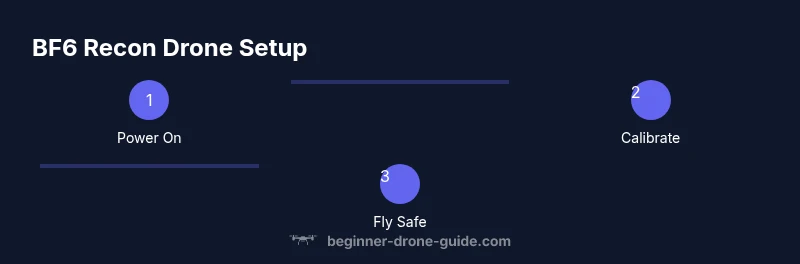
Power on the BF6 controller, then the drone. Open the BF6 app and verify a stable link between the device and the aircraft. Confirm that the map and telemetry appear correctly on screen.
Tip: Ensure you are in a safe environment and within line of sight before any movement. - 2
Calibrate compass and IMU
Follow the on-screen prompts to calibrate compass and IMU. Perform the calibration away from magnetic interference, metal structures, and large crowds. A successful calibration reduces drift during flight.
Tip: Do the calibration in a controlled calm area and recheck after any noticeable drift. - 3
Update firmware if available
Check for firmware updates in the BF6 app, then apply them as instructed. Updated firmware often improves stability and safety features.
Tip: Back up your settings if the app offers this option before updating. - 4
Plan your mission and home point
Set a home point and outline your reconnaissance route with waypoints. Confirm altitude limits and avoid restricted zones. Save the plan before takeoff.
Tip: Keep the plan simple on your first mission to build confidence. - 5
Takeoff and verify hover
Lift off slowly to a safe altitude and verify that the drone maintains stable hover. Check GPS lock and on-screen indicators for stability.
Tip: If drift is detected, pause and re-check compass calibration. - 6
Execute the recon route
Follow the planned waypoints at a comfortable speed. Capture imagery or data as needed, watching battery life and signal integrity.
Tip: Maintain line of sight and avoid high winds or gusts. - 7
Return, land, and power down
Return to the home point, descend smoothly, and power off the motors. Remove the battery and store equipment safely.
Tip: Review flight data and footage to improve future missions.
Frequently Asked Questions
What is the BF6 recon drone and what is it used for?
The BF6 recon drone is a beginner friendly UAV designed for basic reconnaissance and aerial awareness. It combines a stabilized camera with GPS and basic sensing to help new pilots learn flight control and data collection in open spaces.
The BF6 recon drone is a beginner friendly UAV for basic reconnaissance, offering stabilized video and GPS features for safe flight.
Do I need a license or registration to fly BF6?
Regulations vary by country and region. Check local aviation rules to determine if registration, remote ID, or waivers are required. Always fly in authorized areas and follow geofencing guidelines.
Regulations differ by location. Check local rules for registration or waivers and always stay in authorized areas.
How do I calibrate the BF6 compass and IMU correctly?
Use the BF6 app prompts to complete compass and IMU calibration in a non-magnetic environment. Verify the drone is stationary during calibration and re-check drift after takeoff.
Calibrate your compass and IMU using the app instructions in a non-magnetic space, then verify stability after lift-off.
What should I do if the BF6 loses signal?
Pause flight, check controller range, ensure GPS lock, and consider returning to home. Avoid aggressive maneuvers while the link is weak and re-check environment before resuming.
If the drone loses signal, pause, check the link, and return home if needed. Do not push the aircraft when connection is weak.
Can BF6 be used for professional tasks like mapping or surveillance?
BF6 can support basic reconnaissance and data collection in controlled scenarios. For advanced mapping or surveillance, ensure you have proper permissions and compatible software workflows.
BF6 supports basic data collection; for advanced tasks, verify permissions and software compatibility.
Watch Video
Quick Summary
- Start with a thorough pre-flight check.
- Calibrate sensors before every flight.
- Plan and stay within line of sight.
- Review data after landing to improve future flights.