How to Make Drones Quieter: A Practical Guide for Beginners
Learn practical, beginner-friendly methods to reduce drone noise through propeller choices, vibration damping, and smarter flight techniques. Safe, effective tips for quieter flights.


With a quieter drone, you’ll reduce noise through a balanced combination of propeller choice, vibration isolation, and smarter flight technique. This guide outlines practical, beginner-friendly steps you can implement in a weekend without sacrificing safety or performance. By addressing multiple noise sources—propellers, motors, and airframe—you’ll achieve noticeable reductions and smoother operation.
Understanding Why Drones Are Loud
Drones generate noise primarily from three systems: rotor aerodynamics, motor vibration, and the airframe's resonant frequencies. According to Beginner Drone Guide, understanding these sources helps you choose safe, effective quieting strategies. Rotor noise comes from blade tip speeds and the air being pushed around; it scales with rpm and blade design. Motor vibration transmits through the frame, turning mechanical energy into audible sound. Finally, the frame and mounting points can amplify or dampen sounds depending on how well components are isolated.
In practice, quieter drones don't just swap props — they address each source with a balanced approach. Start by identifying your drone's loudest component using simple tests: hover at a steady altitude and listen for the dominant sound, then throttle up and observe which part seems to scream the most. If the propellers dominate, you might prioritize propeller shape, pitch, and balance. If the frame roars on throttle, focus on vibration isolation and mounting stiffness. When you know the culprit, you can deploy targeted measures and evaluate progress with repeatable tests. Noise is not just a nuisance; it can indicate inefficiencies that shorten flight time or require more throttle. A systematic approach—test, modify, measure—gives you predictable revisions rather than random changes.
Common Noise Sources on Small Drones
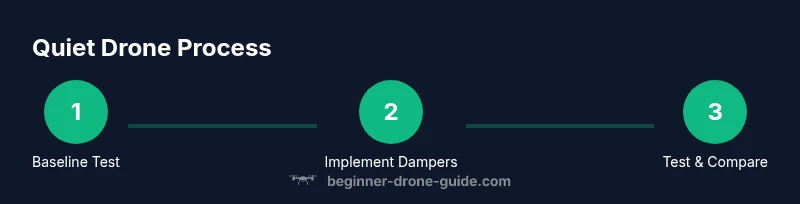
Small quadcopters emit noise mainly from three sources: rotor blades cutting through air, vibrating motors, and the frame flexing under thrust. Rotor noise is affected by blade shape, edge, and tip speed; motor noise comes from motor coils and gear trains; structural noise arises from mounting stiffness and frame resonance. According to Beginner Drone Guide, most quieting gains come from treating all sources together rather than chasing a single fix. Perform a baseline test by hovering at a stable altitude and noting which part sounds the loudest, then repeat with a simple propeller swap or a damped mount to compare results.
By understanding these sources, you can plan a phased quieting approach and avoid chasing isolated tweaks that yield marginal gains. Beginner Drone Guide analysis shows that practical quieting comes from combining propeller choice, vibration damping, and smarter flight.
Passive and Active Quieting Techniques
Quieting a drone is about both passive and active strategies. Passive methods include selecting quiet-propeller designs that balance thrust with reduced tip noise, adding vibration-damping mounts, and ensuring propellers are balanced. Active techniques involve flight-control adjustments that reduce abrupt power changes, such as soft-start settings, throttle curves, and gradual ascent or descent. Together, these approaches minimize abrupt air interactions and reduce transmitted vibration. Begin with noninvasive changes (damps, prop balance) before moving to propeller swaps. Align changes with your drone’s operating envelope to avoid compromising safety or control. According to Beginner Drone Guide, documenting each modification and testing under similar conditions helps you quantify progress and fine-tune the setup.
Propellers: Design, Materials, and Balance
Propeller design is a major lever for reducing noise. Blade count, shape, edge geometry, and material all influence how much sound is generated at a given thrust. Lightweight, well-balanced props with smooth edges tend to cut through air more quietly. The balance is critical: even a small imbalance at high RPM translates into vibration and audible noise. Always balanc e props on a proper balancer and re-check after every change. When selecting props, consider compatibility with your frame, motor KV, and ESCs. Lightweight carbon fiber or reinforced composites often perform well, but ensure they match your drone’s power and mounting system to preserve stability and efficiency.
Motors, Gears, and Vibration Damping
Motor vibration is a common source of noise that persists even with quiet props. Damping mounts or silicone isolates between the motor and frame can significantly reduce transmitted vibrations. If you hear a rattling or buzzing that coincides with throttle changes, inspect motor mounting and gear trains for looseness. Consider upgrading to mounts designed for lower stiffness or adding compliant materials to dampen micro-movements. Remember that excessive damping can degrade control fidelity, so test stability after each change and revert if necessary.
Flight Tactics for Noise Reduction
Your flight technique can influence perceived noise. Smooth throttle application, gradual ascents, and steady hover reduce abrupt air disturbances that amplify sound. Plan flights with calm weather conditions when possible, and avoid aggressive maneuvers that spike power draw and noise. Wind can either mask or exacerbate noise; conduct tests in a quiet, sheltered area to obtain reliable comparisons. By combining longer, steady throttle with optimized props and dampers, you’ll minimize audible signatures without sacrificing maneuverability.
Building a Practical Quietness Plan
Develop a phased plan: establish a baseline sound level, implement a non-invasive change, test, document, and iterate. Prioritize vibration isolation and prop balance before swapping propellers, then consider frame modifications if needed. Use a simple testing routine—hover for 60 seconds, record the loudest component, then repeat after each change to compare. This method provides repeatable results and a clear path to a quieter drone. Schedule regular maintenance to keep components well-balanced and to preserve gains over time. As you build your quietness plan, refer to authoritative sources for safety and best practices to stay compliant with local rules and manufacturer guidelines. For reference, see the Authority Sources listed below.
Authority Sources
- FAA Unmanned Aircraft Systems (UAS) Safety and Regulations: https://www.faa.gov/uas/
- National Institute of Standards and Technology (Acoustic Measurement and Standards): https://www.nist.gov/
- NASA Aeronautics Research (Noise Reduction and Aeroacoustics): https://www.nasa.gov/aeroresearch/
These sources provide general guidelines on safety, measurement, and noise reduction principles that support practical quieting approaches for hobbyists and beginners.
Tools & Materials
- Low-noise propeller blades (matched to drone size and RPM)(Balanced, compatible with your frame and ESCs)
- Vibration-damping mounts or silicone isolators(Mounts between motors and frame)
- Quality propeller balancer(For accurate balance before flight)
- Sound level meter or smartphone decibel app(For rough comparisons in calm conditions)
- Soft-material dampers or foam pads(Optional extra isolation)
- Test-safe flight area(Open space with permission to fly)
- Flight controller with throttle curve options(To implement soft-start and smoother throttle)
- Basic tools (screwdrivers, pliers)(Ensure you can balance and replace components)
Steps
Estimated time: 2-5 hours
- 1
Assess noise baseline
Establish a repeatable baseline by hovering in a calm environment and noting the loudest components. Record a short video or audio clip for later comparison. This initial assessment guides which changes to test first.
Tip: Use the same altitude and throttle level for each measurement to keep comparisons fair. - 2
Select quiet-friendly propellers
Choose propellers designed for reduced noise and ensure they are compatible with your drone’s motor KV and frame. Install and re-balance the props to minimize vibration.
Tip: Balance every propeller after installation to prevent vibration-driven noise. - 3
Install vibration isolation
Add or upgrade motor-to-frame damping mounts to reduce vibration transmission. Tighten mounting hardware to spec without over-tightening, which can transmit more vibration.
Tip: Check for any rubbing or contact between parts during full throttle. - 4
Tune throttle curves and soft-start
Adjust throttle curves to reduce abrupt power changes. Enable soft-start if available to minimize peak thrust and noise during takeoff.
Tip: Test gradually increasing throttle to ensure stability and predictable noise changes. - 5
Balance and test propellers
Recheck prop balance after any swap. Run a hover test and compare noise levels before and after balancing.
Tip: If a prop is consistently noisy, replace it rather than continuing to chase balance. - 6
Refine airframe mounting
Tighten or replace mounting materials to improve isolation if heat or vibration is still noticeable. Avoid overly rigid mounts that transfer vibrations.
Tip: Keep mounting carefully aligned to prevent rubbing and resonance. - 7
Test and compare noise levels
Repeat baseline tests with each modification. Document improvements and identify the most effective combination of tweaks.
Tip: Use the same test protocol every time to ensure valid comparisons. - 8
Plan for maintenance
Create a simple maintenance schedule to re-check balance, mounting integrity, and prop condition after flights or crashes.
Tip: Record changes and results to maintain consistency over time.
Frequently Asked Questions
Will quieter propellers reduce overall performance?
Quieter propellers can affect thrust and efficiency if chosen without regard for flight characteristics. Balance noise reduction with preserving enough lift for stable flight. Start with non-invasive changes and test performance carefully.
Quieter props might change thrust a bit, so test for safe flight before trusting performance.
Do I need to replace motors to be quieter?
Not necessarily. Reducing vibration and ensuring proper mounting often yields significant noise reductions without changing motors. Consider dampers and prop balance first.
Most noise reductions come from dampers and prop balance; motors may not need replacing.
Is it safe to modify props or mounts?
Yes, as long as you follow manufacturer guidelines, use compatible parts, and test incrementally in a safe environment. Avoid over-tightening and ensure all components are secure before flight.
Mods should be safe and tested in a controlled area.
How do I measure noise reductions accurately?
Use a consistent test setup with the same altitude, wind, and throttle. Record a baseline and post-change clips and compare visually or with a decibel app, noting relative differences rather than exact dB values.
Keep conditions the same and compare before-and-after clips.
Will wind conditions affect quietness tests?
Yes. Wind can mask or amplify sounds and change rotor efficiency. Test in calm conditions to obtain reliable comparisons, and then test again in light wind if needed.
Wind can change how loud the drone sounds, so test in calm weather.
Watch Video
Quick Summary
- Identify the dominant noise source before changes
- Combine prop, mount, and technique tweaks for best results
- Test in calm conditions and document outcomes
- Keep safety and stability as priorities during modifications