Which Drone Is Right For Me? A Beginner's Guide to Buying Your First Drone
Learn how to choose the right drone for your needs with a practical, beginner-friendly approach. Define goals, set a budget, evaluate key specs, and use a simple decision framework to buy confidently.


By the end of this guide, you’ll identify your needs, set a realistic budget, and compare key specs to pick the best drone for you. Start by defining your goals (beginner-friendly flights, photography, or learning FPV), your local rules, and the features you must have. According to Beginner Drone Guide, focus on ease of use and safety first.
Understanding Your Needs
Choosing the right drone for you starts with honest questions about how you plan to fly. What will you actually use it for in the next 3–6 months: casual flights, basic video, or learning to pilot? For beginners, the safest and most satisfying path is to emphasize ease of use, stability, and safety features over the latest camera tech. According to Beginner Drone Guide, new pilots often overemphasize camera quality while undervaluing stabilization, reliable GPS, and beginner modes that prevent crashes. Start with a drone that offers automatic takeoff/landing, stable GPS positioning, and intuitive controls. If you live in a place with strong wind or little open space, consider models with larger prop guards and wind resistance. Also plan for legal basics: registration if required, flight restrictions, and local privacy expectations. The Beginner Drone Guide team emphasizes learning fundamentals first: basic throttle control, hover, and controlled descents before ambitious aerial shots. By laying out your priorities early, you reduce disappointment and increase your confidence as a new pilot.
The Core Specs Beginners Should Prioritize
For new pilots, certain specs translate to faster learning and fewer crashes. Start with stability: a drone that holds position reliably in light wind helps you practice without fighting drift. GPS and return-to-home (RTH) are essential safety features that prevent you from losing the drone after a rough control input. Look for beginner modes (such as low-speed limits and fixed-pitch controls) and propeller guards to reduce damage on first flights. Weight and size matter too: smaller, lighter models are easier to handle indoors, while larger bodies usually provide longer flight times and steadier footage. Camera capability matters less than overall flight experience for beginners, but plan to balance camera quality with stabilization and shooting modes. The goal is to minimize crashes while building muscle memory for the controls. When comparing brands, prioritize a user-friendly app, clear on-screen feedback, and accessible tutorials. As you gain experience, you can upgrade to models with more advanced features and higher-resolution footage, but the learning curve should remain gentle. Begin with a drone that grows with you, not one that overwhelms you from day one.
Budget, Lifespan, and Ecosystem
Budgeting for a first drone isn’t just about the upfront price. A lower-cost model in the $100–$300 range can be perfect for learning the basics, while mid-range options ($300–$600) often offer better stabilization, longer flight times, and safer auto features. Keep in mind total ownership: batteries, spare props, a charging hub, a carry case, and a microSD card all affect long-term cost. Ecosystem matters: availability of spare parts, compatibility with third-party accessories, and strong customer support can save you headaches later. Beginner Drone Guide analysis shows that buyers who invest in a robust starter kit—extra batteries, a protective case, and an easy-to-use controller—tend to progress faster and enjoy more consistent flights. If you anticipate growing into more advanced use (like enhanced cameras or FPV), choose a model that has an upgrade path or a clear model family that you can expand within. Always compare not just the sticker price, but what you’ll actually use over the first year.
Real-World Scenarios: Starter Drones for Different Needs
If you’re a city dweller who wants casual footage from parks and rooftops, prioritize compact size, solid GPS, and decent stabilization. Indoor practice is easier with tiny, beginner-friendly models that include prop guards. For someone focused on learning photography, balance a steadier platform with a camera that records at reasonable resolutions, plus robust gimbal performance and quick-access modes. Outdoors enthusiasts who want longer flights should look for larger battery capacity and wind resistance without sacrificing weight and portability. Finally, if you expect to travel or shoot in varied environments, choose a drone with a reliable app, well-supported firmware, and readily available spare parts. In each scenario, the right model should feel forgiving, offer simple calibration, and provide helpful safety features like obstacle sensing where available. The Beginner Drone Guide team notes that most successful starters buy one step up from the absolute minimum to gain flexibility as skills grow.
How to Test and Decide: A Simple Evaluation Plan
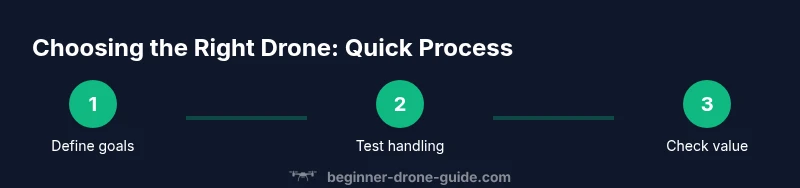
Put together a short, practical test flight plan before you buy: 1) verify stability by hovering in a calm area; 2) test takeoff and landing in a controlled space; 3) run a basic photo or video capture to assess stabilization; 4) check the controller’s response time and range; 5) simulate a return-to-home to verify the feature works in your environment. Keep a log of each model’s performance, including battery life and responsiveness, then compare notes against your initial goals. Try to borrow a friend’s drone or visit a local hobby shop to handle different layouts and firmware interfaces. If possible, attend a beginner workshop or watch reputable tutorials to see real-world flight behavior. Remember to always start with prop guards on your first flights and gradually remove them as you gain confidence. The aim is to build muscle memory and an intuitive feel for the controls so you can focus on creative outcomes rather than fighting the drone.
Tools & Materials
- Internet-connected device (laptop or smartphone)(Research models, read reviews, and compare specs.)
- Notebook or note-taking app(Capture preferences, shortlist decisions, and test results.)
- Safe practice area (open space, away from people and obstacles)(Prefer outdoor calm conditions for initial tests.)
- Access to retailer or online store for model comparison(Check return policy and warranty terms.)
- Phone or tablet to run drone companion apps(Ensure compatibility with the chosen model.)
- Basic protective gear (prop guards, etc.)(Helpful for first flights in small spaces.)
Steps
Estimated time: Total time: 60-90 minutes
- 1
Define your goals
Clarify what you want to achieve with your first drone: casual flights, learning to pilot, or capturing photos/videos. This defines the most important features and helps you avoid overpaying for capabilities you won’t use.
Tip: Write down 3 concrete use cases to guide your search. - 2
Set a realistic budget
Decide how much you’re comfortable spending upfront and for accessories over the first year. Include extra batteries, a charger, a case, and a microSD card in your plan.
Tip: Allocate 20–30% of your budget to batteries and safety gear. - 3
Check local rules
Learn the basic regulations in your region, including registration, flight restrictions, and any mandatory training. This helps you avoid penalties and ensures responsible flying.
Tip: Bookmark your local aviation authority’s drone page for quick reference. - 4
Make a shortlist of beginner-friendly models
Narrow down to drones with strong stability, beginner modes, GPS, and positive safety reviews. Favor models with spare parts availability and good after-sales support.
Tip: Aim for 3–5 candidates you can compare side by side. - 5
Compare specs side-by-side
Create a simple matrix: flight time, weight, camera quality, range, sensors, and price. Prioritize stability, safety features, and learning resources.
Tip: Copy the key specs into your notes for quick reference. - 6
Test flight and usability
If possible, demo test a few models in a store or with a friend. Evaluate handling, responsiveness, and how easy it is to use beginner modes.
Tip: Ask staff about firmware updates and troubleshooting. - 7
Make the purchase and plan learning
Choose the model that best fits your goals, budget, and test results. Create a simple learning plan with progressive flights and a schedule for practice.
Tip: Register your drone and set up safety zones in the app.
Frequently Asked Questions
What should I look for in a beginner drone?
Look for stability, ease of use, GPS positioning, and beginner modes. Prioritize safety features that prevent crashes and make learning smoother.
Look for stability, beginner modes, and GPS safety features to ease learning.
Do I need a license to fly a consumer drone?
Regulations vary by country. Some places require drone registration and a knowledge test; others allow casual use with certain rules. Always check your local regulations before flying.
Regulations vary by country; check local rules and registration needs.
Can I use my phone as a controller?
Many beginner drones use smartphone apps for some controls, but most still rely on a dedicated controller for precise input and better range.
Most beginners use a dedicated controller, but many models support phone apps for basics.
How much should I budget for accessories?
Plan for extra batteries, a charger hub, prop guards, and a microSD card. Accessories extend flight time and protect the drone during learning.
Set aside funds for extra batteries and protective accessories.
What’s the best way to practice safely?
Practice in open spaces, start with hover and gentle movements, and gradually add complexity. Always fly within line of sight and follow local rules.
Practice in open space, start simple, and stay within line of sight.
How do I compare drones effectively?
Create a simple side-by-side spec sheet focusing on flight time, weight, camera ability, range, and safety features. Use your priority list to weigh differences.
Make a side-by-side spec sheet and compare what matters to you.
Watch Video
Quick Summary
- Define needs before browsing
- Prioritize beginner safety features
- Budget for ownership, not just upfront cost
- Test flights in safe spaces before buying
- Choose a model with a growth path and support