Drone Buy Guide: How to Choose Your First Drone
Learn how to pick and purchase your first drone with confidence. This beginner-friendly guide covers needs, specs, safety, licensing basics, budgeting, and a practical step-by-step approach to a smart drone buy.


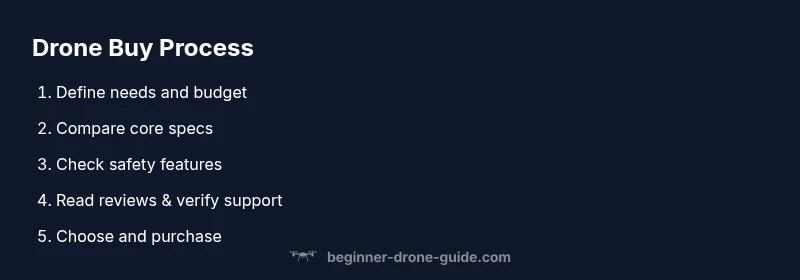
To buy your first drone, define your intended use, set a budget, and compare core specs like flight time, stability features, and camera quality. This guide walks you through evaluating your needs, researching models, checking safety features, and selecting a beginner-friendly drone with reliable support. By the end, you'll know how to make a confident drone buy.
Why the drone buy matters for beginners
Buying a drone is not just about choosing a gadget; it's about aligning a tool with your goals. When you start with a clear purpose, you avoid wasting money on features you won’t use and you gain faster progress in learning. This is why a thoughtful drone buy matters. According to Beginner Drone Guide, starting with a clear list of needs before you buy helps ensure you pick a model you'll actually enjoy. The Beginner Drone Guide team found that many new pilots overestimate the appeal of flashy specs and underestimate practical considerations like flight stability, portability, and after-sales support. By focusing on your use-case—aerial photography, classroom demonstrations, or casual flying—you can narrow the field early and reduce decision fatigue. In this guide, we’ll help you translate goals into a short list of must-have features, a comfortable budget, and a plan to test before you buy.
note
Tools & Materials
- Smartphone or tablet with internet access(Needed for research, tutorials, and app setup)
- Notebook or digital planner(For a needs list, budget, and feature checklist)
- Budget sheet or spreadsheet(To compare price ranges, value, and total cost of ownership)
- Access to reputable retailers(Verify warranty, return policy, and customer support)
- Local drone regulations resource(Know licensing and airspace rules before buying)
Steps
Estimated time: 60-120 minutes
- 1
Define use case and budget
Start by outlining how you’ll use the drone (photos, video, learning, or mapping) and where you’ll fly most often. Set a realistic budget that accounts for extra batteries, chargers, and a protective case. This step prevents feature overkill and keeps your search focused.
Tip: Write down your top three must-haves and three nice-to-haves to speed comparisons. - 2
Check core flight specs
Look for flight time, maximum range, GPS-based stabilization, and return-to-home features. For beginners, prioritize stable flight and predictable responses over fancy aerobatic modes. A lighter form factor often improves handling in wind.
Tip: Prefer models with automatic return-to-home and altitude hold for safer practice. - 3
Assess safety and user-friendliness
Evaluate obstacle avoidance (if offered in your price range), propeller guards, beginner modes, and how easy it is to cancel or pause controls. A forgiving controller and helpful flight modes reduce the learning curve.
Tip: Read reviews from other beginners about real-world handling and crash resilience. - 4
Review camera needs versus weight
If image quality matters, compare video resolution, photo quality, and the stability of the gimbal. Remember that higher-quality cameras often add weight and cost, which can affect flight time.
Tip: Prioritize stabilization and color consistency over megapixels for beginners. - 5
Check after-sales and community
Investigate warranty terms, repair options, and the availability of spare parts. A large user community helps with tutorials and troubleshooting, which is especially valuable for new pilots.
Tip: Choose a model with widely available replacement parts and a good chat/forum presence. - 6
Make the purchase and plan setup
Select a model that fits your criteria, purchase from a reputable retailer, and set up the drone according to the manual. Create a simple flight plan and practice area to build confidence before more ambitious flights.
Tip: Register the drone if required in your country and update firmware before first flight.
Frequently Asked Questions
What is the most beginner-friendly drone for a first purchase?
For beginners, seek a model with stable flight, easy controls, and strong customer support. Prioritize beginner modes, easy calibration, and accessible spare parts over luxury camera specs.
For beginners, look for stable flight and easy controls, prioritizing beginner modes and good after-sales support.
Do I need to register my drone?
Drone registration rules vary by country and sometimes by weight. Check your local aviation authority to determine whether registration, operator certification, or specific flight restrictions apply.
Registration rules depend on where you fly. Check your local aviation authority for requirements.
What features matter most for beginners?
Important features include stable GPS positioning, altitude hold, beginner mode, return-to-home, and protective guards. These features make first flights safer and more forgiving.
Key features are stability, beginner modes, return-to-home, and guards to keep flights safe.
How long does it take to learn to fly a drone?
Learning duration varies with practice, but most beginners achieve comfortable control within several hours of focused practice in safe spaces.
Many beginners feel comfortable after a few hours of practice in a safe area.
Are used drones a good idea for beginners?
Used drones can offer value, but they come with risks like degraded battery health and worn parts. If you buy used, choose trusted sellers, request test flights, and inspect for wear.
Used drones can be risky; buy from trusted sources and inspect battery and propellers carefully.
What accessories should I consider?
Consider extra batteries, a quality charger, propeller guards, a protective case, and a simple microSD card for saving footage.
Extras like extra batteries and guards are smart upgrades for beginners.
Watch Video
Quick Summary
- Define use-case and budget before browsing.
- Prioritize stability, safety features, and after-sales support.
- Balance flight time with camera needs for beginners.
- Research regulations and register if required.