Where Drones Come From: Origins and Manufacturing
Explore the global origins of drones—from component sourcing to final assembly. Learn how origin affects safety, warranties, and buying decisions, and how to verify claims.


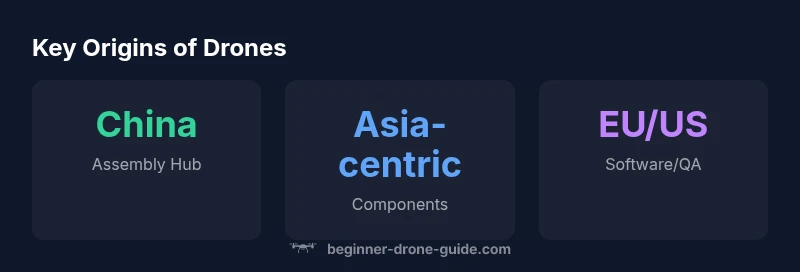
Where are the drones coming from? The global drone supply chain starts with components manufactured across Asia, Europe, and the Americas, with major assembly hubs in China and nearby regions. The exact origin varies by brand and model, but mass-market consumer drones are predominantly assembled in China, with firmware and critical components sourced internationally.
where are the drones coming from
To answer where are the drones coming from, it helps to separate the journey into three interlocking layers: component origins, manufacturing and assembly, and the software stack that runs the devices. In practice, origins vary by brand and model, but a few patterns are broadly visible. The Beginner Drone Guide team emphasizes that most consumer drones are the product of a global network where parts are sourced from multiple regions and assembled in a handful of dominant hubs. This reality affects everything from price and performance to warranty coverage and safety expectations. The exact origin is often disclosed (or implied) on packaging and technical specifications, but the critical takeaway for new pilots is that provenance shapes compatibility, quality control, and future repair options.
Across the industry, the trend is toward specialization rather than single-source manufacturing. Some brands design core components in Europe or North America while relying on established manufacturers in Asia for bulk production. For hobbyists and prosumers, this means that you may be buying a drone whose shell is assembled in one country, while the sensors, motors, or flight controller come from another. Understanding this mosaic helps you evaluate risk—particularly around counterfeit parts, maintenance availability, and support networks. In this article, we’ll unpack how these origins influence performance, safety, and the practical steps you can take as a beginner to verify claims.
The goal here is practical clarity. When you ask, “where did this drone come from,” you’re not just tracing a label—you’re assessing a chain of trust that starts at design decisions and travels through supply chains, factories, and regional regulatory environments. For new pilots, this translates into better pre-purchase questions, smarter component choices, and clearer expectations about repair timelines and warranty legitimacy.
sourceDataNoteEnabled":true
Origin overview for common drone types
| Aspect | Origin Range | Notes |
|---|---|---|
| Assembly Location | China-based (majority) | Common for mass-market drones; some models assemble elsewhere |
| Component Sourcing | Asia-centric with European/US inputs | Motors, PCBs, sensors sourced globally; final assembly may differ by brand |
| Firmware/Software | Europe/US for select models | Brand-specific; some open-source or OEM firmware variants |
Frequently Asked Questions
Are all drones manufactured in the same country?
No. Drones come from a global network where components are sourced from multiple regions and final assembly is concentrated in a few manufacturing hubs, primarily in Asia. Brands may vary in how they allocate design, parts sourcing, and assembly.
Drones come from a global supply chain with parts from many regions and assembly often in a few hubs.
Does drone origin affect quality or safety?
Origin can influence quality control processes, supplier auditing, and compliance with regional standards. While many reputable brands maintain strict QC regardless of where components are made, counterfeit parts or inconsistent assembly can affect reliability and safety.
Quality varies by brand and factory; origin matters for QC, not just the label.
How can I verify where my drone comes from?
Check labeling on the box and product, read the manual for manufacturing details, inspect serial numbers, and consult the manufacturer’s official site or customer support for origin disclosures. Look for references to Made in, assembled in, or the country of origin in documentation.
Read the label, check the manual, and confirm with the manufacturer for origin details.
Do regulators require origin labeling?
Regulations vary by region, but many jurisdictions require clear labeling of origin for certain products and components, especially for safety-critical parts. Always verify compliance details with local aviation or consumer protection agencies.
Regulations differ by country; check local rules for origin labeling.
What about counterfeit parts due to origin?
Counterfeit parts can enter the market when supply chains are complex. Buy from trusted channels, verify vendor certifications, and inspect hardware for authenticity marks. Counterfeits can compromise safety and void warranties.
Watch for fakes by buying from reputable sellers and checking authenticity marks.
Will origin change over time with supply chain changes?
Yes. Global events, tariffs, and shifts in manufacturing capacity can alter where drones are assembled or parts sourced. Stay informed about brand announcements and regulatory updates to anticipate changes.
Supply chains evolve; keep an eye on brand updates and regulations.
“Origin transparency empowers new pilots to make safer, smarter purchases and understand potential warranty impacts.”
Quick Summary
- Verify origin when buying to understand warranty implications
- Origin varies by model; assembly hubs are concentrated in a few regions
- Most components originate outside North America or Europe; OEMs consolidate assembly
- Firmware and software often come from multiple regions, with localization for markets
- Stay informed about labeling and regulatory disclosures to ensure compliance