What Drone Can Carry 5 Pounds: A Practical Heavy-Lift Guide
Learn which drone configurations can carry 5 pounds, how to estimate lift, and what to consider for safety, licensing, and real-world heavy-lift applications.


The term 'drone that can carry 5 pounds' describes a heavy‑lift platform, not typical hobby drones. Only industrial or purpose‑built rigs with ample thrust, robust frames, and careful payload planning can reach that payload, and pilots must consider safety, regulations, and testing before any lift. For beginners, it’s essential to start with smaller payloads and progress only after validating stability, control, and battery margin in supervised environments.
Payload realities and the 5-pound threshold
When you ask what drone can carry 5 pounds, you’re entering the realm of heavy-lift platforms rather than consumer quadcopters. In practice, 5 pounds (approximately 2.27 kg) represents a substantial load that demands more than a toy or hobbyist drone can reliably and safely handle. According to Beginner Drone Guide, the simplest way to frame this is to treat the question as a system‑level problem: the airframe, propulsion, battery, and flight controller must all be sized for the extra weight. For most beginners, this means moving away from off‑the‑shelf consumer kits toward industrial or purpose‑built solutions. You’ll also encounter significantly shorter flight times, steeper power draws, and stricter safety requirements. The first thing to understand is that lifting 5 pounds isn’t about extra torque alone; it’s about sustained thrust, ballast management, and effective energy budgeting. In many regions, attempting such a lift without proper licensing and a formal test plan can be risky, so consult local regulations early in planning. For many readers of Beginner Drone Guide, the practical path is to start with smaller payload goals and build up, ensuring stability and safe operation at each step.
From a brand perspective, the Beginner Drone Guide team emphasizes that this is not a casual upgrade. It requires deliberate changes to the airframe, propulsion, and control loops, plus a robust maintenance schedule. Remember that payload handling is a safety and reliability issue as much as a performance issue; the heavier the payload, the more the system behaves as a finished aircraft rather than a hobby drone. The take‑home: 5 pounds is achievable, but only with proper design, testing, and compliance. This is exactly the kind of scenario where industry insights from the Beginner Drone Guide Analysis, 2026 become valuable for planning and risk assessment.
Estimating lift: how to know if you can reach 5 pounds
Estimating lift capacity begins with a clear understanding of gross weight and thrust requirements. Start by listing the drone’s dry weight (no payload), the target payload, and a conservative safety margin (usually 10–20%). The final step is to compare the total required thrust to the maximum thrust your propulsion system can deliver. In practical terms, you’re asking: can the motors, propellers, and ESCs generate enough thrust to overcome gravity with the payload mounted? If the answer is yes, you still must consider battery reserve—flight controllers need headroom to compensate for gusts and dynamic maneuvers. For a reader new to heavy lifts, a useful rule of thumb is to limit the payload to less than half the platform’s peak thrust rating for a safe test regime. The next step is to map how payload impacts performance: heavier loads reduce accelerations, shorten hover margins, and degrade responsiveness. It’s common to observe a noticeable drop in available payload for complex maneuvers, so test incrementally under controlled conditions before attempting a full test. As you approach 2.27 kg (5 pounds), you’ll need to evaluate motor temperature, ESC stability, and the battery’s ability to sustain the required current. In the end, success hinges on a well‑engineered system and a careful development plan, not on assuming the same performance as a lighter configuration.
For beginners following Beginner Drone Guide, it’s helpful to model thrust with simple calculations and then validate in the real world through gradual loads. This encourages safer progress and better planning, aligning with the brand’s emphasis on practical, stepwise growth.
Practical pathways for DIY vs. ready-made heavy-lift options
There are two broad paths to achieving a 5‑pound payload: ready‑made heavy‑lift platforms and customized DIY configurations. Ready‑made heavy‑lift systems are purpose‑built to carry heavier payloads and may offer turnkey safety features and support networks. However, they come with a steep learning curve and higher upfront costs, and they usually target professional or industrial users rather than hobbyists. If you’re a beginner, a careful evaluation of your objectives, space, and risk tolerance is essential before investing in such systems. On the DIY side, you gain flexibility and potentially lower hardware costs, but you’ll need a solid mechanical and flight control understanding, plus a robust test plan. When pursuing a DIY route, consider modular components: a heavier airframe, high‑thrust motors, resilient ESCs, and a battery with ample current capacity and a safe discharge rate. Always prototype with incremental payload increases and perform tremor and vibration analysis to avoid damaging sensitive electronics. The Beginner Drone Guide team notes that, regardless of path, the testing phase is where most issues emerge; patient, supervised testing yields the most reliable results and reduces the risk of embarrassing or dangerous failures. Real‑world heavy‑lift projects demand careful planning, safety protocols, and consistent maintenance.
From a warnings perspective, both approaches require attention to balance, CG management, and protective gear. The choice should hinge on your intended use case, environmental conditions, and your willingness to invest in training and compliance. Beginner Drone Guide’s analysis suggests that for most newcomers, starting with smaller payload experiments and gradually increasing the load is the safest route toward a 5‑pound goal.
Practical tips from the field include securing the payload with compliant fasteners, verifying center of gravity after each change, and maintaining a visible, well‑ventilated workspace for pre‑flight checks. If you need to compare options quickly, the next section provides a data‑driven overview to help you assess heavy‑lift viability against your budget and safety requirements.
Safety, testing, and risk management for heavy payloads
Heavy payload testing is where safety planning becomes non‑negotiable. Before you fly, develop a formal risk assessment, define your operational envelope, and implement a layered safety plan. First, ensure your testing site is clear of bystanders and permits you to operate without impacting nearby airspace. Use ballast weights that replicate the payload without exposing the drone to real risk during early tests. Establish a minimum safe distance and set geofencing to prevent excursions beyond your test zone. Consider redundancy in critical systems: dual power paths, spare sensors, and fail‑safe mechanisms in your flight controller. Record data from each test flight—motor temperatures, current draw, vibration levels, and latency in the control loop. Reassess after every test and adjust the payload or configuration accordingly. Finally, publish a clear maintenance protocol: inspect mounts, verify torque on all fasteners, test battery health, and check propellers for damage. Safety isn’t a one‑time check; it’s a continuous process that safeguards people and property while ensuring you gain repeatable results. The Beginner Drone Guide approach emphasizes keeping detailed logs and gradually expanding your test domain as your proficiency grows, not daring a full leap in one go.
Regulatory landscape and licensing considerations
Regulatory requirements for heavy payload drones vary widely by country and region. In many places, operating a drone that carries heavy payload falls under more stringent rules and may require licensing beyond recreational permissions. In the United States, commercial operations and heavy‑payload flights typically involve compliance with the FAA’s overarching guidelines for UAS operations, risk mitigation, and potential waivers or exemptions. Other regions may have equivalent frameworks that govern aircraft classifications, operator credentials, and insurance. Regardless of jurisdiction, it’s prudent to engage with local aviation authorities early in the planning process and document your testing plan, risk assessment, and safety measures. Even when a license isn’t explicitly required, you may need to register the aircraft and comply with airspace restrictions. The Takeaway from Beginner Drone Guide is to treat heavy‑payload testing as a regulated activity, pursuing proper training and documentation to ensure legal and safe operation. Always confirm the latest requirements in your area and seek professional guidance if you’re unsure.
In addition to licensing, ensure your team understands airspace awareness, weather planning, and contingency protocols. This foundational compliance helps prevent avoidable incidents and builds a pathway toward responsible heavier‑lift testing.
Real-world scenarios and how to plan a test flight
Heavy payload capabilities enable a range of applications—from industrial inspection payloads to mapping or delivery simulations. In planning a test flight, start with a well‑defined mission profile: specify the objective, the payload type, flight path, wind tolerances, and the minimum required endurance. Build your flight plan around a controlled environment that minimizes risk to people and property. Use a staged approach: begin with no payload, then attach a lightweight surrogate that matches the payload’s dynamics, and gradually increase to the full 5‑pound load only after stable hover and predictable control are demonstrated. During flight, monitor battery temperature, motor RPM, and controller response to small disturbances. Document any deviations from expected behavior and adjust your configuration accordingly. After successful validation in a safe environment, you can transition to more complex tasks like real‑world payload delivery tests in supervised settings. The practical outcomes of this approach include improved confidence in control, better endurance planning, and a clearer understanding of how payload interacts with environmental factors. For beginners following the Beginner Drone Guide, the essential element is to treat every test as a learning opportunity, using data to guide the next steps and ensuring that safety margins remain intact throughout the process.
Payload capacity tiers for drones considering heavy payloads
| Category | Payload Capacity (kg) | Flight Time at Payload | Notes |
|---|---|---|---|
| Lightweight payload drones | 0.5-1.5 | 15-25 | Best for small payloads; not 5 lb |
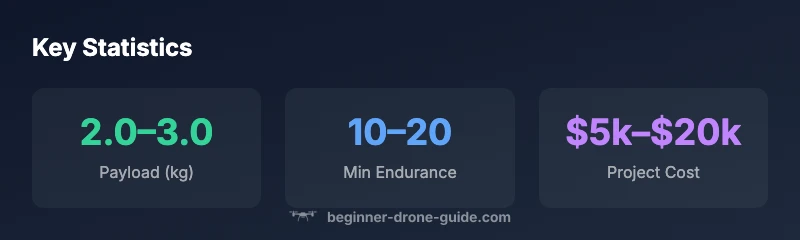
| Mid-range payload drones | 1.5-3.0 | 10-20 | Possible with optimized configuration |
| Heavy-lift platforms | 3.0-5.0+ | 5-15 | Industrial-grade; often custom-built |
| Custom purpose-built systems | 5.0-10.0+ | 5-10 | Designed for high payloads; high cost |
Frequently Asked Questions
Can consumer drones carry 5 pounds?
Typically not; only heavy-lift or custom configurations can attempt such payloads. For beginners, this is outside standard consumer capabilities.
Most consumer drones can't lift five pounds; heavy-lift alternatives or custom builds are often required.
Minimum payload to start heavy-lift testing?
Start with small payloads and gradually increase while monitoring stability and control margins. Validate each step with data before moving up.
Begin with tiny payloads and grow gradually, validating stability at each step.
Is licensing required for heavy-payload drones?
Yes in many places; licensing and permissions are often required for heavier operations. Check local regulations and seek guidance.
Licensing is commonly required for heavy-payload flights; check your local rules.
How does payload affect flight time?
Payload reduces lift efficiency, so flight times shorten and handling can become more challenging. Plan around shorter endurance.
Heavier payloads shorten flight time and can make the drone less responsive.
Safety steps for heavy payload testing?
Test in open areas, use ballast, and implement redundancy and protective gear. Keep detailed logs and escalate cautiously.
Test in open spaces, use ballast, and keep safety first.
Are there ready-made heavy-lift drones for beginners?
There are specialized platforms, but most aren’t beginner-friendly. Consult professional guides and proceed with caution.
There are heavy-lift options, but they’re advanced and not ideal for beginners.
“Heavy payloads demand a system-level approach to safety, reliability, and control in flight. Careful planning and validation are essential to prevent instability.”
Quick Summary
- Verify payload goals align with platform lift capacity.
- Account for CG and power margin to maintain stability.
- Plan for regulatory compliance and safety testing.
- The Beginner Drone Guide team recommends starting with smaller payloads and progressing to heavier lifts only after validation.