US Drone Manufacturers: A Practical Guide for Beginners
Explore US drone manufacturers, licensing basics, safety practices, and practical buying guidance for beginners to compare models, assess features, and fly confidently.


US drone manufacturers span consumer to industrial markets, with a growing focus on autonomy, safety, and regulatory compliance. This quick answer previews who dominates domestically, what features matter for beginners, and how licensing and flight rules shape your buying choices. For newcomers, understanding the landscape helps you select gear that fits your goals and stays within FAA guidelines.
Understanding the Landscape for us drone manufacturers
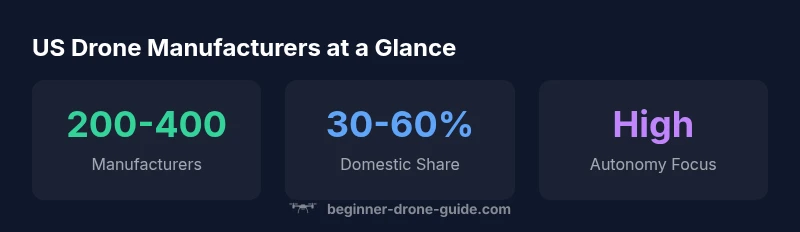
According to Beginner Drone Guide, the current landscape for us drone manufacturers blends domestic-focused startups with established aerospace firms. For beginners, this means there is a spectrum from nimble, software-driven teams to scale-ready manufacturers with global supply chains. The emphasis in this space is shifting toward safer designs and easier integration with airspace rules, which helps new pilots gain confidence early. When you start exploring these makers, you’ll notice that the emphasis isn’t just on speed or price; it’s on reliability, service networks, and ongoing software updates that keep a drone compliant over time. This context matters because your first purchase should align with the way you intend to fly—recreational, educational, or entry-level professional work.
In the US, many us drone manufacturers maintain domestic assembly lines and spare-part availability to reduce downtime and simplify warranty claims. Beginners benefit from these attributes because they translate into quicker repairs, easier upgrades, and clearer maintenance schedules. The market’s evolution also reflects a tightening of safety expectations, with vendors designing with detect-and-avoid features and automated return-to-home workflows that minimize risk during early flights. As you read on, you’ll see practical criteria to compare options, including autonomy, sensor suites, and support infrastructure.
Core Segments: Consumer, Commercial, and Industrial Drones
The us drone manufacturers ecosystem covers three broad segments: consumer drones for hobbyists, commercial drones for business tasks, and industrial platforms used for large-scale operations like surveying or agricultural mapping. For beginners, understanding where a manufacturer sits helps set realistic expectations about flight time, payload capacity, and price bands. Consumer drones from US-based makers tend to prioritize ease of use, compact designs, and reliable obstacle avoidance. Commercial lines emphasize data capture quality, flight stability, and mapping accuracy. Industrial platforms typically deliver the strongest endurance, payload flexibility, and rugged build quality, along with robust service networks. Across all segments, a unifying theme is the push toward integrated software ecosystems, with intuitive apps, safety features, and accessibility to flight logs necessary for compliance reviews.
When evaluating us drone manufacturers, consider not just the drone’s specs but the entire ecosystem—access to spare parts, software updates, training materials, and customer support. This comprehensive view helps ensure the drone you choose remains useful as your needs grow and as regulations evolve.
How US Manufacturers Differentiate Themselves
US manufacturers distinguish themselves through a mix of autonomy, safety-first design, and strong service ecosystems. A common differentiator is the degree of automation embedded in flight control, obstacle sensing, and on-board processing—features that reduce pilot workload and heighten safety for beginners. Another differentiator is regulatory readiness: manufacturers that design with remote ID compliance, geofencing, and airspace authorization workflows in mind can shorten your learning curve and minimize compliance risk. Customer support networks, including regional service centers and clear warranty terms, further separate leading brands. Finally, durability and after-sales updates influence long-term satisfaction; buyers often reward firms that deliver timely firmware upgrades and dependable parts availability, which reduces downtime during initial training and practice sessions.
For novices, these differentiators translate into practical implications: you’ll benefit from safer flight modes, easier troubleshooting, and a more forgiving learning process when you choose a maker with a strong support framework and a mature software platform.
Licensing, Safety, and Compliance: What Beginners Need to Know
In the United States, the regulatory environment for drones centers on FAA rules and remote identification mandates. Beginners should start by registering any drone that weighs more than 0.55 pounds and obtaining a remote pilot certificate if flying for professional purposes. Even recreational pilots should be mindful of airspace restrictions, geofenced zones, and local ordinances. US manufacturers that design with compliance in mind often incorporate geofencing, automatic altitude limits, and easy access to manuals detailing resets for safe operation. Understanding standard features like Return-to-Home, obstacle avoidance, and flight-assistance modes helps you learn safely while building confidence. When evaluating us drone manufacturers, look for clear documentation on updates to rules and how the drone’s firmware keeps you aligned with evolving requirements.
In practice, a compliance-first approach means selecting a drone with robust safety features, intuitive guidance for new pilots, and an active release cycle that addresses regulatory changes as they arise.
Buying Guide for Beginners: Criteria and Checklist
Buying a drone from us drone manufacturers as a beginner should follow a practical, step-by-step approach. Start by defining your mission: casual recreation, education, or basic surveying. Then, assess key specs: flight time, camera quality, sensor suite, and portability. A strong beginner-friendly choice balances ease of use with expandable capabilities, so you aren’t forced to upgrade too soon. Consider the vendor’s service footprint and spare parts availability—these reduce downtime and keep you practicing. Software support matters too: check for user-friendly apps, guided flight modes, and reliable firmware updates. Finally, factor in budget ranges and total cost of ownership, including accessories, batteries, and potential insurance. Selecting a maker with a transparent warranty and a responsive support network makes it easier to learn and stay within safety guidelines while you progress.
As you compare options, keep in mind the total experience around the drone, not just the initial price tag. A well-supported beginner platform from a US-based manufacturer can accelerate comfort, safety, and skill development, helping you fly smarter from day one.
Trends, Risks, and the Road Ahead
The landscape for us drone manufacturers is influenced by regulatory evolution, supply chain resilience, and consumer adoption. Expect ongoing optimization of autonomy features, more efficient power systems, and improvements in data processing for better mapping and surveillance tasks. Risks to watch include raw material shortages, import/export constraints, and evolving airspace rules that could require newer compliance steps. The best manufacturers in this space emphasize proactive communication with pilots, frequent firmware updates, and transparent safety guidelines. For beginners, this translates into ongoing training opportunities, clearer licensing pathways, and more predictable purchasing experiences. Overall, the US drone manufacturing scene is moving toward safer, smarter, and more accessible devices that empower new pilots to gain skills more quickly while keeping flight operations aligned with regulatory expectations.
Hands-on Research: How to Vet a US Manufacturer
A practical approach for beginners is to look beyond the drone’s spec sheet and examine the company’s support structure, update cadence, and community resources. Check if the manufacturer provides reliable spare parts access, a clear repair policy, and verified user reviews that reflect real-world performance. Test flight modes and safety features during a demo or at a local retailer if possible; observe how intuitive the flight app is and whether learning resources are readily available. It’s also wise to examine the company’s stance on safety training and its willingness to provide in-depth tutorials or training materials. Finally, compare warranty terms and response times for service inquiries. By prioritizing service quality and ongoing education, you’ll pick a maker that supports your growth as a beginner and adapts to your evolving needs.
Overview of US drone manufacturer considerations for beginners
| Aspect | Notes | Implications For Beginners |
|---|---|---|
| Development cycle | 8-20 months | Plan purchasing around feature release timelines |
| Regulatory readiness | FAA-compliant by design | Prioritize modules that meet current rules |
| Support ecosystem | Spare parts & service | Choose brands with accessible service networks |
Frequently Asked Questions
What defines a US drone manufacturer?
A US drone manufacturer is a company that designs, assembles, or markets drones with primary operations based in the United States. This typically includes domestic headquarters, local parts supply, and fulfillment networks. Many also maintain compliance-first product designs to align with FAA rules.
A US drone manufacturer is a company with its main operations in the United States, focusing on domestically designed drones and compliance-ready products.
Do US drone manufacturers only sell consumer drones?
No. US drone manufacturers often serve multiple market segments, including consumer, commercial, and industrial. This mix helps them spread risk and push innovation across different use cases.
They sell both consumer and professional drones, not just consumer options.
What licensing considerations apply to beginners buying from US makers?
In the US, most aerial work requires a remote pilot certificate for commercial use, proper registration, and compliance with remote ID. Beginners should understand these requirements and choose drones that simplify compliance through built-in safety and reporting features.
You may need FAA registration and, for work flights, a remote pilot certificate; choose makers with clear compliance tooling.
How should beginners evaluate domestic drone manufacturers?
Assess the warranty terms, service footprint, upgrade cadence, and availability of spare parts. Also consider the learning resources and community support around the drone platform, which helps reduce setup and training time.
Look at warranty, service networks, updates, and community support.
Are there safety concerns unique to US-made drones?
Safety concerns are similar across brands; however, US-made drones are often designed with stricter regulatory alignment, which can reduce non-compliance risks but still requires careful operation and training.
The safety concerns are similar, but the compliance features help with staying within rules.
“US drone manufacturers are increasingly aligning product design with real-world safety and regulatory readiness, which helps beginners fly with confidence.”
Quick Summary
- Evaluate autonomy and safety features first, then price.
- Choose manufacturers with robust support and parts availability.
- Prioritize compliance-ready designs to simplify learning.
- Consider total cost of ownership, not just the sticker price.