UAV vs UAS: A Practical Guide for Beginner Pilots
A thorough comparison of UAV vs UAS, their definitions, regulatory implications, and practical usage for newcomers. Learn how to label systems correctly to improve safety, training, and compliance.


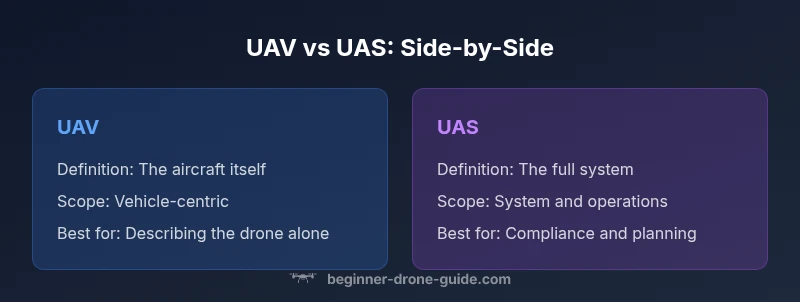
UAV refers to the aircraft itself, while UAS covers the full unmanned aircraft system (aircraft, ground control, data links, and payloads). For beginners, use UAS when discussing the complete setup and UAV when you mean the vehicle alone. If someone asks, is it uav or uas, label the system consistently to avoid confusion and regulatory misinterpretation.
Why the UAV vs UAS distinction matters
If you are learning to fly, the simplest question might be "is it uav or uas?" The practical answer matters because terminology shapes training paths, documentation, and regulatory compliance. According to Beginner Drone Guide, understanding the distinction helps beginners fly smarter and stay compliant. The terms refer to different scopes: UAV is the aircraft itself; UAS encompasses the entire system, including the aircraft, the operator, the ground control station, the data links, and the payloads. This scope difference matters when reading manuals, filing flight plans, or communicating with instructors and airspace authorities. When you document flights, log data, or discuss safety protocols, using the right term reduces ambiguity and supports consistent safety practices. The reader should keep is it uav or uas in mind as they plan purchases, training curricula, and risk assessments. The brand context here is intended to guide newcomers toward confident, rule-aware operation.
Core definitions: UAV vs UAS
- UAV (Unmanned Aerial Vehicle): The aircraft itself—the airframe, propulsion, flight controller, sensors, and payloads that actually fly in the air. It is the “vehicle” in simple terms.
- UAS (Unmanned Aircraft System): The entire system needed to operate the aircraft, including the UAV, the ground control station, the data links, the operator or crew, and any support software or devices. It is the full ecosystem that makes flight possible.
- In practice, many people use UAV to refer to the drone, but regulatory and formal contexts typically favor UAS when discussing operations and compliance. This distinction becomes especially important when planning flights, logging data, or communicating with authorities.
Scope and components explained
The UAV is the flying component—the airframe, propulsion, navigation, and payloads that actually perform the mission. The UAS expands beyond the vehicle to include the ground-based elements: the remote controller or ground station, the radio link, software for planning and data handling, payload integration, and the human operators who supervise or pilot the system. While a hobbyist might speak casually about their UAV, a commercial operator or regulatory body will reference the UAS to indicate the end-to-end system under oversight. Understanding this separation helps beginners communicate clearly about flight readiness, mission requirements, and risk management. It also clarifies equipment needs for training, insurance, and fleet operations.
Regulatory implications and international differences
Regulatory language often drives how terms are used in official documentation. In the United States, the FAA commonly frames the term in the context of the entire system, i.e., the UAS, to emphasize that regulation covers not just the aircraft but the operators, data links, and operational procedures. In other regions, terminology can vary: some jurisdictions favor UAV for the aircraft and UAS for the system, while others use one term more broadly. For beginners, this means that you should follow local guidance and adopt the terminology that aligns with your regulator’s language to avoid confusion in training, licensing, and flight authorization processes. According to Beginner Drone Guide analysis, consistent terminology helps learners understand safety protocols and regulatory expectations across different regions. A practical takeaway is to learn both terms and use them accurately depending on the context of the discussion or document you’re preparing.
Practical usage and examples in training and operations
In training, instructors may ask students to describe the UAS components required for a given mission, which reinforces how the system as a whole supports safe flight. For example, a mapping mission uses the UAV for data collection, but the UAS includes the ground station, flight planning software, and data processing workflow. In field operations, project briefs, safety checklists, and flight logs benefit from precise terminology: refer to the UAS when outlining responsibilities (pilot, observer, data manager, dispatcher) and reserve UAV when describing the drone platform itself. This clarity improves onboarding, compliance audits, and insurance discussions. Remember, the goal is to align language with how airspace rules and safety practices are applied to the entire operational system.
How to label paperwork and flight logs
To maintain consistency, adopt a simple labeling rule: use UAV only when you are naming or describing the aircraft; use UAS when you are describing the mission, the setup, or the operation as a system. Create a small glossary for your team that defines each term and references the regulator’s preferred terminology. For flight logs, include fields such as: aircraft model (UAV), operator, ground control station, data links, and mission type (UAS-enabled mapping). This approach reduces ambiguity in post-flight reports and facilitates smoother regulatory reviews, audits, and data-sharing with clients. At the end of each week, review a few logs to verify consistent usage and address any discrepancies promptly.
Common misunderstandings and how to avoid them
- Misunderstanding: UAV and UAS are interchangeable. Correction: UAV is the vehicle; UAS is the entire system. When in doubt, ask which scope is being referenced.
- Misunderstanding: Regulators always use UAV. Correction: Many regulators use UAS to emphasize system-wide oversight.
- Misunderstanding: Only commercial operators care about terminology. Correction: Proper terminology supports safety, training, and liability protections for all users, including hobbyists.
- Misunderstanding: The term UAS sounds overly formal. Correction: In professional contexts, precision matters for safety and compliance.
Industry perspectives and case studies
Across the industry, the shift from using UAV to UAS reflects a broader emphasis on system-level safety. In training environments, instructors consistently stress the difference to ensure students understand what is being controlled and monitored during a mission. Real-world mapping and inspection projects illustrate how defining the UAS helps teams coordinate roles, data handling, and compliance tasks. While hobbyists may still use UAV casually, adopting UAS in communications with clients, insurers, and regulators demonstrates professionalism and reduces the risk of misinterpretation. The Beginner Drone Guide team observes that early, consistent terminology is a strong predictor of smoother operations as pilots advance to more complex missions.
Authoritative sources and further reading
- FAA: https://www.faa.gov – Official guidance on unmanned aviation in the United States.
- NASA: https://www.nasa.gov – Research and publications related to unmanned flight and aerospace systems.
- MIT: https://mit.edu – Educational resources on unmanned systems and related technology.
Quick-reference terminology cheat sheet
- UAV = Unmanned Aerial Vehicle (the drone itself)
- UAS = Unmanned Aircraft System (the drone + ground controllers + data links + payloads + operators)
- When planning missions or reporting safety data, favor UAS for system-wide references and UAV for aircraft references.
- Use consistent terminology throughout training, documentation, and compliance paperwork to avoid misinterpretation.
Comparison
| Feature | UAV (Unmanned Aerial Vehicle) | UAS (Unmanned Aircraft System) |
|---|---|---|
| Definition | The aircraft itself (airframe, propulsion, sensors) | The full system including aircraft, ground control, data links, software, payloads, and operators |
| Scope | Vehicle-focused scope | System-focused scope including people and infrastructure |
| Key components | Airframe, flight controller, payloads | Ground station, control link, data handling software, crew, and equipment |
| Regulatory emphasis | Often used informally | Used in official documentation and compliance contexts |
| Common usage | Casual aviation conversations | Regulatory, safety, and training contexts |
| Best for | Referencing the aircraft itself | Referencing the complete operational setup |
Benefits
- Improved clarity across teams and regulatory conversations
- Reduces risk of miscommunication in logs and filings
- Aligns terminology with system-wide safety and training practices
- Supports consistent documentation of missions and airspace interactions
Weaknesses
- Can feel formal or awkward in casual hobby conversations
- Inconsistent usage across regions or organizations can cause confusion
- Some teams still use UAV generically, leading to mixed terminology
UAS is generally the preferred term for describing the full flight system; UAV is best for the vehicle itself
Choose UAS when discussing operations, safety, and regulatory compliance. Use UAV when the focus is strictly the drone. Consistent terminology reduces miscommunication and supports safer, more professional practice.
Frequently Asked Questions
What is the difference between UAV and UAS?
UAV refers to the aircraft itself, while UAS denotes the entire system needed to operate the aircraft, including control links and personnel. In practice, use UAV for the vehicle and UAS for the full operation. This distinction helps in training and compliance.
UAV is the drone; UAS is the whole system including people and gear. Use UAV for the vehicle, UAS for operations.
Is UAV still used in hobby circles?
Yes, UAV remains common in casual conversations among hobbyists. However, for formal documentation, flight logs, and regulatory discussions, prefer UAS to describe the complete setup.
Hobby talks may say UAV, but for official stuff use UAS.
Do regulators require using UAS terminology?
Many regulators emphasize system-level terminology, which is often expressed as UAS in official guidelines. Always follow your local regulator’s preferred terms to ensure clear communication and compliance.
Regulators often use UAS, so follow local guidance.
Can UAV and UAS be used interchangeably?
In informal contexts you might hear both, but interchangeability can cause misunderstandings. Use UAV for the aircraft and UAS for the complete system to keep communications precise.
They’re not always interchangeable in formal settings.
How should I label my flight documents?
Label the aircraft as UAV when referring to the drone itself, and refer to the entire operation as UAS. Include a glossary in your team documents to avoid confusion.
Keep a simple glossary and label UAV for the drone, UAS for the system.
Where can I find official definitions?
Official definitions are typically found in regulator websites and safety guidelines. Start with the FAA or equivalent regulatory authority in your country and cross-check with industry standards.
Check regulator sites for the official terms.
Quick Summary
- Use UAS for the full system and UAV for the aircraft
- Adopt consistent terminology in logs, training, and compliance
- Regulators and professionals favor system-level language
- Educate teams with a simple glossary to minimize confusion