How Big Is the Biggest Drone? A Practical Guide Today
Explore how large the biggest drones can be, what factors drive size, and how to evaluate dimensions for beginners. Learn about wingspan, payload, safety, and regulations with clear, data-driven guidance.


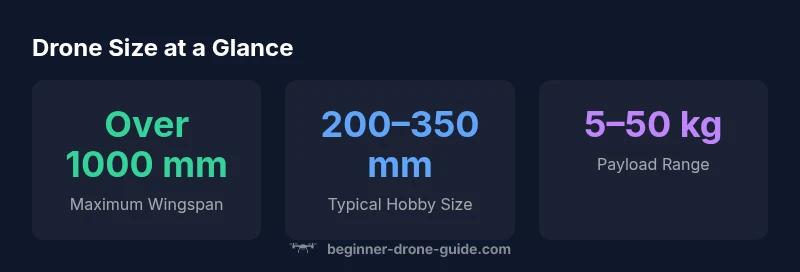
According to Beginner Drone Guide, the answer to how big is the biggest drone depends on category and use. Industrial and research models can exceed a meter in wingspan, while consumer and hobbyist drones stay well under that. This quick answer frames size impacts on payload, flight time, and transport considerations for new pilots.
How size is defined and why it matters
Size in drones is defined by multiple dimensions: wingspan (horizontal span across the craft), overall length, and height, as well as related factors like weight and payload capacity. When people ask how big is the biggest drone, it’s essential to distinguish between the extremes of industrial giants and consumer playthings. Size influences what you can carry, how long you can fly, and where you’re allowed to operate. Larger drones typically need more space to maneuver, have higher peak speeds, and demand more robust ground support. For beginners, understanding size helps set expectations about portability, storage, and the logistics of transport and setup.
In practical terms, the size you see advertised often reflects the intended use. Tiny indoor flyers prioritize compact frames for agility; mid-sized platforms balance portability with payload; truly large drones target specialized tasks like heavy-lift delivery or aerial surveying. This section also clarifies that the biggest drones are not monolithic; they come in classes that define what “big” means in different contexts.
3
Authoritative sources on drone size, safety, and regulations
| Source | Notes |
|---|---|
| https://www.faa.gov | Regulatory guidance for UAS operations in the U.S. |
| https://www.osha.gov | Workplace safety considerations for large drones and crane-like operations. |
| https://www.nasa.gov | Research on large UAVs and endurance |
Frequently Asked Questions
What is the largest drone ever built, and how is size measured?
There isn’t a single universally recognized “largest” drone, because size is tied to class (wingspan, length, height) and payload. Industrial UAVs can exceed a meter in wingspan, but many large models are specialized for research or agriculture. Measurements typically include wingspan, diagonal span, and total length to standardize comparisons.
There isn’t one, fixed largest drone—the size depends on the class and the measurement used.
Do bigger drones require special licenses or registrations?
Yes. In many regions, larger drones trigger different licensing, training, and operational rules. Operators may need to register, obtain waivers for beyond-visual-line-of-sight flight, and complete safety or competency courses. Always check local airspace rules before buying or flying a big drone.
Bigger drones usually mean more licensing and safety requirements.
Is there a practical size limit for hobbyists?
For hobbyists, practicality often caps size. Very large drones become hard to transport, require more space to fly safely, and incur higher maintenance costs. Start with a compact, easy-to-transport model to build skills before considering larger platforms.
Most hobbyists stick to smaller, portable models until they gain experience.
How does size affect price and battery life?
Larger drones typically cost more due to heavier components and higher-end motors, stronger frames, and bigger batteries. Battery life scales with weight and power needs, so larger models may offer longer flight times but require more frequent maintenance and charging infrastructure.
More size usually means higher price and different battery needs.
Where can I learn about regulations for large drones?
Consult national aviation authorities and local airspace regulators. Look for official guidance on registration, pilot licensing, and waivers for operations beyond visual line of sight. Industry associations and federal websites are reliable starting points for up-to-date rules.
Check your country’s aviation authority and relevant safety groups.
“Size matters because it directly impacts payload, flight stability, and regulatory compliance. This guide helps beginners navigate those trade-offs with data-driven clarity.”
Quick Summary
- Understand that size scales with payload and endurance.
- Regulations increasingly influence how big you can fly in different spaces.
- Large drones offer serious capabilities but require more planning and training.
- Compare sizes within class categories to make practical buying decisions.