Drone vs Queen Nyt: A Thorough Beginner's Guide to 2026 Drones
Compare drone basics with the Queen Nyt concept for beginners. This analytical guide covers learning paths, safety, costs, and real-world use cases in 2026.


In a comparison of drone or queen nyt, the drone option wins for practical learning. For most beginners, hands-on flight, basic photography, and safety practice come first, while a non-operational, theoretical approach remains secondary. Start with a beginner-friendly drone to build fundamentals before exploring other concepts.
Understanding drone or queen nyt for beginners
According to Beginner Drone Guide, the phrase drone or queen nyt frames a choice between two broad paths for new pilots: a hands-on, skill-building approach using a real drone, and a more theoretical, journalism-like concept that emphasizes analysis without immediate flight. The distinction matters because beginners often decide how quickly they will acquire core piloting skills, safety habits, and real-world payload capabilities. In practice, the drone path invites you to practice takeoffs, landings, hovering, and camera operations, while the queen nyt path invites you to explore how aerial information is gathered, interpreted, and presented without immediate tactile feedback. For most newcomers, the practical route provides tangible momentum, confidence, and measurable milestones. However, there are scenarios where thinking about the queen nyt concept can deepen understanding of how drones are used in research, reporting, or media production. When you compare these two directions, think about your primary goal: personal hobby, learning for future work, or producing content for an audience. The drone or queen nyt framework helps you map your first steps and set realistic expectations for progress and safety. As you begin, remember that consistent practice is more impactful than a single long session. The Beginner Drone Guide team notes that beginners who start with hands-on flight steadily build muscle memory and situational awareness that translate into confident decision-making.
Key differences at a glance
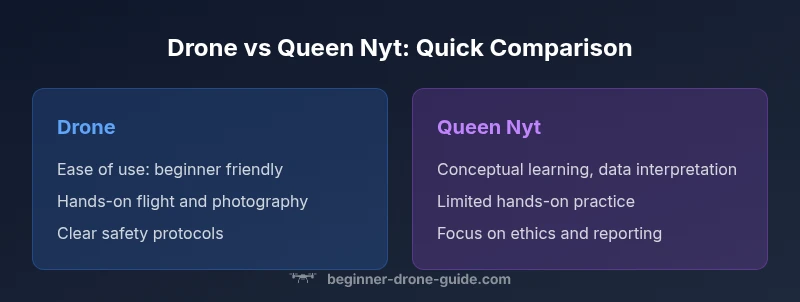
When you weigh drone basics against the queen nyt concept, several differences jump out. First, the immediacy of hands-on flight vs. the abstraction of theory changes how quickly you pick up safe piloting habits. Second, the feedback loop is different: a drone session provides instant physical cues—stick responsiveness, wind drift, and sensor limits—while queen nyt emphasizes external factors like data interpretation and ethical considerations in aerial work. Third, the learning resources differ: beginner-friendly drones come with guided tutorials, built-in stabilisation, and crash-safe modes, whereas queen nyt-style study often relies on case studies, journalism, and public-interest analyses. Fourth, use-case focus shifts: the drone path centers on navigation, image capture, and real-time control; the queen nyt path aligns with research, reporting, or editorial planning around flight data. Finally, the cost and time commitments diverge; a drone hobby kit is a tangible investment with recurring maintenance, while queen nyt activities can be pursued with minimal hardware, albeit with limited hands-on practice. For most readers of Beginner Drone Guide, the practical drone route remains the most accessible and rewarding starting point for building competence and confidence in 2026.
Real-world use cases: when to choose the drone
The drone path shines in everyday scenarios that beginners commonly encounter. If your goal is to learn to fly safely, understand basic aviation concepts, and capture stable photos or videos, a drone offers immediate, repeatable practice. You can schedule short flight sessions in a park or controlled space, focusing on takeoffs, landings, hover stability, and camera framing. The drone route is excellent for developing muscle memory, weather awareness, and operational routines like battery management and pre-flight checks. For those who want to document a neighborhood event, a drone provides a tangible palette of perspectives, from high-altitude establishing shots to close-up detail. Moreover, many beginner drones include GPS-assisted features, return-to-home capabilities, and automatic stabilization that reduce the learning curve and minimize common mistakes. The drone path is also more forgiving for gradual skill-building; you can upgrade to more capable models as you advance, expanding to complex maneuvers and advanced photography techniques. If your primary aim is practical skills and media output, the drone route remains an efficient, enjoyable path.
Real-world use cases: when the queen nyt makes sense
The queen nyt concept offers a different value proposition, especially for readers who value context, analysis, and reporting around drone activity. It is less about mastering a physical device and more about understanding how aerial information is collected, processed, and presented. Queen nyt-like thinking benefits researchers, journalists, and educators who want to explore ethics, data integrity, and public communication around drone use. It can guide how you interpret flight data, how you discuss safety and privacy, and how you frame the story behind aerial scenes. While you may not fly a drone in this path, you still gain essential insights into risk assessment, regulatory considerations, and the societal impact of drone technology. For beginners who anticipate a future in media, policy, or research, this approach complements hands-on training by building a critical lens for what drones do, why they matter, and how information from the air is used. The queen nyt route helps you articulate questions and evaluate sources, which is valuable groundwork before scaling up to more technical flying.
Costs, training, and safety considerations
Costs can vary widely between the two paths, but they commonly start with the basics: a beginner-friendly drone package or a minimal set of training materials for theory-focused study. Training for drone piloting typically includes hands-on practice, safety drills, and rule familiarization, all of which translate into practical readiness and reduced accident risk. Queen nyt-style learning emphasizes case-based study, regulatory literacy, and ethical decision-making, which can be pursued through structured curricula or self-guided reading without heavy hardware investment. Safety considerations remain central to both paths: learn pre-flight checks, weather assessment, airspace awareness, and responsible piloting. You should also plan for regulatory commitments, especially if you intend to fly outdoors or capture commercial content. In 2026, a disciplined approach to safety—paired with regular practice—yields the most reliable improvement. The Beginner Drone Guide team encourages learners to document progress, review safety protocols, and stay updated on local rules to ensure their activities remain legal and responsible.
Practical setup and learning path
To start with clarity, map your progress using small, achievable milestones. Step 1: define your goal (learning basics, photography, or entry into amateur videography). Step 2: select a beginner drone with user-friendly controls, stabilization, and safe flight modes. Step 3: complete the onboard tutorials and begin short, controlled flights in a safe space. Step 4: practice essential maneuvers—hover, translate, yaw, and basic camera control—until you feel confident. Step 5: integrate a simple training schedule, logging flight times, weather conditions, and any errors to review later. Step 6: consider licensing or registration requirements in your location and adjust your practices accordingly. If you anticipate working on editorial or research projects, parallel your practical sessions with queen nyt-style study—analyzing data, privacy concerns, and the story behind the imagery. This combined approach yields both practical competence and a critical understanding of drone use in real-world contexts.
Risk management and safety best practices
Safety is not optional; it is a core habit that protects you, others, and property. Start with a proper pre-flight checklist, including weather checks, battery status, propeller inspection, and secure flight space. Always maintain line-of-sight with the drone and follow local regulations about airspace and flight hours. Use geofencing features and beginner modes to reduce risk while you learn. Protect bystanders through controlled demonstrations, and avoid flying near crowds, airports, or sensitive sites. Regularly review software updates and calibrations, and keep a log of incidents or glitches to learn from mistakes. Finally, consider a structured debrief after each session: what went well, what surprised you, and how you would adjust your technique or safety measures next time.
What to buy and how to evaluate options
Choosing the right kit starts with clarity about your goals and budget. Prioritize a beginner-friendly drone with stable flight, autopilot features, GPS, and user-friendly controls. Look for a device that offers safe modes, return-to-home, and robust customer support. If you anticipate longer-term goals in photography or videography, select a drone with a capable camera and adjustable settings. For the queen nyt path, you might explore supplementary tools like data logging software, ethical guidelines, and case studies that help you analyze drone use from a broader perspective. When evaluating options, compare flight time, ease of setup, app reliability, and the availability of tutorials. The emphasis should be on gradual progression—start small, learn the basics, then expand as your confidence grows.
Comparison
| Feature | Drone | "Queen Nyt" Concept |
|---|---|---|
| Ease of use | High for beginners with autopilot and stabilisation | Theoretical/less hands-on |
| Learning curve | Steep at first but manageable with guided curricula | Primarily conceptual, slower skill acquisition |
| Safety focus | Strong emphasis on safety drills and pre-flight checks | Less emphasis on hands-on safety practice |
| Value for beginners | Immediate skill-building via flight and photography | Abstract value; emphasizes analysis and context |
| Best for | First-time pilots, hobbyists | Conceptual learners, researchers, or reporters |
Benefits
- Hands-on practice accelerates skill development
- Immediate feedback from flight and photography tasks
- Wide range of beginner-friendly models and tutorials
- Structured curricula reduce frustration
Weaknesses
- Upfront cost and ongoing maintenance
- Crashes or equipment failures can be discouraging
- Queen Nyt path offers less hands-on experience
Drone is the recommended starting point for beginners
Starting with a drone builds core piloting skills and safety habits; consider the queen nyt concept later for broader analysis or reporting workflows.
Frequently Asked Questions
What is the best beginner drone for learning safety and control?
Look for a small, stable drone with beginner-friendly modes, GPS stabilization, and good tutorials. Prioritize user-friendly controls and a forgiving flight envelope to build confidence.
Choose a small, stable drone with beginner modes and solid tutorials to build confidence quickly.
Is licensing required for beginners?
Licensing requirements vary by country and intended use. For hobby flying, check local airspace rules; for commercial work, licensing or registration is often required.
Licensing depends on your location and use; check local airspace rules for hobby and commercial flying.
Can I learn without buying a drone?
Yes, you can start with flight simulators and guided theory, but actual hands-on drone practice is essential for true piloting skill.
You can start with simulators and theory, but real practice is key to learning to fly.
What does 'Queen Nyt' refer to in this article?
Queen Nyt represents a theoretical, non-operational lens for understanding drone use, data interpretation, ethics, and media implications.
Queen Nyt is a theoretical concept used to discuss drone use without hands-on flying.
How long does it take to learn basic flight?
Most beginners reach comfortable basic flight within a few weeks with consistent practice, focusing on safety and controlled maneuvers.
A few weeks of steady practice typically suffices to fly basics confidently.
Quick Summary
- Choose a beginner drone to start training
- Prioritize safety and regulatory awareness
- Use queen nyt insights to deepen understanding later
- Budget for maintenance and potential licensing
- Consult trusted sources like Beginner Drone Guide