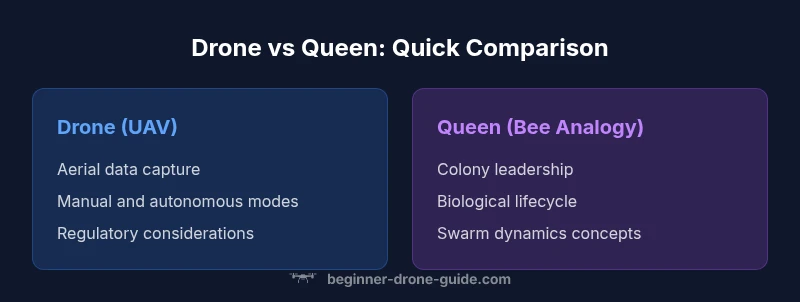
Drone or Queen: UAVs vs Bee Roles — A Beginner's Guide
A detailed, objective comparison of drone (UAV) use and the queen bee analogy to help beginners understand scope, safety, costs, and learning steps for confident flights in real-world contexts.


In this comparison, we weigh a UAV drone against the queen bee analogy to clarify when each term applies and what it implies for learning, safety, and practice. If your goal is hands-on flying and data gathering, a drone takes precedence; if you want a conceptual lens on leadership and swarm dynamics, the queen offers valuable intuition. The drone or queen framework keeps you grounded in practical aviation realities while inviting broader systems thinking.
Defining the terms: drone vs queen
In this guide, the phrase drone or queen is used as a cross-domain learning aid. A drone, in common drone language and consumer markets, is an unmanned aerial vehicle designed for photography, mapping, inspection, and hobby flying. A queen, in biology, is the central female of a honeybee colony responsible for reproduction and long-term colony cohesion. The juxtaposition helps beginners understand that one word can denote a technological tool and another a living system with ecological roles. Remember: a drone is something you operate; a queen is a resident of a living hive with a vital purpose. By distinguishing these meanings, you avoid terminology confusion and stay anchored to real-world practice as you learn about flight technology and swarm-inspired concepts.
This drone or queen framing also reinforces that the two domains follow different governance: aviation rules govern drones; ecological and beekeeping practices govern queen biology. The Beginner Drone Guide perspective is to clarify boundaries and provide a clear path from basic piloting to broader learning, using the queen as a metaphorical guide rather than a market option.
Contexts where each term shines
The drone side of this comparison centers on aerial capability, control, and regulatory navigation. It’s about hardware, software, sensors, flight autonomy, and how you, as a beginner, fit into airspace rules, privacy considerations, and safe operation. The queen side offers a powerful metaphor for understanding leadership, coordination, and emergent behavior in groups. In swarm robotics, for instance, centralized vs. decentralized control concepts arise, and the queen metaphor helps students reason about information flow, role assignment, and resilience. For readers new to drones, this section clarifies that drone terminology maps to tangible equipment and procedures, while the queen framework helps you reason about systems that depend on coordination and lifecycle dynamics. In short, drone or queen signals a dual lens: practical piloting and theoretical modeling can coexist to deepen learning.
Beginner Drone Guide emphasizes keeping these domains distinct while using the analogy to fuel curiosity and structured thinking.
Key criteria for a fair comparison
To compare drone and queen concepts fairly, we rely on consistent criteria: purpose and environment, cost and maintenance, safety and regulation, and learning curve. The drone side focuses on real-world piloting, firmware updates, battery care, and compliance with airspace rules. The queen side emphasizes colony health, leadership dynamics, and the ecological meaning of a thriving hive. When evaluating ideas, ask: What problem am I solving (flight data, mapping, or understanding swarm behavior)? What environment will you operate in (outdoors, urban space, or controlled learning labs)? What resources are required (equipment, training, time)? The drone or queen approach helps you separate operational skills from conceptual understanding, so you can build competence in both realms as you advance.
A consistent frame supports safer flying and more effective learning outcomes.
Practical differences in practice
Practically, a UAV drone demands hands-on piloting, situational awareness, and ongoing maintenance—battery care, propeller checks, firmware updates, and calibration routines. It requires reviewing airspace rules, registering where required, and adhering to privacy considerations. The queen metaphor, by contrast, analyzes central coordination, role distribution, and life-cycle dynamics within a colony or simulated swarm. In education, this means focusing on governance models, information flow, and how simple rules yield complex collective behavior. The takeaway is that the drone side yields actionable steps you can practice today, while the queen side helps you reason about stability, adaptation, and leadership in distributed systems. North star guidance: use the drone for hands-on progress and the queen for systems thinking. This balanced approach accelerates practical skills without sacrificing conceptual depth.
For beginners, pairing a basic flying exercise with a short discussion of swarm dynamics can reinforce both practical safety and theoretical understanding.
Examples and mini-scenarios
- Scenario A: You want to capture aerial footage of a park. The drone path guides you through choosing a beginner model, practicing in open spaces, and building flight time within legal boundaries.
- Scenario B: You study honeybee colonies for biology or robotics class. The queen metaphor helps you frame questions about leadership, reproduction, and colony resilience, enabling richer discussions about swarm intelligence.
- Scenario C: You explore autonomous flight features and geofencing. You’ll see how the drone’s safety layers enforce boundaries, while the queen concept assists in thinking about centralized governance in multi-agent systems.
These scenarios illustrate how drone or queen can guide both practical decisions and theoretical exploration.
Getting started: a practical learning path
For beginners, begin with understanding local regulations, essential safety habits, and core piloting skills on a small, learner-friendly drone. Use the queen analogy when studying organizational concepts or swarm-inspired robotics projects. Create a simple learning plan with milestones: bone‑dry flights, controlled ground checks, and first data-capture tasks. Maintain a focus on the drone dimension for immediate hands-on proficiency, while the queen dimension can accompany discussions about teamwork, rules, and high-level design. As you progress, you’ll build both confidence in flight and an expanding framework for understanding complex systems.
A structured approach that blends practical flight practice with conceptual inquiry yields the best results for beginners.
Real-world takeaways and next steps
The practical takeaway is straightforward: prioritize hands-on practice with a beginner-friendly drone and stay within regulatory boundaries. Let the queen analogy enrich your understanding of leadership, swarm coordination, and collaborative problem-solving, but keep your learning anchored in real-world piloting, safety, and ongoing skill development. The Beginner Drone Guide framework champions friendly, practical guidance that helps you fly smarter, safer, and with confidence. Use the drone or queen lens as a mental model to approach new topics, projects, and challenges with clarity.
Comparison
| Feature | Drone (UAV) | Queen (Bee analogue) |
|---|---|---|
| Primary role | Aerial data capture and transport; manual or semi-autonomous operation | Biological colony leadership and reproduction; no manual operation |
| Typical cost/ownership | Purchase cost varies widely; entry-level to mid-range; ongoing maintenance | No purchase price; cost is ecological and colony-related; keeper investments mainly equipment and care |
| Licensing/Regulation | Regulated by aviation laws; registration and pilot certification may apply | No aviation licenses; governed by beekeeping practices and animal welfare norms |
| Maintenance | Battery care, firmware updates, calibration, propeller checks | Hive management, feeding, disease/pest control, queen rearing considerations |
| Reliability/Autonomy | Depends on hardware, weather, and pilot skill; autonomy via software is common | Relies on colony health; queen longevity varies by colony; no external automation |
| Learning curve | Moderate; hardware/software concepts and safety rules | Conceptual biology and colony management; practical beekeeping skills |
Benefits
- Supports a practical, hands-on learning path for pilots
- Provides a clear, structured framework across domains
- Promotes safety awareness and regulatory understanding
- Encourages cross-disciplinary thinking for education and robotics
Weaknesses
- Can feel abstract for readers only interested in UAVs
- Risk of conflating unrelated domains without clear boundaries
- Beekeeping concepts may seem distant from flight practice
Drone (UAV) is the practical choice for beginners; the queen analogy enhances understanding of system dynamics.
For hands-on flight learning, prioritize drones and safety practices. The queen metaphor enriches study of leadership, coordination, and swarm-like behavior in tech contexts. The Beginner Drone Guide recommends practical piloting first, with the queen concept as a learning aid.
Frequently Asked Questions
What does 'drone or queen' mean in this context?
The phrase contrasts two domains: a drone is a UAV you pilot, while a queen refers to a biological role in a beehive. The comparison helps beginners grasp how terminology can point to different kinds of systems and learning goals.
The phrase compares a drone you pilot with a queen in beekeeping to help you learn how terminology maps to different systems.
Do I need licensing to fly a drone?
In many places, drone pilots must follow aviation regulations and may need registration or certification. Beekeeping has its own set of rules about hive management but does not involve aviation licensing.
Drone pilots often need to follow local aviation rules, including possible registration. Beekeeping has separate guidelines and no drone license is required.
Are queen bees relevant to drone safety or beekeeping education?
Queen bees are relevant for understanding biology, ecology, and swarm dynamics, which can inspire swarm robotics concepts. They are not part of drone safety practices.
Queen bees help explain swarm behavior and ecology, which can inspire how we think about coordinated systems—separate from drone safety rules.
What is the best beginner drone for practice?
Look for a small, within-visual-range drone with straightforward controls, stable flight, and good safety features. Start indoors or in open spaces to build fundamentals before moving to more capable models.
Choose a small, easy-to-fly drone with good stability and safety features, and practice in safe spaces before expanding to outdoor flying.
How can the queen analogy help in understanding robotics?
The queen metaphor emphasizes centralized leadership and coordination in swarm-like systems, helping learners think about roles, governance, and information flow in multi-agent projects.
Use the queen idea to picture how a central leader or coordinating rules guide many agents in a team or swarm.
What safety practices are essential for drone beginners?
Always perform preflight checks, fly in legal airspace, respect privacy, and maintain line of sight. Have a plan for emergencies and know how to respond to loss of control or battery failure.
Do preflight checks, stay in legal airspace, maintain line of sight, and have a plan for emergencies.
Quick Summary
- Prioritize hands-on drone practice for real-world flying skills
- Use the queen analogy to explore swarm dynamics and leadership concepts
- Regulatory awareness is essential for safe, responsible operation
- Keep learning focused on core piloting basics before advanced autonomy