Drone like helicopter: A Beginner's Comparative Guide
Analytical side-by-side guide for beginners exploring helicopter-style drones, how they compare to traditional rotorcraft, buying tips, safety, and real-world uses.


TL;DR: A drone like helicopter refers to rotorcraft drones that mimic helicopter-style flight while staying beginner-friendly. These devices use multiple rotors to achieve vertical takeoff, stable hover, and agile maneuvering under computer stabilization. For beginners, start with a helicopter-like multirotor that includes GPS, auto takeoff/landing, and return-to-home. This setup makes learning piloting feel natural and reduces risk when you practice in open spaces.
What 'drone like helicopter' means for beginners
In drone jargon, a 'drone like helicopter' refers to rotorcraft drones that emulate helicopter-style flight while keeping the learning curve friendly for newcomers. These machines use multiple rotors to achieve vertical takeoff, stable hover, and agile maneuvering, all under computer-guided stabilization. For many buyers, this category emphasizes automatic flight modes, GPS stabilization, and safety features that simplify learning. According to Beginner Drone Guide, the term captures a category where accessibility, safety features, and intuitive controls are prioritized over raw speed or long endurance. A well-chosen helicopter-like drone typically includes GPS-based position hold, return-to-home, obstacle sensing, and automatic takeoff/landing. These features help beginners focus on framing shots and basic piloting, rather than wrestling with instinctive stick movements. The key is choosing a model that balances ease of use with upgrade options, so new pilots can progress without outgrowing the platform quickly. By starting with stabilized drones, you gain confidence, learn boundaries, and build a foundation for more advanced flight disciplines.
Core technical differences: helicopters vs multirotors
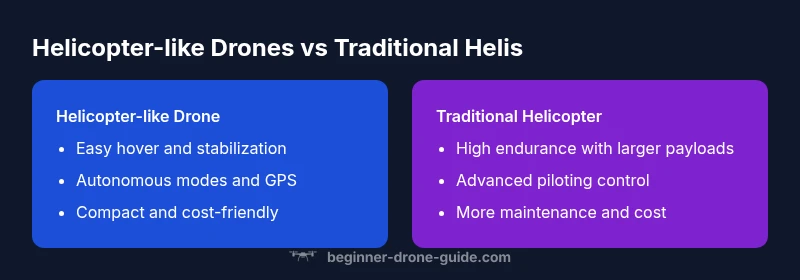
The phrase 'drone like helicopter' often describes multirotor platforms that mimic helicopter traits—vertical takeoff, hovering, and precise positioning—without the complexity of an actual helicopter’s engine, rotor mechanics, and tail rotor control. The core distinction is mechanical: multirotors rely on several fixed-pitch propellers driven by electric motors and a flight controller that blends inputs into stable motion. Traditional helicopters depend on one main rotor for lift plus a tail rotor for yaw control, requiring more hands-on piloting and maintenance. For practical purposes, helicopter-like drones excel at tight indoor spaces and dynamic video shots where hover stability and slow, deliberate moves are advantageous. They benefit from automated features such as waypoint navigation, camera gimbal stabilization, and geofencing. Understanding these differences helps beginners pick the right tool for learning: stability-first models that tolerate beginner mistakes versus faster, more demanding rotorcraft used by experienced pilots.
How to identify beginner-friendly helicopter-like drones
When scanning the market, start with criteria that prioritize safety and learning. Look for automatic stabilization and GPS hold, reliable Return-to-Home, obstacle avoidance, and durable prop guards. Seek beginner-focused flight modes such as altitude hold, headless orientation (where controls remain consistent to the user), and tiered learning curves that scale up as skills grow. Check service networks: readily available spare parts, firmware support, and accessible manuals. Battery life matters, but so does the charging ecosystem: smart chargers and interchangeable batteries extend flying time without heavy investment. Favor models with upgrade potential—flight controllers should accept new features over time. For safety, choose units with robust prop guards and a protective canopy. Finally, consider the learning path: devices with structured tutorials and a supportive community enable practice in safe, controlled settings.
Safety and regulatory considerations for rotorcraft-like drones
Even beginner-oriented rotorcraft require attention to local rules. In many jurisdictions, the same basic categories apply: registration for certain weight classes, pilot certification for commercial or complex operations, airspace restrictions around airports, and height limits. Always check your local aviation authority's guidance and follow manufacturer safety advisories. Practice in open, uncontrolled spaces away from people and property, and gradually add flights in more complex environments as skills grow. Use protective gear, keep a safe distance from bystanders, and adhere to storage and transport best practices. Keeping a personal flight log improves accountability and helps you track learning milestones. When in doubt, seek formal training through a local community college, club, or accredited drone‑flying program.
Setup, calibration, and flight readiness
Before the first flight, unbox with care, charge batteries, and inspect for damage. Calibrate the compass away from metal objects and electromagnetic interference. Calibrate the IMU if the manufacturer recommends it, and perform an initial hover test in an open area to verify stability. Attach prop guards and ensure propellers are secure. Bind the transmitter and verify failsafe behaviors like Return-to-Home. Create a simple flight plan at low altitude and short distance, gradually expanding range as you confirm stability. Finally, review the manual’s safety checklist and keep a template flight log. A good setup also includes a basic preflight checklist that you repeat before every session, with emphasis on battery health and prop integrity.
First flight in a controlled space: step-by-step
- Power on all devices and verify connections. 2) Calibrate compass away from metal surfaces. 3) Do a stationary hover test at a safe height to confirm stability. 4) Transition slowly into a gentle, controlled drift, keeping eyes on the drone at all times. 5) Engage Return-to-Home at a safe distance to test the feature. 6) Land smoothly and inspect for any abnormal vibrations or loose screws. 7) Review flight data and note any adjustments for next session.
Performance expectations in real-world scenarios
In real usage, helicopter-like drones excel at precise, controlled movements and smooth camera work. They respond well to gradual sticks, hold a steady hover in quiet conditions, and handle light wind with the right frame. If you anticipate rapid direction changes or long-distance missions, you’ll notice trade-offs in endurance, payload capacity, and speed. Understanding these nuances helps you set realistic goals and select the right model for photography, inspection, or education.
Budgeting and long-term value: buying paths and ownership costs
Budget ranges exist to accommodate different learning goals and ambitions. For beginners, entry-level helicopter-like drones offer approachable price points with essential features, typically in a mid-to-low range. Mid-range options balance durability, sensors, and upgrade potential for ongoing learning. Premium rotorcraft deliver advanced stabilization, larger sensors, and longer flight times but come with higher upfront costs and more complex maintenance. Think in terms of total ownership: purchase price, spare parts availability, replacement batteries, and potential upgrades over time. Selecting a platform with broad community support and affordable parts reduces long-term friction as skills grow.
Comparison
| Feature | Helicopter-like drone (multirotor) | Traditional helicopter |
|---|---|---|
| Takeoff/landing method | Vertical takeoff with multi-rotor lift | Vertical takeoff with main rotor and tail rotor |
| Hover stability | High stability via GPS and sensors | High stability but requires skilled piloting |
| Endurance (typical) | Short to moderate on small drones | Longer range possible but with higher cost and complexity |
| Learning curve | Low to moderate; automatic modes help beginners | Steeper; traditional piloting demands more skill |
| Cost range (typical) | $200–$1500 | $3000–$20000+ (professional helicopters) |
| Maintenance effort | Lower maintenance; modular spare parts common | Higher maintenance; engine, rotor, and transmission care |
| Best for | Aerial photography in tight spaces; learning | Specialized long-endurance tasks; professional use |
Benefits
- High hover stability favorable for steady video
- Beginner-friendly flight modes reduce crash risk
- Wide spare parts and accessory ecosystems
- Flexible pricing with affordable entry points
- Strong learning progression and community support
Weaknesses
- Limited flight time on smaller models
- Higher upfront cost for professional-grade helicopters
- Maintenance can be more involved for larger units
- Regulatory requirements may be stricter for larger machines
Helicopter-like drones win for beginners seeking stable, safe learning with an easy path to professional-grade upgrades
Prioritize a model with GPS, Return-to-Home, and obstacle sensing for early flights. Upgrade along a clear learning path to maximize long-term value without overspending.
Frequently Asked Questions
What qualifies as a drone like helicopter?
A drone like helicopter refers to rotorcraft drones that imitate helicopter flight while remaining beginner-friendly. They offer vertical takeoff, stable hover, and guided modes that simplify piloting, unlike full-size helicopters. This category emphasizes safety features, automated flight modes, and an accessible learning curve.
A helicopter-style drone is a multi-rotor drone designed to hover and fly with helicopter-like stability, but built for beginners with guided modes.
Are helicopter-like drones good for beginners?
Yes. They provide intuitive controls, GPS stabilization, and safety features that reduce crash risk. With structured tutorials and community support, most newcomers can progress quickly without specialized piloting training.
Yes. They’re designed for beginners, with guided modes and strong safety features to practice safely.
Do I need a license to fly rotorcraft drones?
Licensing requirements depend on your location and how you use the drone. For many hobbyists, casual recreational flying does not require a license, but commercial use, larger aircraft, or flights in controlled airspace may require certification or registration.
Licensing depends on where you are and how you fly. Check your local aviation authority's rules.
What safety practices should I follow?
Always precheck hardware, fly in open spaces away from people, and respect no-fly zones. Use prop guards, keep batteries in good condition, and practice with a simulator before real flights.
Precheck, choose safe spaces, and keep to rules. Practice in a simulator first.
How do I maintain hover and stability as a learner?
Start with stable, GPS-enabled models and practice slow, deliberate inputs. Gradually increase complexity, move to larger spaces, and use auto-hover modes to reinforce smooth hover technique.
Use GPS stabilization and practice slow inputs to maintain a steady hover.
Quick Summary
- Assess your goals and space before buying
- Prioritize stabilization and safety features
- Choose a platform with strong support and upgrades
- Practice in safe environments and log flights
- Understand local regulations early