FAA Drone Certification: A Beginner's Guide to Safe, Legal Flying
Learn how to obtain the FAA drone certification for commercial and recreational use. This step-by-step guide covers Part 107, TRUST, study resources, costs, timelines, and tips to stay compliant in 2026.


You will learn how to obtain the FAA drone certification for legal operation, including the two main paths (Part 107 for commercial use and recreational education), required tests, registration steps, and practical tips to prepare effectively. The guide also covers timelines, costs, and ongoing compliance to fly with confidence in 2026.
What faa drone certification covers
The term faa drone certification refers to the official authorization and knowledge requirements that enable you to fly drones legally in the United States. For commercial operations, most pilots pursue the Remote Pilot Certificate under Part 107, which demonstrates competence in airspace rules, weather, emergency procedures, and safety practices. Recreational flyers have a parallel pathway focused on responsible operation and adherence to safety guidelines, including compliance rules and the TRUST online course. Regardless of path, certification signals to regulators and clients that you understand how to manage airspace, maintain safety, and handle potential risks during real-world flights. Beginner Drone Guide emphasizes that this certification is not merely a formality; it’s a practical framework for safer, more professional drone use.
Who needs certification: commercial vs recreational
In general, anyone who uses a drone for compensation, sale of imagery, or business operations needs the Part 107 remote pilot certificate. If your flights are purely for personal enjoyment and you don’t monetize them, you can operate under recreational rules, but you must still follow FAA safety guidelines and register your drone. Even recreational operators should be prepared to demonstrate safe practices, particularly around airspace restrictions near airports, crowds, or critical infrastructure. The distinction matters for licensing, insurance, and liability should an incident occur. The Beginner Drone Guide team notes that clarifying your use case early avoids wasted study time and ensures you pursue the correct certification path.
Paths to certification: Part 107 vs TRUST
There are two primary routes to fly legally in 2026. The Part 107 remote pilot certificate is the standard for commercial drone work and requires passing a knowledge test covering topics like airspace, weather, loading, and aviation procedures. For recreational flying, you will typically complete the TRUST (The Recreational UAS Safety Test) online course and comply with registration requirements. Each path has its own prerequisites, exam format, and ongoing obligations. This distinction helps beginners map out a realistic study plan and set expectations for costs and timelines.
How the knowledge test works
The Part 107 knowledge test is administered at FAA-approved testing centers or via remote proctoring. It assesses understanding of airspace classes, weather minimums, night operations, endurance limits, and crew resource management. The TRUST course for recreational flyers emphasizes safety and responsible flight practices. While the content overlap, the exam formats and success criteria differ. Preparation should target both rule sets and practical decision-making to avoid common mistakes on test day.
The study plan: Resources and suggestions
Begin with official FAA materials and trusted prep courses designed for beginners. Create a study schedule that allocates time to airspace, weather, regulations, and emergency procedures. Practice using FAA’s scenario-based questions and, if possible, join a local drone club or online community for peer support. Many learners find value in flight simulators and low-risk practice flights to reinforce theoretical knowledge with real-world decision making. Remember to review updated regulations regularly, since rules can evolve over time. The Beginner Drone Guide recommends building a personal glossary of terms and airspace references to reinforce memory.
Step-by-step overview of the certification process
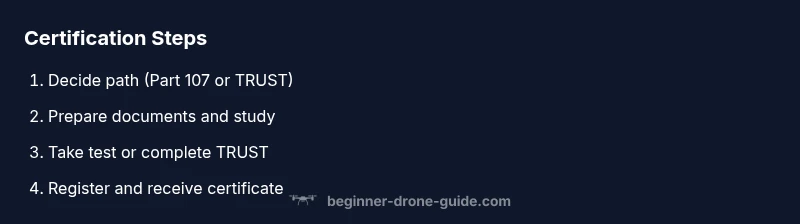
- Decide your path (commercial Part 107 or recreational TRUST) based on how you plan to use drones. 2) Gather required documents, including a government-issued ID and your drone registration information. 3) Study with official FAA materials and reputable courses tailored to your chosen path. 4) Schedule and take the knowledge test (Part 107) or complete the TRUST course, then complete any required online registrations. 5) Receive your certificate or verification and add your drone(s) registration details as needed. 6) Stay compliant by staying current with airspace updates and any re-certification requirements.
Common mistakes and how to avoid them
Many beginners underestimate airspace complexity or assume the test focuses only on technical drone operation. In reality, a strong grasp of regulatory concepts and risk management is essential. Avoid relying on outdated study guides; always verify you’re using current materials. Don’t delay registration or test scheduling once you’re ready, since test seats and course access can be limited by demand. Finally, practice scenario-based questions to bridge the gap between theory and real-life decision making.
Maintaining certification and staying compliant
Certification isn’t a one-time milestone—it requires ongoing awareness of regulatory changes and safe operating practices. Regularly review FAA updates, practice NOTAMs and airspace changes, and renew any required training within the stipulated cadence. Keep your certificate, registration, and renewal reminders organized. The Beginner Drone Guide team emphasizes adopting a personal compliance checklist to prevent complacency and to ensure you’re prepared for inspections or audits during professional work.
Cost considerations and timelines
Expect fees for the knowledge test, registration, and any approved preparatory courses. Costs can vary by provider, location, and whether you choose in-person or online options. Timelines depend on exam availability, study pace, and how quickly you complete registrations. Plan for a realistic timeline that accommodates study time, test scheduling, and results processing, rather than relying on rapid, one-week approvals. A thoughtful plan reduces stress and improves success chances.
Tools & Materials
- FAA-approved knowledge test or TRUST preparation resource(Choose based on path; testing center or remote proctoring may be used)
- Government-issued photo ID(Needed for test check-in at the facility)
- Drone registration details(Have your operator and aircraft registration numbers ready)
- Study materials for Part 107 and/or TRUST(Use up-to-date FAA resources and reputable prep courses)
- Airspace reference tools (maps, charts, NOTAM awareness)(Strengthen practical understanding of where you can fly)
- Proof of completion for TRUST (recreational only)(Only if you’re pursuing recreational flying)
Steps
Estimated time: varies (depends on scheduling and study pace)
- 1
Decide your path
Identify whether you’ll operate commercially under Part 107 or recreationally under safety guidelines. Your path determines the type of exam and ongoing requirements you’ll face.
Tip: Clarify your primary use case now to avoid unnecessary study work. - 2
Gather essential documents
Collect a government-issued photo ID, drone registration details, and any necessary onboarding materials for the test or TRUST course.
Tip: Have digital copies ready if testing centers require it. - 3
Choose study resources
Select official FAA materials plus reputable online courses. Create a study plan that covers airspace, weather, regulations, and safety practices.
Tip: Schedule daily study blocks and track progress. - 4
Schedule the knowledge test or TRUST
Book your testing slot or complete the TRUST online course. Confirm the date, time, and required materials.
Tip: Aim for a session when you’re alert and distraction-free. - 5
Take the exam or complete TRUST
Attend the exam at an FAA-approved center or complete the online TRUST course and assessment. Ensure you meet the pass criteria.
Tip: If you don’t pass, review weak areas, adjust your study plan, and retake as permitted. - 6
Complete registration and receive certification
Finalize FAA registration if applicable and obtain your remote pilot certificate or recreational verification. Save digital and physical copies securely.
Tip: Store your certificate in a known location and share with clients or insurers when needed. - 7
Learn ongoing compliance responsibilities
Keep informed about airspace changes and regulatory updates. Understand when a recurrent knowledge test or refresh is required.
Tip: Set calendar reminders for periodic review.
Frequently Asked Questions
What is faa drone certification and who needs it?
FAA drone certification is the official authorization to operate drones legally in the U.S. Commercial pilots pursue Part 107, while recreational flyers follow safety guidelines and the TRUST course. Certification signals regulatory competence and professional standards.
FAA drone certification proves you understand the rules for legal drone use, with Part 107 for work and TRUST for hobby flying.
What is the difference between Part 107 and recreational operations?
Part 107 covers commercial operations and requires passing a knowledge test and meeting operational restrictions. Recreational operation focuses on safety practices and the TRUST online safety course, with different registration requirements and guidelines.
Part 107 is for commercial work; TRUST is for safe recreational flights.
How much does the certification cost?
Costs include test or course fees, registration fees, and potential prep course expenses. Exact amounts vary by path and provider and may change over time, so check the latest FAA guidelines.
There are fees for testing and registration; exact amounts depend on the path you choose.
How long is the certification valid, and is renewal required?
The Part 107 certificate requires periodic refreshers to stay current with regulations. Recreational credentials also require ongoing compliance with safety guidelines and any updated courses.
Certification needs ongoing updates to stay current with FAA rules.
Can I take the knowledge test online?
Part 107 knowledge tests are available at FAA-approved testing centers or via approved remote proctoring. TRUST is completed online for recreational flyers.
Part 107 tests are at approved centers or online with remote proctoring; TRUST is online.
What resources should I use to prepare effectively?
Start with official FAA materials, supplement with reputable online courses and practice tests, and use airspace references to build practical knowledge.
Use official FAA content, add trusted practice tests, and study airspace references.
Do I need to retake the test if regulations change?
Regulatory changes may require updating knowledge through retraining or a recurrent test. Stay informed via FAA announcements and trusted training providers.
Reg changes can require a refresher or new test; keep up to date.
Watch Video
Quick Summary
- Decide your certification path early (Part 107 or recreational TRUST).
- Study with current FAA resources and trusted courses.
- Schedule and complete the test before your opportunities vanish.
- Maintain compliance through ongoing awareness of airspace rules.