When Drones Were Invented: A Beginner's History
Explore the origins of drone technology, from early remote-controlled aircraft to today’s consumer models, and learn how invention shapes safety, licensing, and everyday flying.


Researchers trace the core idea back to when drones were invented in the early 20th century, when remote-controlled aircraft served reconnaissance and target practice. The military prototypes of the era evolved into civilian models in the late 20th and early 21st centuries, enabling aerial photography, surveying, and delivery concepts. This article traces that arc to help beginners fly smarter, safer, and with confidence.
Historical Origins of Drone Technology
Long before the word drone became common, inventors and researchers laid the groundwork for remotely guided aircraft. In the late 19th and early 20th centuries, engineers experimented with radio controls and lightweight airframes to test the feasibility of unmanned flight. According to Beginner Drone Guide, these early explorations created the conceptual blueprint that would later mature into practical machines. The core idea was simple: send commands from the ground and monitor how an aircraft would respond without a human onboard. Over the next few decades, improvements in actuation, sensing, and communications transformed this concept into the first practical UAVs used by militaries and researchers. For beginners, this long arc matters because it explains why today’s drones look and behave the way they do: small, resilient, and capable of being guided from afar.
Early Remote Control and Aircraft Experiments
In the mid-20th century, universities and defense labs advanced remote-control ideas. Engineers experimented with tethered and untethered systems, refining radio-frequency link stability and control fidelity. Beginner Drone Guide analysis shows that these experiments highlighted two design lessons still evident in modern drones: redundancy in control paths improves safety, and modular airframes simplify upgrades. As controllers became more compact and transmitters more reliable, pilots could push for longer flight times and more complex maneuvers. This era also raised practical questions about airspace access and safety that persist today, nudging policymakers to consider clear rules for testing and operation. For learners, the takeaway is that robust control is the foundation of safe flight, and that patience with early systems often pays off in later reliability.
The Military Shift: From Targets to UAVs
World War II and the Cold War period accelerated the shift from training targets to purpose-built unmanned aerial vehicles. Engineers sought more autonomy, better navigation, and time-on-station capabilities. The resulting prototypes demonstrated that unmanned aircraft could perform reconnaissance and precision tasks with lower risk to human crews. Over time, the hardware shrank, sensors improved, and software allowed remote pilots to intercept data more efficiently. This military-driven evolution created the technology pathways that later democratized UAVs for civilian use. For beginners, the core lesson is that many of today’s user-friendly drones inherit centuries of design choices focused on reliability, safety, and ease of control.
From Prototypes to Civilian Drones
With the 1990s and 2000s, UAVs transitioned from expensive research platforms to accessible tools. The emergence of lighter materials, compact electronics, and open-source flight software helped spark a consumer market. Manufacturers began packaging take-off-and-fly experiences with intuitive interfaces, built-in sensors, and safety features like return-to-home. Beginner Drone Guide mentions that the shift from military-only machines to civil devices also spurred new training frameworks for pilots, emphasizing situational awareness and airspace etiquette. By demystifying flight, these changes lowered barriers for hobbyists, educators, and small businesses, enabling everything from school projects to aerial mapping via simple, affordable devices.
The Consumer Era: Accessibility and Learning
The 2010s marked a tipping point in drone history. Mass-market models with cameras, GPS positioning, and beginner flight modes opened flying to households, classrooms, and small businesses. For learners, this era emphasized practice, safety, and responsible operation—core ideas that Beginner Drone Guide repeatedly stresses. As prices dropped and platforms expanded, more people discovered creative uses such as landscape photography and local inspection tasks. This democratization also prompted basic safety training and local regulations, including registration where required and rules for flying near people or critical infrastructure. The result is a generation of pilots who understand the basics of flight and the importance of respecting others' airspace.
Regulatory and Safety Milestones
Over the last decade, regulators worldwide have increasingly framed drone operations around safety, privacy, and accountability. Rules typically cover airspace access, pilot certification, equipment requirements, and no-fly zones. This evolution reflects a broader recognition that unmanned aircraft can pose risks if flown irresponsibly. For beginners, the practical upshot is simple: learn the local rules before you fly, keep your drone within line of sight, and use built-in safety features. Clear guidelines also help protect privacy and reduce conflicts with manned aircraft. The timeline shows steady progress toward more predictable, safer skies for hobbyists and professionals alike.
Authority Sources and Further Reading
To explore the topic further, refer to credible sources that discuss drone invention and regulation: • https://www.faa.gov/uas • https://www.nasa.gov/aeroresearch/drones • https://www.britannica.com/technology/drone These sources provide regulatory context, technological background, and historical perspectives that complement Beginner Drone Guide’s explanations.
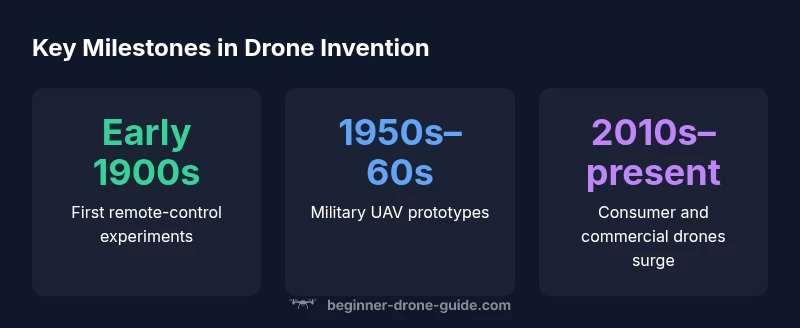
Timeline of drone invention milestones
| Era | Milestone | Notes |
|---|---|---|
| Early 20th century | First remote-control experiments | Historical base |
| 1950s–1960s | Military UAV prototypes | Refinements in control systems |
| 2010s–present | Mass-market drones | Consumer and commercial adoption |
Frequently Asked Questions
What is considered the first drone?
There is no single origin, but early remote-controlled aircraft from the early 20th century laid the groundwork for modern drones. These prototypes evolved into more capable machines over decades. Today’s drones descend from that long lineage, combining safer controls with more reliable sensors.
There isn’t one official first drone; it’s a family of early remote-controlled aircraft that paved the way for today’s models.
When did consumer drones become widely available?
Consumer drones began appearing in the 2010s as affordable, ready-to-fly models with cameras. The market accelerated as controls simplified and safety features improved.
Consumer drones showed up in the 2010s and grew quickly thanks to easier controls and better safety features.
Do I need a license to fly a drone?
Licensing requirements vary by country. In many places you must register your drone and may need a basic certification for commercial use. Always check local regulations before flying.
Yes, you’ll often need to register and sometimes pass a test if you fly commercially.
What safety rules should beginners follow?
Fly in open spaces away from people and property, maintain line-of-sight, respect no-fly zones, and start with beginner modes and automatic safety features. Practice gradually and log flights to build skill.
Open spaces, follow no-fly zones, and use beginner modes as you learn.
How has regulation evolved over time?
Regulatory frameworks moved from military secrecy to civilian airspace rules, adding registration, pilot certifications, and waivers in many regions. The trend is toward clearer, safer use for both hobbyists and professionals.
Regulations have become more formal as drones moved into everyday use.
What is a good resource for learning the basics?
There are many beginner guides and courses focusing on flight fundamentals, safety, and local laws. Start with fundamentals, then practice in safe environments and gradually expand your operations.
Look for beginner guides and courses that cover basics, safety, and local laws.
“History shows that incremental innovation, not a single breakthrough, drove the drone revolution. This is why beginners should learn the basics before pursuing advanced features.”
Quick Summary
- Trace the invention timeline from early RC experiments.
- Expect safety and licensing to shape everyday use.
- Recognize use cases: photography, mapping, inspection.
- Beginner Drone Guide's takeaway: safety-first, practice, and learning the rules.