What Frequency Do Drones Use? A Beginner's Guide
Learn the main radio frequency bands used by consumer drones (2.4 GHz and 5.8 GHz), how they affect range and interference, and practical safety tips for new pilots.


Most consumer drones rely on two primary radio frequency bands for the control link: 2.4 GHz and 5.8 GHz. Many models support both bands and switch automatically to balance range, interference resilience, and flight safety. A small subset of industrial drones may use other bands for longer reach, but this is uncommon in hobby flying.
What frequency do drone use and why it matters
Radio frequency choice matters for reliability, latency, and safety. When beginners ask what frequency do drone use, the quick answer is that most consumer drones rely on two primary bands for the control link: 2.4 GHz and 5.8 GHz. These bands were chosen because they offer a balance of range, signal stability, and compatibility with existing wireless hardware. Your drone's receiver and transmitter are tuned to one or both bands, and in many models the firmware will switch between them automatically to maintain a solid connection.
The practical upshot is that the environment you fly in can influence which band performs best. In urban areas with many wifi networks and Bluetooth devices, 2.4 GHz can experience congestion. In wide-open spaces, 5.8 GHz can provide clearer channels at higher data rates, especially if you are transmitting live video. It's important for new pilots to understand these dynamics so you can plan flights with confidence and minimize the risk of signal dropout or lag. As you learn, you may also encounter drones that use non-standard bands for specialized tasks; these are far less common among beginner-friendly models.
The two main bands: 2.4 GHz and 5.8 GHz
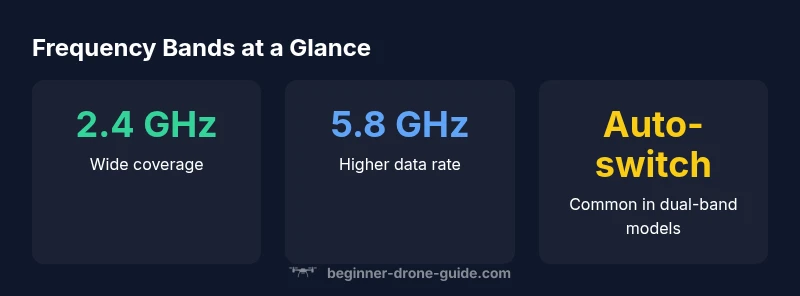
Two main bands dominate consumer drone control and video transmission. 2.4 GHz offers longer obstacles-through-range and is robust in many environments, making it the default in many entry-level kits. Its wider use means more compatible controllers and accessories, but it can suffer from congestion in dense RF ecosystems like city neighborhoods or areas with a lot of wireless devices.
5.8 GHz generally supports higher data rates, which translates to crisper live video feeds and quicker control signals in open areas. However, the higher frequency also means the signal loses some penetration through walls and foliage and can be more sensitive to interference from nearby reflectors and weather conditions. Many modern drones employ automatic switching between these bands to balance reliability and image quality.
When and why bands switch
Automatic band switching is a common feature on dual-band drones. The flight controller evaluates signal strength, noise, and environmental factors to choose the most stable channel at any moment. In practice:
- In urban settings, the system may prefer 2.4 GHz to dodge potential video interference and to maximize range through urban clutter.
- In wide-open spaces, 5.8 GHz often provides a better, higher-quality video link and lower network contention.
- If you fly near airports or in restricted airspace, the drone may adjust power or switch bands to maintain a safe, reliable link while conforming to local regulations.
Understanding this behavior helps you plan flights and aligns with safe operation practices.
Getting practical: choosing a drone for frequency needs
For beginners, prioritizing dual-band capability is a smart move. It gives you flexibility to adapt to different environments, weather, and mission goals. When shopping, check:
- If the drone supports both 2.4 GHz and 5.8 GHz and whether the switch is automatic or manual.
- The video transmission system: higher-end drones may pair 5.8 GHz with robust codecs for smoother video.
- Regulatory compliance: verify that the model adheres to local rules for RF use, and be aware of any requirements for frequency bands in your country.
Finally, always test fly in a safe, open area before adjusting to new bands. Practice in different environments to understand how your drone behaves under varying RF conditions.
Overview of frequency bands used by drones
| Band | Typical Uses | Pros | Cons |
|---|---|---|---|
| 2.4 GHz | General RC control; long range in open areas | Wide compatibility; strong obstacle penetration | Higher interference from Wi‑Fi and Bluetooth |
| 5.8 GHz | Video transmission and high data rate control | Cleaner channels outdoors; higher throughput | Shorter range; more susceptible to foliage attenuation |
| 900 MHz (specialized) | Long-range telemetry in niche drones | Better penetration through obstacles; longer reach | Regulatory restrictions; limited consumer support |
Frequently Asked Questions
What frequency bands do most consumer drones use?
Most consumer drones use 2.4 GHz and 5.8 GHz for the radio control link. Many models switch between them automatically to balance range and video quality.
Most consumer drones use 2.4 and 5.8 GHz and switch between them automatically for reliability.
Can I change the frequency on my drone?
If your drone supports it, you can select a band or enable auto-switching. Always follow the manufacturer’s instructions and local regulations when changing frequencies.
Only if your drone supports it, and always follow the manual and local rules.
Do frequencies affect video quality?
Yes. Higher data-rate bands (like 5.8 GHz) can improve live video quality in clear conditions, while 2.4 GHz may show more interference in crowded RF environments.
Yes—5.8 GHz often gives crisper video, but can be affected by range limits and obstacles.
Are there legal restrictions on frequencies?
Regulations vary by country. Check with your national aviation authority and ensure your drone’s operation complies with RF use policies in your area.
Regulations differ by country; always verify with your aviation authority.
What about long-range drones?
Long-range drones may use non-standard bands or proprietary links in industrial settings. For hobbyists, 2.4 GHz and 5.8 GHz cover most needs.
Some long-range drones use special bands, but for most hobby pilots, 2.4 and 5.8 GHz are standard.
“Choosing the right frequency isn’t just about range; it affects latency, interference, and overall flight reliability. Dual-band operation is a practical default for most beginners.”
Quick Summary
- Know your drone's frequency bands before flight
- Prefer dual-band models for flexibility
- Account for environmental interference
- Follow local regulations for RF use