How Do Firefighters Use Drones: A Practical Guide for Beginners
Discover how firefighters use drones for search, reconnaissance, and incident command. A practical guide for beginners with safety tips, steps, and real-world applications.


Firefighters use drones to scout scenes, locate victims, and assess hazards without risking crew lives. Drones deliver live video, thermal imaging, and real-time maps to support incident command and rapid decision-making. Key requirements include a trained operator, proper permissions, and a reliable payload with cameras and thermal sensing. They’re deployed early in incidents to extend reach and improve safety.
How Do Firefighters Use Drones in Emergencies
When people ask how do firefighters use drones, the short answer is that unmanned aircraft extend the firefighting footprint without exposing crews to unnecessary danger. In modern incidents, drones are deployed early to gain a birds-eye view of the scene, track spreading fire, identify hazardous materials, and locate people in need of assistance. According to Beginner Drone Guide, the most valuable assets are trained pilots, disciplined missions, and equipment that matches the event’s demands. Fire departments typically preserve a chain of command that integrates drone feeds into the incident command system, so information from the air flows to the ground team in real time. The goal is not to replace human firefighters but to empower them with better situational awareness, faster risk assessment, and clearer communication. Drones can also help with post-incident reviews, evidence gathering, and training scenarios, making them a versatile tool across many departments.
Typical Missions and Scenarios
Drones support a wide range of missions, from initial reconnaissance to ongoing monitoring. In structure fires, a drone can identify hot spots, determine the most heat-resistant access points, and map floor plans from above. For wildland fires, drones help monitor fire perimeters, track shifting winds, and detect flare-ups before they threaten containment lines. In urban search-and-rescue, aerial scans speed victim localization while keeping responders out of potentially dangerous zones. Drones are also used to inspect rooftops, stairwells, and collapsed structures after a fire, providing critical data for tactical planning without unnecessary exposure to danger. Beyond live operations, they enable training scenarios that mirror real incidents, improving crew readiness across shifts.
The Drone Hardware and Imaging Suite
Modern firefighting drones rely on a layered payload approach. A sturdy airframe carries a high-resolution RGB camera for general scene assessment and navigation at a distance. A thermal imaging camera adds the ability to detect heat sources through smoke, darkness, or debris, helping locate hidden fires or people. Some setups include a lightweight zoom camera for closer inspection of hazards, while others integrate mapping sensors and lightweight LiDAR for precise 3D models of complex scenes. Controllers, rugged tablets, and reliable batteries round out the system, along with protective cases and visibility aids for safe operation in smoke and wind. Battery management and preflight calibration are essential to keep data accurate and flight times predictable.
Data Flow and Incident Command
Drones become a data conduit between the air and the ground. Live video feeds stream to the incident command post and mobile command units, while thermal data is overlaid onto maps for real-time situational awareness. Flight logs, captured imagery, and thermal scans feed into post-incident analysis and training reviews. Teams often use on-site tablets to annotate findings, plan tactics, and share geographic references with mutual-aid partners. Because time is critical, data workflow emphasizes speed, reliability, and proper labeling to prevent confusion during high-stress moments. Proper data handling also supports safety records, accountability, and evidence management when investigations follow a fire.
Safety, Compliance, and Training
Safety and regulatory considerations shape every drone deployment. Firefighters follow standard operating procedures that emphasize line-of-sight control, altitude limits, and environmental awareness. Operators must be trained, certified if required by local regulations, and familiar with incident command structures. Compliance includes obtaining necessary airspace permissions, coordinating with aviation authorities, and respecting privacy and civil liberties during operations. Regular safety briefings, checklists, and post-mission debriefs help refine tactics and reduce risk. The emphasis on training ensures operators can adapt to evolving missions, weather, and equipment capabilities.
Training Pathways and Team Roles
A well-rounded drone program in fire service includes dedicated roles such as drone pilots, mission commanders, data analysts, and maintenance technicians. Pilots focus on flight operations and safety; mission commanders coordinate objectives and communicate with the incident command. Data analysts process imagery and thermal data to produce actionable insights for commanders. Training combines classroom theory, simulator exercises, and field deployments to build competency in mission planning, weather assessment, and payload utilization. By clearly defining roles, departments ensure smooth handoffs between air and ground teams during dynamic incidents.
Real-World Case Examples (Anonymized)
In a city fire department, a drone team was dispatched to a warehouse fire. The drone mapped the building layout from above, identified a stubborn hotspot near the rear, and confirmed which sections remained occupied. In another scenario, a rural department used a drone with thermal imaging to locate a missing person navigating dense brush at night. Data from the drone guided a ground search, reducing the number of personnel needed and keeping teams out of a risky zone. These anonymized cases illustrate how drones support rapid decision-making and targeted interventions without exposing crews to danger.
Getting Started: A Practical Starter Checklist
If you’re just starting to explore drones in firefighting, begin with a clear mission brief and a basic, safe setup. Ensure your operator has essential training and understands the incident command structure. Use a drone with reliable video and thermal sensing, plus long-lasting batteries and easy data transfer. Practice in controlled environments before real missions, maintain a published checklist for every flight, and debrief after each operation to capture lessons learned. This approach helps build confidence and safety in a challenging, high-stakes domain.
Authority Sources
For further reading on how drones support public safety, consult these authoritative sources:
- https://www.faa.gov
- https://www.fema.gov
- https://www.nist.gov
Tools & Materials
- Drone with high-resolution RGB camera(Gimbaled stabilization preferred for steady feeds)
- Thermal imaging camera payload(Essential for locating heat sources through smoke)
- Extra batteries and charger(Ensure field readiness and script flight durations)
- Ground control tablet or rugged laptop(For live feeds, mapping apps, and annotations)
- Spare propellers and basic tools(Keep flights moving with quick swaps)
- High-visibility safety vest and PPE(Maintain crew safety and visibility)
- MicroSD cards and data storage(Archive mission data and imagery)
- Weather-appropriate drone cover or shield(Helps protect gear in rain or debris)
Steps
Estimated time: 60-90 minutes
- 1
Plan and brief the mission
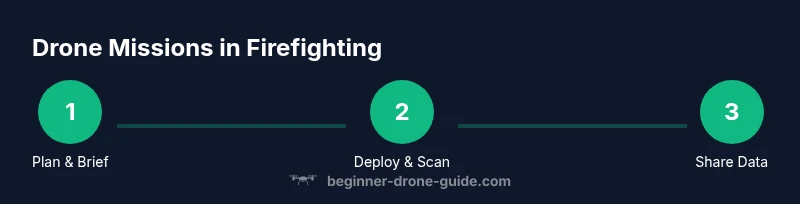
Before flight, confirm objectives, coordinate with incident command, and review available data. Establish safe boundaries and identify potential hazards. Clarify who will operate the drone and who will receive feeds.
Tip: Pre-brief with the IC to align air and ground tactics. - 2
Perform a preflight safety check
Inspect the airframe, confirm battery health, verify payload integrity, and calibrate sensors. Check wind, visibility, and airspace status. Ensure all crew understand the plan and hand signals.
Tip: Use a standardized preflight checklist every time. - 3
Deploy and initiate initial scan
Launch the drone within line of sight and begin a broad sweep to establish a scene-wide view. Focus on entry points, smoke behavior, and potential victim locations.
Tip: Maintain stable altitude to optimize both visibility and data quality. - 4
Deliver data to the incident command
Transmit live video and, if available, thermal overlays to the command post. Mark key features on maps and rotate data to support decision-making.
Tip: Label critical targets clearly for fast reference. - 5
Targeted assessments and data collection
Zoom in on hotspots, structural weaknesses, or collapsed areas as directed by IC. Collect thermal readings and capture high-resolution imagery for later analysis.
Tip: Avoid hovering over civilians or sensitive areas. - 6
Post-mission wrap-up and review
Download data, secure recordings, and conduct a quick debrief with the crew. Note what worked well and what could be improved for future deployments.
Tip: Document lessons learned for training use.
Frequently Asked Questions
What kinds of drones do firefighters use?
Firefighting drone programs typically use small to mid-size drones with visual and thermal cameras. The choice depends on mission needs, weather, and local regulations. Operators must be trained to pilot and interpret sensor data for incident command.
Firefighting teams usually use small to medium drones with cameras and heat sensors. Operators train to fly safely and read the footage for incident decisions.
Are drones allowed at every fire scene?
Drones must comply with national airspace rules and local regulations. Availability of permissions, coordination with air traffic control, and respect for privacy are essential components of every deployment.
Drones have to follow airspace rules and local laws, and you must coordinate with authorities before flight.
What training is required to operate a firefighting drone?
Operators typically complete basic flight training, mission planning, and safety certifications. Ongoing practice with incident simulations helps integrate drone data into command decisions.
You’ll need flight training, safety certification, and practice with real-world simulations to use drones effectively.
Can drones replace human firefighters?
No. Drones augment firefighter decisions by providing information from the air, but human crews remain essential for execution, rescue, and hazardous tasks.
Drones don’t replace firefighters; they support missions by giving air-level insights.
What data do drones collect at a fire scene?
Drones collect live video, thermal readings, and geospatial data like maps and models. This information aids situational awareness and supports post-event analysis.
They collect video, heat data, and maps to help understand the scene.
How do drones integrate with command staff?
Drone feeds are shared with the incident commander and ground teams to shape strategy, resource allocation, and safety planning in real time.
The drone data feeds help the command staff make smarter, faster decisions.
Watch Video
Quick Summary
- Drones extend scene awareness without placing crews at risk
- Thermal imaging reveals hidden hotspots and people in need
- Data feeds support real-time decisions and post-incident reviews
- Safety, training, and compliance are foundational
- Practice with purpose to build proficiency and confidence