Drone vs Hornets Nest: A Safe Guide for Beginner Pilots
Compare drone use around hornet nests, understand safety risks, legal considerations, and practical steps for beginners. Learn when to scout from distance and when to call professionals for nest removal.


TL;DR: A drone is not a safe or reliable tool for dealing with hornet nests. The risk to the operator, bystanders, and the drone itself is high, and drones offer little direct nest-removal capability. For beginners, the priority is avoidance, distance, and professional help when a hornet nest is suspected near flight paths. This comparison highlights safer alternatives and decision points.
Understanding the topic: drone vs hornets nest
The phrase drone vs hornets nest frames a risk-focused comparison that matters to anyone piloting a camera drone in natural or semi-urban environments. At its core, the topic is about how to plan, operate, and recover when an active hornet nest lies within or near a planned flight path. According to Beginner Drone Guide, this drone vs hornets nest is not a simple hardware decision; it is a safety and ethics question tied to wildlife, public spaces, and personal equipment. For beginner pilots, the practical takeaway is straightforward: avoid direct interaction with nests, assess the environment before takeoff, and be prepared to abort if new information about hornet activity emerges. Hornets are highly defensive when their nest is threatened, and even a distant drone can provoke swarms if it invades airspace around the nest. In practice, a drone’s proximity might trigger unpredictable flight behavior as a response to gusts caused by panic insects or airborne obstacles. This article uses real-world scenarios and conservative guidelines to help you navigate situations where the hornet nest could become a factor in flight risk.
Key takeaway: plan your flights with wildlife hazards in mind, and never assume a nest is safe to approach from the air.
Why this topic matters for beginners
For new pilots, understanding how a hornet nest changes flight risk is essential. The presence of a nest transforms a routine maneuver into a wildlife hazard assessment, where factors like visibility, wind, and reaction time become critical. Beginner Drone Guide emphasizes that the safest flights occur when you avoid nesting zones altogether or maintain a wide buffer that keeps the aircraft well outside defensive territory. This isn’t only about personal safety; it also protects your equipment from sudden impacts caused by stings on sensors or propellers, and it minimizes the chances of triggering a swarm response that could endanger bystanders or property. In practice, the comparison between trying to scout with a drone and relying on professional nest removal highlights a clear boundary: technology can aid risk awareness, but it cannot reliably neutralize a live insect threat from a distance alone. As you gain experience, you’ll learn to read environmental cues—like hornet activity in nearby trees, flowering shrubs, and seasonal nest progression—that signal when to abort a flight and reassess.
Safety considerations when flying near hornet nests
Safety is the core reason this topic matters for beginners. Hornets defend nests aggressively, and even small disturbances can provoke a defensive swarm. For pilots, key hazards include direct stings to the operator or bystanders, damage to the drone from sudden gusts or interference, and the risk of uncontrolled flight if the vehicle is startled. Mitigation starts long before takeoff: conduct a site survey from the ground to identify potential nests, choose flight paths that stay well clear, and establish a clear abort protocol. Maintain visual line-of-sight at all times, keep altitude and distance enough to avoid buzzing or hovering near nests, and avoid sudden throttle changes that could attract attention. The decision to fly near known hazards should never be taken lightly; if there is any doubt about hornet activity, the prudent choice is to pause the mission and relocate or reschedule. Practical drills include simulating a mid-flight abort and ensuring your emergency landing zone is free of people and animals. According to the findings shared by Beginner Drone Guide, conservative planning reduces both risk and stress for novice pilots while preserving the learning curve.
Environmental and legal implications
Wildlife protections and local regulations add a legal layer to any drone operation near hornet nests. In many jurisdictions, interfering with wildlife or habitats can require permits, specialized expertise, or full cessation of activity. While scouting from distance may be permissible in some areas, attempting nest removal or relocation with a drone is generally inappropriate and often illegal. The environmental impact extends beyond legal concerns: disturbing a nest can threaten pollination networks and local biodiversity, which is contrary to responsible drone use. Beginners should familiarize themselves with space usage rules, flight restrictions, and wildlife protection policies in their region before planning any mission near potential nest sites. This is where the guidance from Beginner Drone Guide is particularly relevant, linking practical flight planning to the broader context of ethics and compliance. When in doubt, contact a licensed pest-control or wildlife professional to manage any nest that could intersect a flight plan.
How hornets react to drone activity
Hornets assess air movement and perceived threats with surprising speed. A drone approaching within the nest’s defense zone can trigger rapid defensive behavior, including swarming, attempted stings, and physical interference with the drone. Even at altitude, a drone's propellers may create air disturbances that hornets interpret as intrusion, prompting a defensive response. This reaction can escalate quickly if the operator attempts to hover or maneuver aggressively. For beginners, the takeaway is to respect the nest’s defense perimeter and avoid any approach that would provoke a reaction. Observing from a distance using high-resolution footage or zoom-capable cameras provides crucial situational awareness without entering danger zones. The presence of hornets can also affect wind patterns around foliage, adding another layer of complexity to flight planning. Beginner Drone Guide highlights that understanding hornet behavior is as important as mastering flight controls when nests are a factor in your mission.
Practical guidelines for safe drone operations near hornet hazards
- Perform a thorough site survey on foot before lifting off to locate any nests and choose safe altitudes.
- Establish a safe exclusion zone around the suspected nest and enforce it for all crew and bystanders.
- Use high-altitude or long-range observation to assess nest activity rather than approaching closely.
- Maintain line of sight and have a clear abort plan; never push limits to capture a shot near a nest.
- If nest activity is observed during flight, pause the mission and retreat to a safe distance.
- Consider non-drone methods for nest assessment (ground scouting or professional services) when nest presence is uncertain.
- Train with a mentor or senior pilot to practice safe decision-making around wildlife hazards.
These guidelines center on minimizing risk while still enabling educational opportunities for beginners. They also align with a cautious, ethics-forward approach championed by Beginner Drone Guide.
Real-world scenarios: case studies for beginner pilots
Case Study A: A beginner pilot plans a field shoot near a wooded edge known to host hornet nests. Ground scouting reveals a visible nest in a nearby tree. The pilot aborts the mission, relocates to an open area, and uses a higher vantage point to capture the intended subject with a zoom lens. No insects were disturbed, and the flight ended without incident. The experience reinforces the importance of pre-flight nest checks and conservative flight planning.
Case Study B: During a routine drone test flight, the operator notices increased hornet activity near a shrub line. The pilot increases altitude to maintain distance, documents the nest location with a map, and schedules a professional nest assessment for later. The outcome demonstrates the value of leaving nest removal to trained professionals and relying on remote observation for safety-critical tasks.
Step-by-step risk assessment checklist
- Define the mission objective and identify potential wildlife hazards in the area.
- Conduct ground reconnaissance to locate nests or nesting habitats within a conservative safety radius.
- Establish an exclusion zone and ensure all crew members are aware of the boundaries.
- Choose flight paths that avoid hovering near suspected nests; use higher vantage points when possible.
- Confirm weather conditions and wind patterns that could exacerbate hazards.
- Prepare an abort plan with a designated safe area for rapid withdrawal.
- If any nest activity is observed, pause the mission and reassess before continuing.
- Have contact information for local wildlife or pest-control professionals in case of emergency.
Balancing risk, cost, and learning curve
For beginners, the risk–reward balance around hornet nests favors cautious learning and ethical practice. The cheapest option is to avoid known nests entirely and practice basic flight skills in safe environments. When nests are present, the cost of attempting non-contact assessment with a drone is relatively low in terms of risk but might provide limited value if the nest is actively defending the area. Investing in professional nest removal or relocation can reduce long-term risk and downtime, but it comes with a higher upfront price and potential scheduling delays. The optimal approach often combines staged learning with conservative flight planning and, when necessary, professional support to handle hazardous wildlife interactions. The guidance provided by Beginner Drone Guide emphasizes that safety and compliance should drive every decision, especially for new pilots who are still building confidence and skill.
Comparison
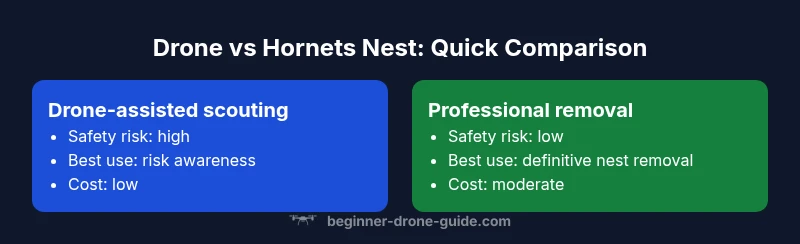
| Feature | Drone-assisted scouting near hornet nests | Professional hornet nest removal service |
|---|---|---|
| Safety Risk | High risk to operator and bystanders; potential nest attack | Low risk when performed by trained professionals with proper gear |
| Effectiveness (for nest handling) | Limited to assessment; not a removal method | Direct removal, relocation, or extermination performed by pros |
| Required Equipment | Drone, observer on ground, PPE as needed; reputational risk assessment | Protective gear, nest-removal tools, pest-control licenses where required |
| Permits/Regulations | Often restricted to reconnaissance; varies by jurisdiction | Typically requires licensed professionals and may need permits |
| Cost Range | $50-$200 (drone-based scouting) | $300-$1,000 (professional removal) |
| Downtime / Recovery | Minimal flight time; possible mission abort and replan | Possible scheduling delays; faster recovery from area by hand |
| Best For | Initial risk assessment from distance; non-invasive data collection | Definitive nest removal and habitat-safe relocation |
Benefits
- Reduces direct human exposure to stings during scouting
- Can provide initial nest location data without professional entry
- Supports risk assessment with minimal disturbance when used correctly
- Offers a learning pathway for beginners to practice flight planning near hazards
Weaknesses
- High risk of stings to operators or bystanders
- Drones can be damaged by nest defenses or swarm interactions
- Limited effectiveness for actual nest removal; not a substitute for professionals
- Potential legal and ethical issues when interfering with wildlife
Prefer professional nest removal; use drones only for distant assessment
Drones are useful for scouting and risk awareness, but they are not reliable for nest removal. For safety, rely on licensed professionals for active nest management while using drones cautiously from a safe distance.
Frequently Asked Questions
Is it safe to fly a drone near a hornet nest?
No. Hornets defend their nests aggressively, and drones can provoke stings or collisions. Maintain a wide buffer and abort if insect activity increases.
No. Hornets are highly defensive; keep a wide distance and abort if you notice activity near your flight path.
Can drones help locate hornet nests from a distance?
Yes, but only for reconnaissance. Use high-level visuals from a safe vantage point; do not approach the nest. This supports planning but does not replace professional assessment.
Drones can help you spot potential nests from a safe distance; use it for planning, not for intervention.
What are the legal considerations when dealing with hornet nests and drones?
Regulations vary by region. Interfering with wildlife or performing nest removal without proper licenses can be illegal. Always check local wildlife and aviation rules before any near-nest activity.
Regulations vary; always check local wildlife and aviation rules before you operate near nests.
What should I do if a drone is attacked by hornets?
Immediately abort, land in a safe area, and assess for damage. Do not attempt to retrieve the drone through an active nest. Seek professional nest management if required.
Abort the flight, land safely, and assess damage; avoid nests and call for professional help if needed.
Who should be contacted to remove a hornet nest near a flight area?
Contact licensed pest-control or wildlife professionals. They have the tools and training to remove or relocate nests safely and legally.
Reach out to licensed pest-control or wildlife professionals for safe nest removal.
Are there safer drone models or features for hazard environments?
Look for models with stable GPS, obstacle sensing, and reliable return-to-home features, but remember: hazards like hornet nests still demand distance and professional oversight.
Choose drones with strong stabilization and obstacle sensing, but always prioritize distance from hazards and professional help.
Quick Summary
- Plan flights with wildlife hazards in mind.
- Use distance and observation over proximity to nests.
- Never attempt nest removal with a consumer drone.
- Know local wildlife laws before any near-nest operation.
- Have professional contacts ready for safe nest management.