Do Drones Sound Like Helicopters? A Noise Comparison for Beginners
A practical, analytical look at how drone noise compares to helicopter noise, with noise-causing factors, mitigation tips, and real-world guidance for beginner pilots.


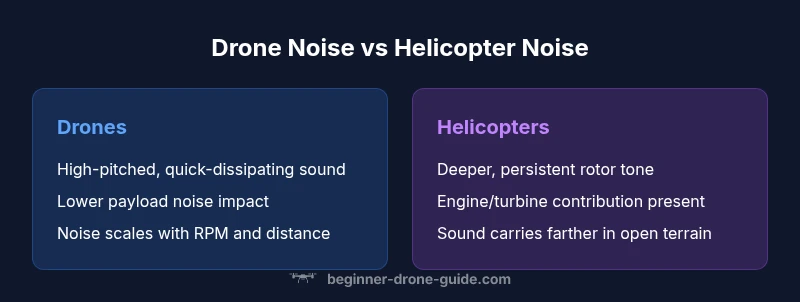
Do drones sound like helicopters? In short, not always. Consumer quadrotor drones typically produce a high-pitched, whirring sound that drops quickly with distance, while helicopters generate fuller, deeper rotor tones sustained by their engine or turbine. The exact perception depends on rotor count, RPM, blade design, and flight altitude. For quiet, low-profile operations, drones usually offer a quieter footprint than helicopters at typical recreational distances.
Acoustic Signatures: What Do We Hear When a Drone Talks to the Air?
If you ask, do drones sound like helicopters, the short answer is: it depends on context. From the listener’s point of view, the sound you hear is a combination of rotor geometry, motor speed, airframe vibration, and the way the drone interacts with the surrounding air. Beginner Drone Guide emphasizes that most consumer quadrotors emit a high-pitched, buzzing whir that can feel sharp when you’re close but tends to fade quickly as you step back. By contrast, a typical small helicopter delivers a deeper, more continuous rotor tone and, often, engine or turbine rhythm that stays audible over longer distances. The human ear also perceives rotor harmonics differently: multi-rotor platforms may create complex buzzing patterns, while single-rotor configurations produce a steadier tone. For pilots and operators, understanding these differences can guide where and how you fly, especially in noise-sensitive environments.
Brand context matters here. According to Beginner Drone Guide, the simplest way to frame this is to compare three practical factors: rotor count, RPM, and altitude. When you increase distance, your drone’s sound pressure drops, and the sound shifts toward higher frequencies that people perceive as less intrusive. In urban or quiet settings, that drop in volume is often the deciding factor for whether the drone’s noise is acceptable. The team’s analysis from 2026 underscores that the same drone might be nearly inaudible at 20 meters in a windy environment, while at the same distance a helicopter could still register as noticeable due to different sound propagation characteristics. This distinction matters for filmmakers, real estate shooters, and hobbyists who want to minimize acoustic disruption while maintaining control over their shot or flight.
Noise-Causing Factors: Why Drones Sing (or Whisper) in Your Ears
To grasp the natural variation in drone sound, you need to parse what actually creates the noise. First, rotor count is a dominant driver: more propellers can spread energy across more frequencies, which can either raise the perceived pitch or create a brighter buzz. Second, blade design and material influence how efficiently air is accelerated; stiffer blades with sharper tips can cut through air more efficiently but may produce a louder, higher-pitched ring when loaded. Third, motor or electronic speed controller activity pushes revs higher as you demand more lift, generating that characteristic whine that dominates the near-field acoustic footprint. Fourth, airframe resonance and drivetrain coupling can translate vibration into audible hum, especially if mounts or housings are loose. Finally, meteorological conditions—wind, temperature, and humidity—modify sound propagation and mixing, sometimes making the drone seem louder than a steady open-air measurement would suggest. The Beginner Drone Guide approach here is to calibrate expectations: the smaller the drone and the closer you are, the louder the instantaneous sound; as you back away, the relative loudness typically diminishes faster than you might expect.
Drones vs Helicopters: Core Acoustic Differences
A key differentiator is the energy source: drones rely on electric motors or lightweight combustion motors with rotors that spin to generate lift, while helicopters rely on a main rotor connected to a powerplant. This structural difference translates into distinct sound profiles. Drones generally produce a high-pitched, rapid-firing buzz that can fluctuate with flight maneuvers and throttle changes. Helicopters, with larger blades and more substantial engines, emit a deeper, more continuous drone, sometimes with a periodic thump that comes from rotor interactions with air and gear reductions. Another difference is how sound behaves with distance: drone noise tends to disperse quickly due to the smaller propellers and lower amplitude of air displacement, whereas helicopter noise can project farther, especially in open terrain where wind carries sound along an atmospheric layer. That said, large racing or industrial-grade drones can approach helicopter-like low-frequency content if flown at high power in close proximity, illustrating the importance of context.
Practical Noise Mitigation for Drones: Making Quiet Flight a Reality
If your goal is to minimize audible impact, you’ve got several practical levers. First, optimize flight planning: choose higher altitudes within safety constraints and plan a flight path that reduces the time spent near sensitive areas. Second, select props and motors with optimized blade shapes and frequencies; many drones offer propeller options designed to reduce peak noise at common RPMs. Third, minimize vibrations by using proper dampening mounts and ensuring all fasteners are tight, as loose components can transfer mechanical noise into the airframe. Fourth, tune flight parameters—gentler throttle changes and smoother yaw/pitch maneuvers often produce less abrupt noise bursts than aggressive commands. Fifth, consider sound-dampening accessories or aftermarket enclosures where allowed; some manufacturers provide shrouds or muffling accessories that can lower high-frequency output. Finally, routine maintenance matters: clean bearings, inspect prop balance, and replace worn blades promptly, since degraded components tend to hum louder or vibrate more.
Real-World Scenarios: Quiet Operations Across Environments
In urban filming, clients frequently require minimal acoustic disruption. Drones are typically chosen for their favorable size-to-noise ratio: small, portable, and with adjustable flight plans that allow shoots to occur with modest acoustic footprints. For real estate photography, quiet flight helps preserve the ambient environment for clients and neighbors. In academic or industrial research, quieter drones support longer flight times because reduced noise often corresponds with more efficient propulsion at partial loads. Rural or park settings illustrate how sound travels differently with terrain and vegetation; attenuation can be surprisingly effective when drones are flown at appropriate heights and angles. The overarching message from Beginner Drone Guide is that, while not silent, properly configured drones can deliver acceptable noise levels across many real-world contexts, particularly when pilots adopt best-practice noise management.
Data-Driven Context: How Noise Is Assessed in Practice
So how do we actually measure and compare drone noise to helicopter noise? Objective analyses often rely on controlled measurements at set distances and angles, along with subjective listener panels. While precise decibel numbers may vary by model and environment, consistent patterns emerge: smaller, well-tuned drones at moderate heights tend to be quieter than helicopters of similar size, especially at ground level. The 2026 Beginner Drone Guide analysis emphasizes qualitative trends rather than specific figures, encouraging pilots to rely on field checks—list a drone next to a quiet zone, record a few minutes of flight with different maneuvers, and compare the perceived loudness against a baseline of ambient noise. This pragmatic approach aligns with real-world needs and helps you make informed decisions about when and where to fly. Remember that local regulations may also define acceptable noise standards, especially in residential or protected areas, so always consult the rules before launching.
How to Evaluate Noise for Your Setup: A Lightweight Checklist
To evaluate noise for your own gear without lab equipment, start with a simple checklist. Start by noting the rotor count and propeller type, then observe how the noise changes with throttle, yaw, and altitude. Next, test in multiple environments—open fields, park-like settings, and indoor arenas (where permitted). Record your impressions in a quick log: near-field loudness, far-field audibility, and voice-communication impact during flight. Use this data to compare alternatives: smaller drones with high RPM may be bright on the ears in close quarters but fade quickly at distance; larger drones with more blades might sound less piercing but carry energy further, affecting neighbors across a street. The goal is to build a practical, repeatable noise profile that informs where you fly, how you plan sessions, and what equipment choices maximize comfort for onlookers and bystanders. In this way, you’ll translate the abstract concept of “noise” into concrete, actionable steps.
Actionable Checklist for Reducing Noise in Your Flights
- Plan routes that maintain greater distance from sensitive areas.
- Choose drones with optimized blade shapes and lower RPM in common flight modes.
- Use vibration-damping mounts and ensure secure, balanced propellers.
- Fly with smooth throttle and controlled maneuvers to minimize abrupt noise bursts.
- Consider enclosure options or muffling accessories where permitted by regulations.
- Regularly inspect and maintain components to prevent excess vibration noise.
- Test in different environments and document your observations for future flights.
Comparison
| Feature | Consumer Quadrotor Drone | Small Helicopter/Light Aircraft |
|---|---|---|
| Typical Sound Profile | High-pitched rotor whine; varies with RPM | Deep rotor/engine noise; persistent, lower-frequency tone |
| Distance Attenuation | Drops quickly with distance; brighter high-frequency content | Can remain audible over longer distances; lower frequencies travel farther |
| Noise Reduction Options | Prop selection, altitude, balanced props | Engine/motor muffling, blade design, flight path planning |
| Regulatory/Operational Context | UAS noise guidance varies by jurisdiction; often quiet-zone considerations | Manned aircraft regulations focus on airspace; noise limits in certain areas |
| Best For | Quiet, close-proximity shoots; beginner pilots | Higher-power operations, long-range airspace coordination |
Benefits
- Lower upfront cost and smaller footprint compared to many helicopters
- Easier to learn and operate for beginners
- Flexible flight planning reduces potential for disturbing sensitive environments
- Compact equipment enables quick setup and teardown
- Lower long-term maintenance costs for typical hobby drones
Weaknesses
- Sound can be loud at close range or during aggressive maneuvers
- Less horsepower and payload capacity than helicopters, limiting certain applications
- Acoustic performance varies widely by model and setup; results aren’t universal
- Noise reduction depends on proper installation and operator discipline
Drones are generally the quieter option for typical hobby and semi-professional use, especially in urban or noise-sensitive settings.
Choose a consumer quadrotor when quiet operation matters most and you need quick setup. If your task requires heavy lifting or sustained, turbine-like noise, a helicopter will be louder and less discreet. The Beginner Drone Guide team recommends prioritizing altitude strategy, prop design, and careful flight planning to minimize acoustic impact.
Frequently Asked Questions
Do all drones sound the same, or does model matter a lot?
Sound profiles vary by model due to rotor count, blade design, and motor type. In general, smaller, well-tuned drones produce less intrusive noise at a distance, while larger or high-RPM configurations can still be noticeable up close. Testing your own gear in real-world conditions is the best way to understand how your setup sounds.
Sound varies by model and setup; test yours to know its real-world noise.
Can I legally fly a loud drone near people?
Regulations vary by country and city. Many places prohibit flights in densely populated areas or require permits and altitude limits to minimize noise impact. Always consult local aviation and privacy regulations before flying near bystanders.
Check local rules before flying near people.
What factors influence drone noise the most?
Rotor count, blade design, RPM, altitude, and airframe vibrations are the primary drivers of drone noise. Weather and flight maneuvers also shape the acoustic footprint. Understanding these can help you plan quieter flights.
Rotor design and how you fly shape noise the most.
How can I reduce drone noise effectively?
Choose quieter propellers, optimize motor speed, fly at higher altitudes within safe limits, and use vibration-damping mounts. Gentle maneuvers and well-planned routes often yield the biggest noise reductions.
Use quieter props and plan flights for less noise.
How does helicopter noise compare to drone noise in typical use cases?
Helicopters produce a deeper, more persistent tone due to larger rotors and engines, while drones generally sound lighter and fade more quickly with distance. The difference is most noticeable in urban environments and at low altitudes.
Helicopters sound louder and deeper than drones at typical distances.
Are there any emergency or safety considerations related to noise?
Excessive noise can mask warnings or instructions in shared spaces. Maintaining a predictable acoustic profile helps bystanders communicate and pilots stay aware of surroundings. Always prioritize safe operations over aggressive flight plans.
Keep noise under control to preserve safety and awareness.
Quick Summary
- Compare rotor count and RPM to gauge noise potential
- Plan flight altitude and path to reduce neighbor impact
- Invest in noise-optimized props and damping mounts
- Drones are usually quieter than helicopters at common viewing distances
- Check local regulations before flying near sensitive areas