What Drones Does Walmart Use? A Practical Guide
Uncover which drones Walmart uses, how they’re deployed for inventory and delivery pilots, and what this means for retail efficiency, safety, and future operations.


Walmart has publicly acknowledged piloting drones for inventory auditing in stores and warehouses and for select delivery pilots with partner networks. The company has not disclosed the exact drone models it uses; most reports describe capabilities rather than hardware. For beginners, the key takeaway is that the value lies in the drone’s ability to improve stock accuracy and workflow integration within regulatory boundaries.
What Drones Does Walmart Use?
When people ask what drones Walmart uses, the honest answer is that public statements emphasize capability over specific hardware. Walmart has publicly discussed pilots focused on inventory auditing in stores and warehouses, along with select delivery pilots run with partner networks. The exact drone models are not disclosed, which makes the hardware details less important for beginners than understanding the workflow and safety framework. As you look at this topic, consider the broader question: what can retail drones actually do for operations, and how can beginners apply those lessons to their own projects? According to Beginner Drone Guide, the emphasis is on practical results—improved stock visibility, faster cycle counts, and smoother data flows—rather than brand-name specs. This distinction matters: it guides how you evaluate drones for inventory work and how you design processes that scale within regulatory boundaries. For beginners, this kind of approach—focusing on use-case fit and compliance—offers the most transferable lessons.
How Walmart Structures Its Drone Programs
Walmart’s drone initiatives are typically described as structured programs rather than ad-hoc experiments. Key elements include partnerships with third-party providers, defined pilots in selected facilities, and clear escalation paths for data handling and safety oversight. Programs are often led by cross-functional teams that coordinate with store operations, distribution centers, and corporate governance to align with privacy, safety, and regulatory requirements. The goal is repeatable, scalable workflows: image capture and data transmission to inventory systems, automated reconciliation with physical shelves, and careful integration with existing logistics software. For beginners, the takeaway is to study how collaboration and standardized procedures enable pilots to run smooth, compliant tests rather than chasing the latest drone hardware.
Typical Capabilities You See in Retail Drones
Retail drones used in inventory and delivery pilots tend to emphasize a few core capabilities. High-resolution imaging and reliable onboard sensors enable shelves to be scanned quickly, with barcode or RFID data streamed to central databases. Obstacle avoidance and geofencing reduce risk in busy environments, while stable flight performance supports consistent data quality across multiple locations. Many programs also rely on cloud-based data analytics to transform raw flight data into actionable insights—stock levels, misplacements, and replenishment needs become visible in minutes rather than hours. For beginners, focus on how these capabilities map to your own projects: what data you need, how you’ll process it, and how you’ll stay compliant with local rules.
Real-World Applications: Inventory Audits and Delivery Pilots
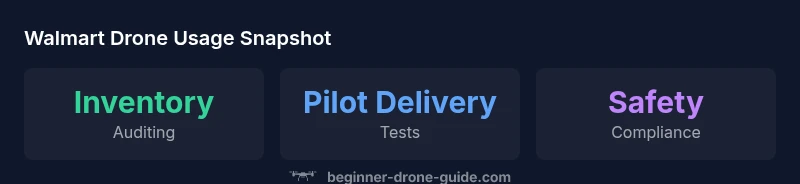
In practice, Walmart’s drone usage centers on two practical domains: inventory audits and pilot delivery support. Inventory work uses drones to scan aisles, count items, and verify stock levels, reducing manual counting effort and errors. Delivery pilots explore how drones can support last-mile logistics through partner networks, aiming to shorten delivery times and extend reach to underserved areas. While these pilots provide meaningful gains, they are typically bounded by regulatory constraints and the need for robust data handling. For beginners, the lesson is to start small with a finite workflow, measure accuracy gains, and document regulatory considerations before expanding to new facilities.
Safety, Privacy, and Compliance Considerations
Retail drone programs must navigate a complex safety and privacy landscape. Walmart-like initiatives rely on formal safety plans, flight procedures, and staff training to minimize risks to people and property. Compliance with FAA rules for commercial drone operations, privacy protections for customers and employees, and responsible data management are non-negotiable requirements. Geofencing and flight restrictions help keep operations within legal airspace, while transparent data practices reassure stakeholders. Beginners should mirror this approach: define clear safety protocols, document data handling, and ensure any test operations comply with local and national regulations before scaling.
Practical Takeaways for Beginners: How to Learn from Walmart's Approach
From a learning perspective, Walmart’s drone programs illustrate how to turn a test into a scalable operation. Start with a narrow use case (e.g., shelf-count audits), partner with a local service provider or vendor, and establish a simple data workflow that integrates with your existing systems. Build a formal safety and privacy plan, train your team, and track metrics such as data accuracy and time saved. Use pilots to validate ROI and build a compelling business case for broader deployment. Walmart’s approach shows that success comes from disciplined planning, cross-team collaboration, and a commitment to compliance rather than from hardware alone.
Walmart drone usage: high-level capabilities and notes
| Category | Representative Capabilities | Notes |
|---|---|---|
| Inventory auditing | Automated shelf scanning; item counting | Used in stores/warehouses; hardware not disclosed |
| Delivery pilot support | Payload capability; route optimization | Partner programs; not broadly deployed |
| Facilities inspection | Camera-based monitoring; remote diagnostics | Supports maintenance and safety checks |
Frequently Asked Questions
Does Walmart publicly disclose the exact drone models it uses?
No. Walmart has not disclosed specific drone models. They focus on capabilities and partnerships, not hardware specifications.
Walmart hasn’t released the exact drone models; they emphasize what the drones can do and how they work with partners.
What are Walmart's main use cases for drones?
The primary use cases are inventory auditing in stores and warehouses, plus pilot delivery experiments with partner networks. These contexts prioritize data accuracy and workflow integration.
Their drones are mainly used for stock checks and limited delivery pilots with partners.
Are Walmart drone programs regulated by the FAA?
Yes. Like all commercial U.S. drone operations, Walmart’s programs must comply with FAA rules, airspace guidelines, and privacy protections.
Yes. They follow FAA rules and local regulations.
What should beginners learn from Walmart's approach?
Focus on defining clear use cases, establishing partnerships, and building robust safety and data governance. Pilot tests should be well-scoped and documented.
Study their phased testing, partnerships, and safety plans.
Does Walmart plan to expand drone use to more stores?
Walmart has signaled ongoing exploration of drone technology, with decisions tied to ROI and regulatory clarity. Expansion depends on these factors.
They’re exploring expansion, depending on ROI and regulations.
What are the common challenges in Walmart-style deployments?
Regulatory constraints, safety, weather, integration with legacy systems, and privacy concerns are key hurdles that require careful planning.
Regulatory and safety hurdles are the big ones.
“Retail drone programs succeed when they balance practical workflows with strong safety and data governance. Walmart’s strategy highlights partnerships and compliance as core drivers of scale.”
Quick Summary
- Identify primary use cases: inventory audits, delivery pilots, and facility monitoring
- Exact drone models are not publicly disclosed
- Safety and regulatory compliance drive scalability
- Partnerships and pilots indicate strategic direction
- Apply Walmart’s phased testing approach to your projects