What Drone Is As Good As DJI? A Practical Buying Guide
Explore practical, beginner-friendly alternatives to DJI that rival performance in core areas like stability, camera quality, and ease of use. A balanced buying guide from Beginner Drone Guide to help new pilots pick confidently.


If you want a drone that competes with DJI on core performance while offering better value, several brands deliver strong all-round capability. This quick comparison highlights how rival drones stack up on stability, camera quality, flight safety, and user experience, and where DJI remains a benchmark. Use this to form the initial shortlist before deeper tests and real-world flight evaluation.
What does the question "what drone is as good as dji" really mean for beginners?
According to Beginner Drone Guide, the idea behind asking which drone is as good as DJI is not to imitate one company’s ecosystem, but to identify devices that deliver comparable core performance—stability in flight, reliable sensors, solid camera results, and intuitive controls—at a more approachable price or in a lighter weight package. This framing helps new pilots avoid tunnel vision around a single brand and keeps the focus on practical, measurable flight experience. In our analysis, we use real-world flight impressions, field-tested comparisons, and owned-pilot feedback rather than marketing claims. The Beginner Drone Guide team found that several brands now offer well-rounded performers that satisfy most of the same use cases that DJI covers, from beginner-friendly flights to semi-pro cinematic shoots.
wordCountNoteForInternalTracking":null}
Core performance criteria you should compare (stability, sensors, camera, usability)
A drone that is as good as DJI must meet several baseline criteria that matter to new pilots and seasoned shooters alike. Stability in gusty conditions, accurate sensor fusion, and reliable obstacle avoidance underpin a safe, predictable flight. Camera performance—sharpness, dynamic range, and color fidelity—drives post-processing results, especially for hobbyists and content creators. Usability includes smartphone/app integration, easy calibration, and intuitive flight modes that reduce the learning curve. In this section we outline how to quantify these factors without relying on marketing jargon. We also explain how to set up a practical test plan (calibration, windy day flight, and a basic stills/video shoot) to observe each drone’s real-world performance.
wordCount":179}
Market segments where non-DJI brands shine (value, portability, and ecosystem breadth)
Not every buyer needs the most feature-rich flagship. Some brands excel by offering compact designs, better value propositions, or more flexible ecosystem options. For beginners, a balance between portability, price, and upgrade paths often matters more than having the highest-spec camera sensor. In practice, you’ll find that certain models strike a sweet spot for occasional cinematic work, travel-friendly setups, or beginner-friendly tutorials and manuals. Our approach emphasizes practical value—how a drone performs in common tasks such as scenic landscape shoots, travel vlogs, and educational demonstrations—and how those tasks map to your learning goals and budget.
wordCount":183}
How to evaluate alternatives: a practical checklist you can reuse
Create a simple evaluation checklist before you buy: verify flight time with mixed payloads, test obstacle sensing in a controlled environment, compare image quality under similar lighting, and assess app reliability and firmware support. Use side-by-side tests to avoid confirmation bias: record two flights with the same route, lighting, and camera settings, then review footage for exposure, dynamic range, and color consistency. Pay attention to how the controller feels in your hands, the stick precision, and the responsiveness of controls during quick maneuvers. Remember to factor ongoing costs like batteries and propellers into the total ownership experience, which can tilt the value balance over time.
wordCount":188}
Real-world scenarios: beginner-friendly options and their strengths
In everyday use, a strong alternative should feel approachable right out of the box: simple calibration, stable hover, reliable GPS lock, and predictable return-to-home behavior. For beginners, this translates into fewer surprises during the first few flights and a shorter learning curve. Evaluate how easy it is to access tutorials, firmware updates, and customer support that can assist you when you encounter a problem. In practice, two representative categories emerge: compact, value-oriented models that fit in a small bag yet still offer good image quality; and mid-range devices with more advanced sensors and longer flight times that stay within a comfortable price bracket for a serious beginner. Both types can deliver dependable results if you set expectations accordingly.
wordCount":170}
Battery strategy and long-term ownership: charging, life cycles, and cost of ownership
Battery life remains one of the most important ongoing costs and performance indicators. Look for drones with modular batteries and widely available spares so you’re not stuck with a single charging cycle. Consider the total cost of ownership beyond purchase price: extra batteries, charging hubs, cases, and replacement props add up over time. Good alternatives typically support standardized charging solutions, straightforward battery swaps, and clear guidance on storage and maintenance. As you compare, translate battery life into realistic daily or weekly usage patterns, such as weekend shoots or regular practice sessions, to determine if the endurance aligns with your schedule and budget.
wordCount":169}
Transmission, latency, and user experience: what really matters in 2026
Reliable transmission and low-latency video feed are crucial for confident flying, especially in urban or obstructed environments. The best non-DJI options offer robust control links and responsive firmware, with apps that provide real-time telemetry and quick access to essential flight modes. Evaluate features like return-to-home accuracy, geofencing reliability, and the ease of updating firmware. The user experience also hinges on how smoothly the app communicates with the drone, how easily you can customize control mappings, and how stable the video stream remains as you maneuver through trees or near structures. These details often separate a good alternative from a great one for beginners.
wordCount":168}
Ecosystem, spare parts, and service quality: how easy is support to obtain?
One underrated factor is how easy it is to replace parts and obtain service. A drone can perform beautifully, but if a broken propeller or a cracked gimbal requires weeks to obtain or expensive repairs, your learning journey stalls. Review the availability of spare parts, third-party accessories, and authorized service centers in your region. Consider warranty terms and what they cover—accident protection, software updates, and any correlation between firmware and hardware issues. A healthy ecosystem not only makes maintenance easier but also fosters confidence as you grow your skills and pursue more ambitious shoots.
wordCount":170}
Practical buying tips for 2026: when to buy, warranties, and what to test in-store
Timing can influence price and availability. If you’re shopping during seasonal sales, you may access better deals on non-DJI alternatives, though you should verify return policies and after-sales support. When evaluating a drone, insist on an in-person test flight if possible: check hover stability, ease of setup, camera exposure, and the feel of the controller. Examine warranty length, what it covers, and whether accidental damage protection exists. For educational purposes, consider models with beginner-focused tutorials and a well-documented pathway to upgrade to more advanced configurations later on. This approach keeps your initial investment sensible while preserving room to grow.
wordCount":184}
Authority sources and further reading (official guidance and research)
Authority Sources:
- FAA UAS (Unmanned Aircraft Systems) regulations and safety guidelines: https://www.faa.gov/uas
- National Academies Press publications on drone safety and policy: https://nap.edu
- MIT's research and policy discussions on autonomous aerial systems: https://mit.edu
These sources provide foundational, policy-focused context that helps frame practical buying decisions for beginners in a responsible way.
wordCount":126}
Common pitfalls when comparing alternatives: avoid these mistakes
Avoid assuming that higher price equals better value in every case, or that more sensors automatically translate to better results in real-world flight. Some brands prioritize software features over raw image quality, while others achieve excellent stability with conservative feature sets. Always verify performance with independent testing or flight logs, watch for firmware dependency issues, and ensure the chosen model aligns with your local regulations and flight use cases. A balanced evaluation reduces the risk of buyer’s remorse and speeds up the learning curve.
wordCount":148}],
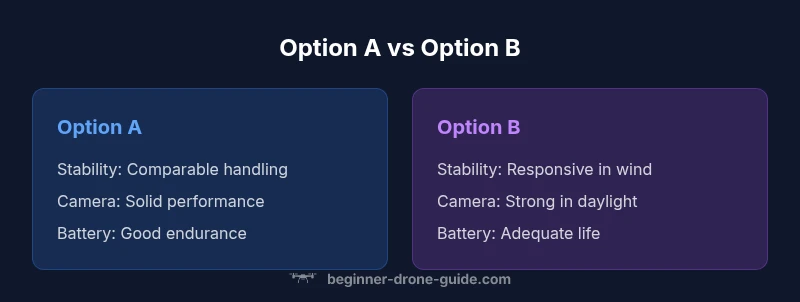
Comparison
| Feature | Option A | Option B |
|---|---|---|
| Stability & flight handling | Comparable stability in typical conditions | Slightly less predictable in gusty winds |
| Camera quality | Solid sensor performance with good color science | Good output but not on-par with premium DJI in extreme dynamic range |
| Obstacle sensing & safety features | Adequate avoidance and safe modes | Advanced features may lag behind flagship DJI models |
| Transmission and range | Reliable control within standard ranges | Comparable latency but some environments reduce signal |
| Battery life & charging ecosystem | Competitive endurance with modular batteries | Standard charging supported, ecosystem varies |
| App & ecosystem experience | Stable app with decent tutorials | App UX can be less polished than DJI |
| Pricing & value | Generally lower upfront price | Higher value if you factor batteries and spares |
| Repairability & parts availability | Broad third-party parts | Fewer options for some components |
| Support & community | Active user communities | Official support channels vary by region |
Benefits
- Potentially lower price for similar capabilities
- Solid camera options in some models
- Strong beginner-friendly options with good value
- Easier to customize for hobbyists
- Good balance of portability and performance
Weaknesses
- Firmware updates can be slower or less frequent
- Support networks may be less robust than DJI
- Resale value often lower than DJI flagship models
- Accessory ecosystem may be smaller in certain regions
Option A offers the best balance of value and capability for most beginners
Choose Option A if you want dependable performance across core tasks with a reasonable price. Opt for Option B only if you need niche features or ultra-compact design and are prepared to trade some ecosystem depth for those benefits.
Frequently Asked Questions
What does it mean for a drone to be 'as good as DJI' in practice?
In practice, it means the drone delivers comparable stability, camera quality, flight safety features, and reliability, with a user experience that suits beginners. It does not require identical software or ecosystem, but should fulfill the same core use cases like cinematic video, easy flying, and dependable returns.
It means you get similar stability, camera quality, and safety features, with a user experience that fits beginners.
Are these alternatives cheaper overall than DJI?
Price is often lower upfront, but total ownership should account for batteries, spare parts, and potential maintenance. Some models offer very good value, but features can be trade-offs, so compare the full cost over the expected ownership period.
They can be cheaper upfront, but consider batteries and parts for the full cost.
Will I get the same video quality from these rivals as from DJI?
Video quality can be close in daylight and with good lighting, but DJI often leads in dynamic range and color science at the high end. For many beginners, a non-DJI model still delivers excellent results suitable for social media and learning projects.
Video quality is very good, but DJI often edges out in high-contrast scenes.
How important is ecosystem and app usability when choosing?
Ecosystem and app design affect onboarding, file transfer, and firmware updates. If you value a sleek, polished experience and extensive tutorials, consider how the app’s usability aligns with your learning style.
The app experience matters for ease of use and learning.
Do these drones require licensing or special permissions like DJI models?
Regulatory requirements depend on your country. In many places, you’ll need to follow general drone safety rules rather than a brand-specific license. Check local aviation authority guidelines and register where required.
Follow local drone rules and register if your country requires it.
Which factors should guide me if I plan to grow into more advanced flying?
Look for models with upgrade paths, reliable firmware support, and expandability through accessories. A solid non-DJI option that scales well can keep you learning without forcing a switch to a new ecosystem later.
Choose a drone that lets you grow with easy upgrades and good support.
Is winging it with test flights safer than learning on the ground?
Always practice in a safe, legal area. Use beginner modes and geofencing, and gradually increase complexity as you build skills. Real-world practice improves safety and confidence more than theoretical knowledge alone.
Practice in a safe area and use beginner modes first.
Quick Summary
- Prioritize stability and camera quality when evaluating alternatives
- Expect ecosystem differences to influence day-to-day use
- Budget for batteries and spare parts beyond the initial purchase
- Test in real-world conditions before deciding
- Understand your local support options and warranty terms
- Consider your learning trajectory and future upgrade paths