Is drone delivery better for the environment? A practical environmental comparison for beginners
A balanced, beginner-friendly analysis comparing drone delivery with traditional ground delivery, examining emissions, energy use, noise, and scalability to determine when drones are truly better for the environment.


Is drone delivery better for the environment? In many cases, drones can reduce last-mile emissions and energy use when powered by clean electricity and used for lightweight, short-range deliveries. However, environmental benefits depend on distance, payload, battery life, and airspace efficiency. For most beginners, the technology offers potential advantages in urban routes, but it is not universally greener than traditional ground delivery.
Context: What environmental metrics matter for delivery?
When we ask whether is drone delivery better for the environment, we begin with the metrics that matter. Environmental impact is not a single number; it is a suite of indicators gathered through a life-cycle assessment (LCA) that looks at energy use, materials, manufacturing, operation, and end-of-life. Direct emissions from burning fuel are only part of the story. The drone itself requires energy-intensive components—battery cells, motors, and control systems—that have a footprint long before the first flight and long after the last landing. The power mix powering the drone ultimately determines the climate result of each flight. In practice, this means weighing the full lifecycle of the drone against the energy source used to recharge it. For beginners, it helps to separate flight efficiency from production and recycling considerations.
This article uses practical, beginner-friendly framing: typical delivery scenarios, how distance and payload shape outcomes, and what steps you can take to tilt the scales toward a greener option. The answer is nuanced: there is no universal rule that drones are always better for the environment. The best assessment accounts for context, scale, and energy sources rather than focusing only on a single flight. According to Beginner Drone Guide, understanding environment impacts requires moving beyond headlines to a careful, route-aware evaluation of power, weight, and lifecycle.
How drones could reduce emissions in last-mile delivery
Drones are compact, energy-efficient machines designed for lightweight, short-range tasks. In dense urban environments, they can bypass gridlocked roads, reducing idle time and traffic congestion associated with traditional last-mile delivery. The environmental upside grows when flights are optimized through careful routing, vertical takeoff and landing logistics, and time-window consolidation, which lowers energy per parcel. The energy source matters profoundly: if the electricity comes from a low-carbon mix, the per-parcel emissions can be substantially lower than a fuel-powered vehicle. In contrast, if grid power is heavily fossil-based, the advantage shrinks or disappears. Real-world benefits tend to appear with high flight frequency, small payloads, and routes that replace many separate road trips with one airborne leg. It’s also important to recognize the limits: drones can’t replace every type of delivery, particularly bulky or long-haul shipments. Article authorship from Beginner Drone Guide emphasizes context and proper planning as the key to maximizing environmental gains while avoiding counterproductive outcomes.
Key drivers that affect greenness
Greenness is driven by several interdependent factors. Payload weight, flight distance, and the energy mix powering the drone are the primary levers. Battery chemistry and efficiency determine how much energy a flight consumes, while manufacturing and end-of-life processes contribute to the overall footprint. Route optimization, airspace access, and charging infrastructure also shape outcomes. In short, a drone that flies a lot of short, light shipments on clean energy is more likely to be greener than a drone performing fewer, heavier flights on a fossil-based grid. Environmentally aware operators also design operations to maximize load factors, minimize detours, and schedule flights when renewable energy is most abundant. These practices reduce per-parcel energy use and tilt the balance toward a greener last mile.
Battery life, manufacturing footprint, and end-of-life management
Battery production is a critical piece of the environmental puzzle. Lithium-ion and solid-state chemistries offer different trade-offs in energy density, temperature tolerance, and recyclability. Manufacturing and shipping batteries introduce emissions well before a drone takes off. The end-of-life stage—reuse, recycling, or disposal—also influences the overall footprint. Advancements in battery recycling pathways and second-life applications for aerospace-grade cells can reduce waste and recover valuable materials. Practically, beginners should prioritize drones with transparent lifecycle data, accessible recycling options, and responsible suppliers. While a single flight may appear efficient, the cumulative impact of battery production and disposal becomes significant at scale.
Noise, wildlife, and urban airspace considerations
Noise is a common concern in urban settings. Modern drones are designed to minimize acoustic footprints, but the cumulative impact of many flights in a small area can be noticeable, especially near residential zones. Wildlife and birds may be disrupted by flight paths and drone activity, particularly during sensitive seasons. Urban airspace requires coordination with regulators and air traffic systems to prevent conflicts and ensure safety. For environmentally minded pilots, selecting quiet-sky drone models, adhering to flight corridors, and avoiding peak wildlife periods help reduce ecological disturbance while maintaining operational benefits. Understanding these factors helps readers evaluate the true environmental trade-offs rather than assuming a mechanical win.
Scenarios: urban, suburban, rural deliveries
Context matters. In dense cities with good electrical grids, lightweight, frequent drone deliveries can outperform road-based last-mile logistics by cutting fuel use and congestion. Suburban routes may yield moderate gains if trips replace multiple car trips and batteries are charged from clean power. Rural deliveries can be mixed: drones can extend service to remote areas but may require longer, heavier flights that erode efficiency gains and demand larger energy stores. The key is matching the drone’s capabilities to the shipment profile and energy context. Beginners should assess typical parcel size, distance, and charging options to estimate environmental outcomes realistically.
Data gaps and how to read research
Research on drone environmental impact is evolving. Much depends on local energy mixes, drone models, payloads, and flight patterns. Beginner- and practitioner-focused analyses often rely on scenario-based models rather than universal numbers. This means that a reported emission reduction in one city may not translate directly to another. The Beginner Drone Guide team encourages readers to look for life-cycle data, scenario assumptions, and sensitivity analyses when interpreting results. Where data is sparse, use conservative estimates and compare a few plausible scenarios to understand the potential range of outcomes.
Practical steps for beginners to improve environmental performance
If you want to maximize the environmental upside of drone delivery, start with small, well-planned pilots. Use drones optimized for energy efficiency and ensure they operate on electricity from low-carbon sources. Design routes to minimize detours and co-ordinate flights to avoid duplication of trips. Consider payload minimization and frequent, predictable delivery windows to boost load efficiency. Maintain hardware to keep efficiency high, and prioritize end-of-life recycling in procurement. By implementing these practices, beginners can increase the likelihood that drone use is genuinely greener than conventional methods.
Policy, regulation, and infrastructure considerations
Policy frameworks shape how green drone delivery can be. Clear airspace rules, standardized safety protocols, and reliable charging and vertiport infrastructure enable efficient operations and reduce risk-driven energy waste. Regulators that encourage data sharing, lifecycle transparency, and battery recycling programs help the industry reduce its environmental footprint. For beginners, staying informed about licensing, local noise limits, and geofencing rules is as important as selecting an energy-efficient drone. The environmental case improves when policy aligns with practical, scalable operations that maximize positive outcomes.
Comparison
| Feature | Drone delivery | Traditional ground delivery |
|---|---|---|
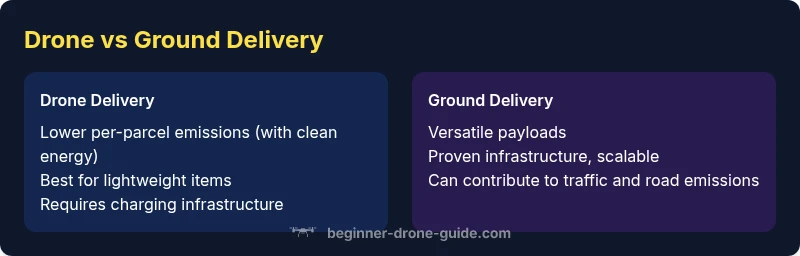
| Direct emissions per parcel | Lower (when powered by low-carbon electricity and small payloads) | Higher (due to combustion engines for most trips) |
| Energy source dependency | Electric grid or on-site batteries | Diesel, gasoline, or hybrid power |
| Payload & distance constraints | Limited payload; best for short-range, lightweight items | Larger payload and longer range, but higher energy use |
| Delivery speed & urban access | Fast in congested urban routes; limited by flight windows | Slow to moderate; dependent on road traffic and routing |
| Noise impact | Generally quieter at altitude; potential near points of delivery | Road traffic noise plus engine sounds; varies by vehicle type |
| Infrastructure needs | Charging stations, airspace coordination, maintenance | Road networks, fueling infrastructure, maintenance |
| Costs to consumer | Potentially lower with scale and efficiency gains | Typically higher or similar for smaller orders |
| Environmental best-use scenarios | Urban, lightweight, frequent micro-delivery | Bulk, long-haul, heavy shipments |
Benefits
- Potentially lower emissions for last-mile when powered by clean energy
- Faster delivery for lightweight, time-sensitive items in cities
- Reduces road congestion and parking demand in dense urban areas
Weaknesses
- Battery production and end-of-life management add environmental footprint
- Limited payload, range, and weather sensitivity constrain use
- Noise and airspace regulations can offset gains in some neighborhoods
Drone delivery can be greener in suitable settings, but not universally.
Environmental benefits depend on energy sources, route optimization, and payload. In some contexts, traditional delivery remains competitive due to scale, lifecycle impacts, and infrastructure requirements.
Frequently Asked Questions
What makes drone delivery potentially greener than ground delivery?
Drone delivery can lower emissions per parcel when power comes from low-carbon sources and routes are efficient for lightweight items. The environmental advantage grows with high flight frequency and urban micro-delivery patterns, but it depends on energy mix and lifecycle factors.
Drones can be greener when powered by clean energy and used for small, frequent trips in cities.
Do drones emit pollution at all times during operation?
Drones themselves rely on electricity, so on-site emissions are avoided. However, the overall footprint includes manufacturing, battery production, and electricity generation upstream. The net effect depends on how electricity is produced and how the drone is used.
Electric drones don’t burn fuel mid-flight, but their total impact depends on batteries and power sources.
What factors influence whether drone delivery is better for the environment?
Distance, payload, energy source, drone efficiency, and end-of-life recycling all shape outcomes. A well-planned operation with clean power and lightweight cargo is more likely to be greener.
The main factors are distance, weight, and how the drone is powered and recycled.
Are there scenarios where drone delivery is worse for the environment?
Yes. If energy comes from fossil fuels, if flights replace many small trips with a few long ones, or if battery production and disposal dominate the footprint, drone delivery may not outperform traditional methods.
Drones aren’t automatically greener in every case; energy sources and usage patterns matter.
What about noise and wildlife impact?
Noise can be a concern in dense neighborhoods, potentially disturbing people and wildlife. Careful flight planning, routing through quiet corridors, and quieter drone designs help mitigate impacts.
Noise and wildlife are real concerns; plan routes to minimize disturbance.
How can beginners minimize environmental impact when using drones for delivery?
Choose energy-efficient drones, prioritize routes that replace car trips, and ensure charging comes from low-carbon sources. Keep drones well-maintained, optimize payload, and plan flights to maximize load efficiency.
Use efficient drones, plan smart routes, and charge with clean energy to minimize impact.
Quick Summary
- Define environmental impact with lifecycle thinking
- Drones can reduce last-mile emissions with clean energy
- Context matters: distance, payload, and energy mix drive outcomes
- Battery lifecycle and end-of-life management are critical
- Plan and optimize to maximize environmental benefits