DJI Agras T40 Review: A Practical Beginner Guide
Deep dive into the DJI Agras T40 for beginners: setup, safety, licensing, field spraying, and practical buying guidance with real-world testing notes.


Definition: The DJI Agras T40 is a large agricultural drone designed for efficient crop spraying and field mapping. It combines automated flight planning, advanced obstacle avoidance, and a high-capacity spray system to cover large plots with minimal pilot effort. For new pilots, success hinges on proper licensing, training, and adherence to local regulations. It is best suited for mid/large farms with established spray routines.
DJI Agras T40 overview and use cases
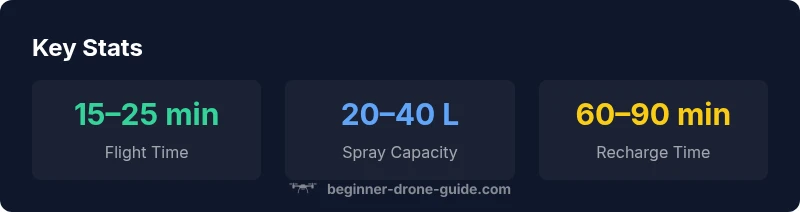
The DJI Agras T40 is a large, field-grade drone designed for agricultural operations such as spraying, seeding, and crop mapping. It targets commercial farms that need to cover large acreage with consistent application and minimal downtime. In practice, operators pair pre-planned flight routes with a spray system that can be tuned for different droplet sizes and pressures. For beginners, the T40 represents a sophisticated platform: it can automate many repetitive tasks, but it also demands careful preflight planning and adherence to local rules. According to Beginner Drone Guide, the T40 stands out for its balance of payload and automation, making it suitable for mid-to-large farms. The combination of a sizeable spray tank supported by precise GPS guidance enables efficient treatment of fields with uneven terrain, while its modular design supports adding accessories such as ground station tablets or multi-spectral sensors for future upgrades. In short, the T40 is less of a toy and more of a productivity tool for growers who need reliable coverage and repeatable results.
Benefits
- High-capacity spray system enables large-area coverage with fewer passes
- Advanced flight planning and automated routes reduce pilot workload
- Robust safety features and obstacle avoidance improve field reliability
- Modular accessories and easy battery management support longer workdays
Weaknesses
- High upfront cost and ongoing maintenance may be a barrier for small farms
- Requires licensed operators and regulatory compliance in many regions
- Bulk and weight can complicate transport and storage
Best for mid-to-large farms seeking efficient spraying and mapping
The DJI Agras T40 delivers reliable coverage and automation, making it a strong choice for larger operations. While the price and regulatory overhead may deter small farms, the long-term productivity gains and real-world capability justify the investment for growers with scale.
Frequently Asked Questions
Is the DJI Agras T40 suitable for beginners?
Yes, but it requires licensing, formal training, and deliberate practice. Beginners should start with calibration and controlled-area tests before field work.
Yes, with proper training and practice in a controlled area.
What licenses or permissions are required to operate the T40?
In many regions, agricultural drones used for spraying require operator licensing and drone registration. Always check your national or local aviation authority and agricultural use guidelines.
You’ll likely need an operator license and drone registration; check your local rules.
What is the typical setup time for the T40?
Initial setup, calibration, and software updates generally take about 30–60 minutes for trained operators; first-time setups may take longer as you learn the workflow.
Plan about an hour for first-time setup and calibration.
How does the T40 compare to smaller drones for field work?
The T40 offers significantly greater spray capacity and longer field endurance, with automated routes that reduce manual flight. Smaller drones are easier to transport and require less regulatory overhead but can’t match the T40’s routine coverage for large fields.
It sprays more and works longer, but it’s bigger and has more rules.
What safety features does the T40 include?
It includes obstacle avoidance, return-to-home, automatic flight logs, and geofencing; these features help prevent crashes and ensure regulatory compliance.
It has obstacle avoidance, geofencing, and safe return-to-home.
What maintenance tasks are required after spraying sessions?
Flush and clean lines, inspect nozzles, check battery health, replace worn filters, and store equipment properly to maximize uptime.
Flush lines, inspect spray nozzles, and charge batteries after use.
Quick Summary
- Learn the licensing and training prerequisites before flight.
- Plan automated spray routes to save time and ensure consistency.
- Expect a higher upfront cost, but potential labor savings over time.
- Maintain spray hardware and batteries to maximize uptime.
- Assess farm size and workflow to confirm the T40 fits your needs.